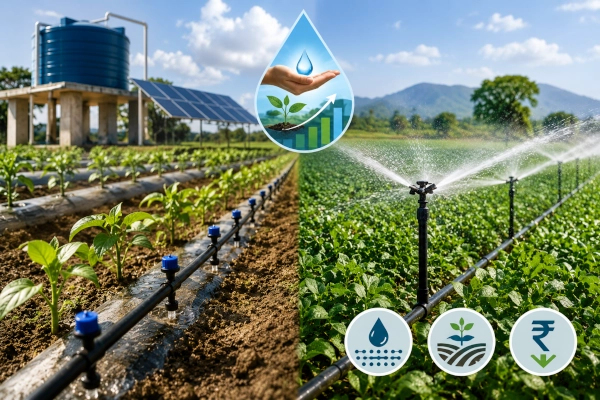
India has brought more than 115 lakh hectares of agricultural land under micro-irrigation through the Per Drop More Crop programme as of July 2026, marking a significant expansion in the country’s effort to use irrigation water more efficiently and reduce dependence on conventional flood irrigation.
The latest figure was released by the Government of India on 29 August 2026. According to the official update, the area covered under the programme now represents about 8.11% of India’s net sown area, reflecting the gradual spread of drip and sprinkler irrigation across some of the country’s most water-stressed agricultural regions.
The programme has become increasingly important because agriculture accounts for more than 80% of India’s available water-resource use, while only around half of the country’s net sown area has access to irrigation. Improving the efficiency with which existing water resources are used is therefore becoming as important as creating new irrigation infrastructure.
From Flood Irrigation to Precision Water Delivery
Traditional surface irrigation often involves releasing relatively large quantities of water across a field and allowing it to spread through channels or over the soil surface.
Although simple and inexpensive where water is plentiful, this method can result in losses through evaporation, runoff, deep percolation and uneven distribution. Some parts of a field may receive excessive water while others remain comparatively dry.
Micro-irrigation approaches the problem differently.
Instead of flooding the entire field, water is supplied more precisely according to crop requirements. The two principal technologies supported under Per Drop More Crop are drip irrigation and sprinkler irrigation.
Drip systems carry water through pipes and release it slowly through emitters positioned close to individual plants or root zones. Sprinkler systems distribute pressurised water through nozzles, producing controlled artificial rainfall over the crop.
Both systems are designed to reduce unnecessary water application while maintaining sufficient moisture for plant growth.
More Than 115 Lakh Hectares Now Covered
The scale of expansion has accelerated considerably.
As of July 2026, 115 lakh hectares had been brought under micro-irrigation through PDMC. The government identified Maharashtra, Karnataka, Andhra Pradesh, Tamil Nadu, Gujarat and Rajasthan as the states recording the highest areas of coverage during 2025–26.
These states include several regions where agriculture faces recurring pressure from low rainfall, declining groundwater levels or high irrigation demand.
The geographic pattern therefore reflects one of the central objectives of the programme: prioritising areas where improving the productivity of each unit of water can generate particularly large benefits.
The latest total also represents continued growth from the 110.92 lakh hectares reported under PDMC at the end of June 2026.
More Than 12 Lakh Farmers Benefited During 2025–26
The government’s latest assessment says 12.30 lakh farmers benefited from the programme during 2025–26.
Around 20% of those beneficiaries were women, indicating a growing role for women cultivators within the programme’s implementation.
The scheme limits financial assistance to micro-irrigation installations covering up to five hectares per beneficiary, helping direct support towards individual farm holdings rather than very large agricultural estates.
Small and marginal farmers receive government assistance equivalent to 55% of the indicative cost of a micro-irrigation system, while other eligible farmers receive 45% assistance. States are also permitted to provide additional support from their own resources.
Farmers can again receive assistance for the same land after seven years, allowing older systems to be replaced or renewed as equipment reaches the end of its practical operating life.
₹8,123 Crore Released in Three Years
The expansion of micro-irrigation has required substantial public investment.
The government says ₹8,123.24 crore in central assistance has been released during the last three years for implementation of the programme.
During 2025–26 alone, ₹3,226.36 crore was earmarked specifically for Per Drop More Crop under the broader Pradhan Mantri Rashtriya Krishi Vikas Yojana framework.
Financial support is increasingly delivered through digital systems and Direct Benefit Transfer mechanisms intended to improve transparency and help farmers gain access to approved micro-irrigation equipment.
The scale of support reflects an important policy shift. Irrigation policy is no longer focused only on constructing dams, canals and reservoirs. Increasing attention is being directed towards improving the efficiency of water after it reaches the individual farm.
The Programme Has Evolved Over Two Decades
India’s micro-irrigation programme predates the present Per Drop More Crop name.
The initiative began in January 2006 as the Centrally Sponsored Scheme for Micro Irrigation. It was upgraded into the National Mission on Micro Irrigation in 2010–11 and subsequently became part of the National Mission on Sustainable Agriculture under the On Farm Water Management component during 2014–15.
From 2015–16 to 2021–22, the programme operated formally as Per Drop More Crop under the Pradhan Mantri Krishi Sinchayee Yojana.
Since 2022–23, PDMC has been implemented under the Rashtriya Krishi Vikas Yojana framework, which was restructured in October 2024 as the Pradhan Mantri Rashtriya Krishi Vikas Yojana.
Its underlying objective, however, has remained consistent: to increase the amount of agricultural production achieved from each unit of water.
Drip Irrigation Delivers Water Directly to the Root Zone
Drip irrigation is particularly well suited to orchards, vegetables, sugarcane, cotton and other crops planted in rows or at defined spacing.
A network of main pipes, smaller lateral tubes and emitters carries water directly to individual plants. Because only the area surrounding the roots is wetted, much less water is lost across unused portions of the soil surface.
PDMC recognises both on-line and in-line drip systems.
In an on-line system, individual drippers can be positioned along the pipe according to where each plant is located. This makes the system useful for plantations and crops with variable spacing.
In an in-line system, emitters are built directly into the irrigation pipe at regular intervals, providing relatively uniform watering across regularly spaced crops.
The technology can also allow irrigation to be scheduled in smaller but more frequent doses, maintaining soil moisture close to the level required by the crop rather than repeatedly cycling between flooding and drying.
Sprinklers Extend Micro-Irrigation to Field Crops
Sprinkler irrigation serves a somewhat different agricultural requirement.
Water is pumped through a pipe network and discharged through nozzles into the air, producing droplets that fall over the crop like rainfall.
The method can be useful for cereals, pulses, seed crops, spices and other densely planted field crops, particularly where traditional surface irrigation is difficult because of sandy soils or uneven terrain.
Portable systems allow farmers to move pipes and sprinkler units between sections of a farm, while micro-sprinklers distribute water over much smaller areas and can be particularly useful for nurseries, vegetables and horticultural production.
Micro-sprinklers can also influence the immediate microclimate around plants, helping maintain humidity and temperature conditions in specialised cultivation systems.
Water Savings Can Be Substantial
The potential benefits of micro-irrigation extend well beyond reducing the visible amount of water flowing across a field.
The Economic Survey 2020–21, cited in the latest government assessment, reported that micro-irrigation produced water savings ranging from 20% to 48% across different agricultural situations.
The same assessment reported energy savings of 10% to 17%, because less water often needs to be pumped.
Labour costs were reported to fall by 30% to 40%, while fertiliser savings ranged from 11% to 19%. Crop yields increased by an estimated 20% to 38% in the cases examined.
These figures do not mean that every farm adopting drip or sprinkler irrigation will achieve identical results. Crop type, soil, climate, irrigation design and maintenance all influence outcomes.
They nevertheless demonstrate why micro-irrigation is increasingly viewed as a productivity technology rather than merely a water-saving technology.
Water-Use Efficiency Improved by as Much as 70% in Evaluations
A separate evaluation by NITI Aayog during 2020–21 examined the broader impact of Per Drop More Crop.
According to the government summary of that assessment, water-use efficiency increased by approximately 30% to 70% among the situations evaluated, while farmer incomes rose between 10% and 69%.
The evaluation also found benefits in employment generation and crop productivity.
A later 2023 study by the Indian Institute of Management Ahmedabad covering six states found that farmers were adopting micro-irrigation principally because of falling groundwater levels, crop-specific irrigation requirements and expectations of long-term agricultural benefits.
These findings are particularly significant because they indicate that micro-irrigation adoption is increasingly being driven not merely by subsidy availability but by farmers responding to changing water conditions on the ground.
Fertigation Adds Another Layer of Efficiency
One of the most important advantages of drip irrigation is its compatibility with fertigation.
Fertigation involves dissolving suitable nutrients in irrigation water and delivering them directly into the crop’s root zone.
Instead of broadcasting fertiliser across an entire field, farmers can apply comparatively small quantities at specific stages of crop development.
This can improve nutrient-use efficiency because water and fertiliser reach the same active root region simultaneously.
PDMC specifically promotes fertigation as part of its precision-water-management strategy.
The approach can be especially valuable for high-value horticultural crops, where both water and nutrient management have a strong influence on fruit size, quality and yield.
An Andhra Pradesh Farmer Illustrates the Potential
The government’s 29 August assessment highlighted the experience of LAM Srinivasa Rao, an acid-lime farmer in Palnadu district of Andhra Pradesh, as an example of the transition from conventional irrigation to drip systems.
Rao installed drip irrigation across his two-acre orchard through the state micro-irrigation programme and PDMC.
According to the official case study, his yield increased from 90 quintals per acre to 105 quintals per acre, while cultivation costs declined from approximately ₹3 lakh to ₹2.4 lakh.
With market prices remaining stable, the government reports that his net income increased from ₹1.5 lakh to ₹2.85 lakh, producing an additional return of ₹1.35 lakh.
The example cannot be treated as a universal result for all farms, but it illustrates the economic pathway through which micro-irrigation can improve profitability: lower input consumption combined with increased or more stable yields.
Groundwater Stress Makes the Programme More Urgent
The significance of micro-irrigation becomes clearer when viewed against India’s groundwater challenge.
Large areas of Indian agriculture depend heavily on groundwater pumped from wells and borewells.
In several intensively cultivated regions, irrigation demand exceeds the natural rate at which aquifers are replenished.
ICAR analysis cited by the government in August 2026 identified mismatches between crop water demand and groundwater availability in parts of Punjab, Haryana, Andhra Pradesh, Telangana, Maharashtra, Karnataka and Tamil Nadu.
Some of these states have highly productive agricultural systems but also face long-term water stress.
Micro-irrigation cannot solve groundwater depletion by itself. If farmers use the water saved through efficient irrigation simply to expand the irrigated area or cultivate more water-intensive crops, total extraction may remain high.
However, when combined with crop diversification, water budgeting and appropriate groundwater management, drip and sprinkler technologies can significantly reduce the amount of water required to produce a given quantity of food.
Climate Variability Adds to the Need for Efficient Irrigation
The case for precision irrigation is also becoming stronger as rainfall becomes increasingly uncertain.
Indian agriculture remains closely linked to the southwest monsoon, even in regions with substantial irrigation infrastructure.
Periods of delayed rainfall, extended dry spells or uneven rainfall distribution can leave farmers dependent on supplementary irrigation at critical stages of crop development.
In 2026, the government strengthened monitoring of kharif agriculture because of concerns over the possible influence of El Niño, underscoring the continuing vulnerability of farm production to climatic variability.
When water supplies are limited, systems capable of delivering smaller, accurately timed quantities of water can help farmers sustain crops for longer periods than conventional flood irrigation.
Micro-irrigation therefore has an increasingly important role in climate-resilient farming.
Solar Pumps Can Be Integrated With Micro-Irrigation
PDMC also encourages integration of drip and sprinkler systems with different water sources, including tube wells, river-lift irrigation and solar-powered irrigation systems.
The combination of solar pumps and micro-irrigation is potentially powerful.
Solar pumps can reduce farmers’ dependence on diesel or grid electricity, while drip systems reduce the volume of water that must be pumped.
Used together, the technologies can lower both energy expenditure and irrigation requirements.
However, solar pumping also requires careful water management because virtually free daytime energy can encourage excessive groundwater extraction where pumping is not regulated.
Combining solar systems with micro-irrigation and local water budgeting can therefore help ensure that energy savings do not unintentionally produce greater water consumption.
Farm Ponds and Water Harvesting Are Being Integrated
A significant recent change to PDMC involves greater flexibility for local water-storage and harvesting infrastructure.
States and Union Territories can now support structures such as diggis, farm ponds and water-harvesting systems under the programme’s “Other Interventions” component.
Earlier funding rules placed limits on how much of the programme allocation could be used for these activities.
Those restrictions have now been relaxed, allowing states to allocate more funding according to local water conditions.
This change addresses a practical limitation of micro-irrigation.
A drip system cannot function if there is no reliable water source available when the crop needs irrigation. Small storage structures can capture rainfall or store water during periods of availability and release it gradually through micro-irrigation later.
The combination effectively links water harvesting with precision delivery.
Horticulture Is Particularly Suited to Drip Irrigation
Micro-irrigation has especially strong potential in India’s rapidly growing horticulture sector.
Fruit orchards, vineyards, plantation crops and many vegetable systems have clearly defined plant spacing and relatively high economic value per hectare, making precise irrigation financially attractive.
Mango, citrus, pomegranate, grapes, banana, coconut and numerous vegetable crops can all be managed using drip systems.
The ability to provide water and nutrients directly to each plant can improve uniformity while reducing weed growth between rows because large portions of the soil surface remain comparatively dry.
This also helps explain why states with large horticultural sectors, including Maharashtra, Karnataka, Andhra Pradesh, Tamil Nadu and Gujarat, are among India’s leading adopters of micro-irrigation under PDMC.
Micro-Irrigation Can Bring Marginal Land Into Production
The government also identifies the ability to cultivate certain marginal lands as another benefit of micro-irrigation.
Fields with uneven topography or soils that make traditional surface irrigation difficult may still be suitable for pressurised drip or sprinkler systems.
Because water is transported through pipes rather than relying entirely on gravity-driven field channels, irrigation can be managed with considerably greater flexibility.
Micro-irrigation can also increase cropping intensity, enabling farmers in some situations to cultivate an additional crop with the same available water resource.
This can be economically important in water-scarce areas where the main constraint on production is not land availability but irrigation supply.
Equipment Quality and Maintenance Remain Crucial
The expansion of micro-irrigation also creates practical challenges.
Drip emitters can become clogged if water contains excessive sediment, dissolved minerals or biological material.
Filters must therefore be cleaned regularly, pipes must be inspected for leakage and damaged emitters must be replaced.
Poor system design can result in uneven pressure and unequal water delivery across a field.
Farmers also need guidance on irrigation scheduling. A drip system saves little water if it is simply left running longer than necessary.
The effectiveness of PDMC therefore ultimately depends not only on subsidising equipment installation but also on ensuring technical quality, farmer training and long-term maintenance.
A well-designed system can remain productive for years. A poorly installed or neglected system can become unusable relatively quickly.
Micro-Irrigation Is Not Suitable for Every Situation
Drip and sprinkler irrigation are valuable technologies, but they are not universal substitutes for every traditional irrigation method.
Some crops, soil types and farming systems may continue to require surface irrigation.
Paddy cultivation, for example, involves very different water-management requirements from an orchard. Certain low-value crops may also make the initial cost of sophisticated irrigation infrastructure difficult to justify without substantial assistance.
High-wind conditions can reduce sprinkler efficiency, while saline water may present additional management challenges in drip systems.
The objective is therefore not to replace every irrigation method with one technology.
Instead, micro-irrigation should be deployed where it offers clear agronomic and water-efficiency advantages.
Only Around Eight Percent of Net Sown Area Is Covered
The 115-lakh-hectare milestone is substantial, but it also highlights how much potential remains.
The government estimates that PDMC coverage currently represents approximately 8.11% of India’s net sown area.
This means that the majority of Indian farmland continues to operate without micro-irrigation.
The actual technical potential varies considerably by crop and region, but there remains significant room for expansion.
The challenge will increasingly be to move beyond the farmers and regions where adoption is easiest and reach areas where small holdings, fragmented land, limited capital, weak water infrastructure or lack of technical support make installation more difficult.
India’s Irrigation Strategy Is Becoming More Layered
The expansion of Per Drop More Crop is part of a broader transformation in India’s irrigation strategy.
Major infrastructure programmes continue to create and restore irrigation potential through canals, dams, surface-minor-irrigation schemes and water-body restoration.
Since April 2016, different components of the Pradhan Mantri Krishi Sinchayee Yojana have created or developed tens of lakh hectares of irrigation and command area across the country.
Micro-irrigation operates at the opposite end of the system.
Large irrigation projects determine whether water can reach a region. Drip and sprinkler systems determine how efficiently that water is used once it reaches the farm.
The two approaches are therefore complementary rather than competing.
Producing More Food With Less Water
India’s agricultural challenge is becoming increasingly defined by the need to produce more food and higher-value crops without proportionately increasing the pressure placed on land, groundwater and energy resources.
Micro-irrigation directly addresses that equation.
By targeting water at the root zone, it can reduce losses. By integrating fertiliser application with irrigation, it can improve nutrient efficiency. By reducing pumping requirements, it can lower energy use. By stabilising soil moisture, it can support more consistent crop growth.
The Economic Survey’s reported 20% to 48% water savings and 20% to 38% yield increases demonstrate the potential scale of these benefits under suitable conditions.
The value of the technology therefore lies not simply in conserving water, but in increasing the amount of agricultural value produced from every unit of water, fertiliser, labour and energy used.
The 115-Lakh-Hectare Milestone Marks a Continuing Transition
Crossing 115 lakh hectares under Per Drop More Crop represents another important milestone in India’s gradual movement towards precision water management.
The change is visible at the level of individual farms: open irrigation channels are increasingly being supplemented or replaced by pipes, filters, emitters, sprinklers, fertigation units and controlled irrigation schedules.
At national scale, however, the implications are much larger.
India has to sustain agricultural production for a population of more than a billion people while managing groundwater depletion, increasing competition for freshwater, rising energy costs and greater climatic uncertainty.
The country’s agricultural future therefore cannot depend only on finding additional sources of water.
It will increasingly depend on using existing water far more efficiently.
Per Drop More Crop represents one of the principal instruments through which that transition is taking place. With more than 115 lakh hectares now covered, over 12 lakh farmers benefiting in 2025–26 and billions of rupees being directed towards expansion, micro-irrigation is steadily moving from a specialised horticultural technology towards a central component of India’s water-smart agricultural strategy.
The next challenge is scale.
If drip and sprinkler irrigation can be expanded alongside water harvesting, crop diversification, groundwater management and precision agriculture, the significance of the programme will extend well beyond the headline area covered.
It could help shift Indian farming towards a system in which every drop of irrigation water produces greater agricultural output while reducing the pressure placed on one of the country’s most limited natural resources.
References
Press Information Bureau — “Water-Smart Farming with Per Drop More Crop: Transforming Indian Agriculture through Water Efficiency,” 29 August 2026. Official source for the 115-lakh-hectare milestone, subsidy structure, state coverage, farmer beneficiaries, programme evolution and impact assessments.
Press Information Bureau — “Pradhan Mantri Krishi Sinchayee Yojana: A Decade of Irrigation-Led Agricultural Transformation,” 30 June 2026. Provides earlier PDMC coverage figures and wider context on India’s irrigation expansion.
Ministry of Agriculture & Farmers Welfare — “Sustainable Agricultural Practices,” 11 August 2026. Provides recent government data on micro-irrigation beneficiaries and its integration with fertigation and sustainable agriculture.
Ministry of Agriculture & Farmers Welfare — “Crop Diversification and Micro Irrigation,” 4 August 2026. Provides context on groundwater stress and crop-water mismatches in several major agricultural states.
Ministry of Jal Shakti — “Progress Made Under PMKSY,” 30 July 2026. Provides broader figures for irrigation-potential creation and command-area development under PMKSY.
You may also like
-
NMDC Moves Closer to Commissioning 2-MTPA Nagarnar Iron Ore Pellet Plant
-
GRSE Expands Into Green Mobility With New Hybrid Ferry and Bailey Bridge Orders
-
ICAR-CIFRI Patents Indigenous Nano-Technology to Combat Fish Ectoparasites
-
Indian Startup Gnani AI Unveils Sovereign AI Stack Built Around 30-Billion-Parameter Evon 3.3
-
India Advances Overseas Lithium Strategy as KABIL Completes Phase-II Drilling in Argentina
