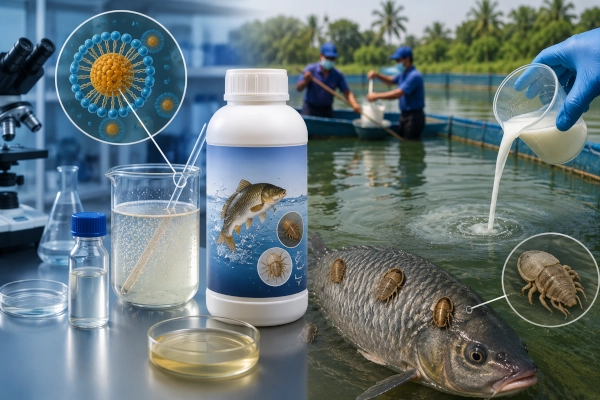
India’s fisheries research ecosystem has achieved an important technological milestone with the ICAR-Central Inland Fisheries Research Institute at Barrackpore receiving Indian Patent No. 600617 for an indigenous nano-formulation technology designed to improve the delivery of hydrophobic bioactive molecules.
The patent, granted on 27 August 2026, covers an invention titled “A Process for Nanoemulsifiable Concentrate Formulations of Hydrophobic Bioactive Molecules.” The technology has already moved beyond laboratory research and has been translated into CIFRI ARGCURE®, a field-oriented formulation developed to control Argulus and other ectoparasites affecting cultured fish.
The development is particularly significant for freshwater aquaculture because ectoparasitic infestations can cause considerable damage to farmed fish. Parasites attaching themselves to the skin and other external surfaces can produce wounds, irritation and physiological stress, interfere with normal growth and create entry points for bacterial and fungal infections. Serious outbreaks can therefore cause mortality as well as substantial economic losses for fish farmers.
CIFRI ARGCURE addresses this problem through a nano-scale delivery system that allows antiparasitic bioactive molecules to disperse efficiently in water at comparatively low application levels. The approach is designed to improve the effectiveness of the active compound while reducing dependence on conventional solvent-heavy formulations.
The Technology Behind CIFRI ARGCURE
Indian Patent No. 600617 protects more than the commercial name CIFRI ARGCURE. The underlying invention concerns the process used to prepare nanoemulsifiable concentrate formulations of hydrophobic bioactive molecules.
Hydrophobic compounds do not dissolve readily in water. This presents an obvious difficulty when such a molecule is intended for use in a fish pond because the active ingredient must be distributed through a large body of water before it can effectively reach parasites attached to fish.
ICAR-CIFRI’s technology addresses this challenge by incorporating the bioactive compound into a nano-scale carrier system capable of producing a stable dispersion after being introduced into the pond.
Official technology documentation describes CIFRI ARGCURE as using polymeric micelles loaded with antiparasitic bioactive molecules. Once the formulation enters the water, it spontaneously forms microscopic carrier structures measuring approximately 100 to 300 nanometres. These extremely small micelles help disperse the otherwise poorly water-soluble bioactive molecules and improve their delivery towards the intended target.
The patent therefore brings together nanotechnology, aquatic animal health and practical fisheries management, demonstrating how advanced materials science can be adapted to an everyday disease problem faced by fish farmers.
Argulosis Is a Major Aquaculture Problem
CIFRI ARGCURE was developed principally to control infestation by Argulus, a genus of crustacean ectoparasites commonly known as fish lice or carp lice.
Unlike microscopic pathogens, adult Argulus can often be seen attached to the surface of an infected fish. The parasite attaches itself to the host and feeds on tissues and body fluids, causing irritation and damage to the skin.
The resulting disease is known as argulosis. Infected fish may become restless or stressed, experience inflammation and tissue injury, and suffer reduced growth. The wounds produced by parasite feeding may also allow opportunistic bacteria or fungi to infect the fish.
For commercial aquaculture operations, the consequences can be serious. Fish that grow slowly require more feed and remain in ponds for longer periods before reaching market size. Severe infestation can produce mortality, while repeated treatment adds further cost.
The parasite’s life cycle creates an additional difficulty because eliminating the adults already visible on fish does not necessarily remove the eggs or developing stages remaining within the pond environment. A population can therefore re-establish itself after an apparently successful treatment.
Effective control must consequently address not only the parasites attached to fish but also the continuing reproductive cycle that allows infestation to return.
The Formulation Can Disrupt the Parasite’s Life Cycle
Earlier development work by ICAR-CIFRI indicated that CIFRI ARGCURE could do more than simply act against the parasites already present on fish.
The institute reported that the nano-formulation could interfere with the hatching process of Argulus, potentially reducing the number of new parasites emerging after treatment. Field observations also suggested that treated water bodies could remain free from reinfestation for longer periods.
This characteristic is particularly valuable because recurring infestation is one of the persistent challenges associated with fish lice.
A farmer may succeed in treating infected fish, only to see the problem return after eggs attached to pond structures or other surfaces subsequently hatch. A formulation capable of suppressing both existing infestation and the emergence of another generation could therefore provide a more durable management option.
Nanotechnology Enables Lower-Dose Treatment
One of the principal objectives behind CIFRI ARGCURE was to improve the effectiveness of antiparasitic compounds while reducing the quantity that must be introduced into the pond.
Government technology documentation recommends an application level of approximately 40 millilitres per acre-metre of water depth.
The same technology profile reports more than 80% control of Argulus infestation in finfish and states that the formulation does not depend on petroleum solvents.
The low application rate is important because a fish pond is an entire aquatic ecosystem rather than simply a container holding cultured fish. Alongside the stocked fish are plankton, microorganisms, insects and other organisms that contribute to ecological balance and biological productivity.
Any treatment placed in the water therefore has the potential to affect organisms other than the intended parasite. Improving the efficiency with which the active molecule is delivered can help reduce the quantity of formulation required to obtain the desired therapeutic effect.
Why Poor Water Solubility Matters
Many useful pharmaceutical, veterinary and agricultural molecules are hydrophobic, meaning that they have very limited ability to dissolve in water.
When a poorly soluble compound is added directly to a pond, it may clump together, settle, float or become distributed unevenly. Some parts of the water body can consequently receive too little active material, while other areas may experience concentrations that are unnecessarily high.
Conventional formulations may use organic or petroleum-derived solvents to overcome this problem.
Nanoemulsifiable technology provides a different route by enclosing or carrying the hydrophobic compound within extremely small structures that can disperse through the surrounding water much more effectively.
In CIFRI ARGCURE, speciality polymers form the nano-scale micelles responsible for this delivery mechanism. The formulation therefore makes a poorly water-soluble bioactive molecule easier to use in an aquatic environment.
The importance of the patent extends beyond one individual fisheries product because the protected invention concerns the wider formulation process used for hydrophobic bioactive molecules. This could potentially give the underlying technology relevance for additional applications in the future, although any such uses would require separate research and validation.
Already Commercialised Before the Patent Was Granted
One of the most important features of CIFRI ARGCURE is that the technology had already begun moving into commercial use before Patent No. 600617 was formally granted.
ICAR-CIFRI signed a technology-transfer licence for ARGCURE with Glaucus Agrochem Pvt. Ltd. in July 2021. The commercialisation process was facilitated by Agrinnovate India Limited, which helps transfer technologies developed within the Indian Council of Agricultural Research system to industry.
By August 2026, the government confirmed that CIFRI ARGCURE had been commercialised twice on a non-exclusive basis through Agrinnovate India Ltd.
A non-exclusive licensing arrangement allows more than one approved manufacturer potentially to commercialise the technology. Such an approach can be especially useful for agricultural and fisheries products because it can help expand availability and prevent dependence on a single commercial producer.
The technology is therefore notable not only as a patented research achievement but also as an innovation that has already entered the process of field adoption and commercial manufacturing.
Field Trials Have Produced Encouraging Results
CIFRI ARGCURE has also undergone field-level evaluation under practical aquaculture conditions.
A Krishi Vigyan Kendra assessment in Odisha tested the formulation against Argulus infestation in carp culture. During that trial, CIFRI ARGCURE was applied at approximately 40 millilitres per acre-metre, with repeated treatment at weekly intervals.
The programme reported approximately 92% control of argulosis under the conditions examined. It also reported that zooplankton were not killed during the trial, an important consideration because plankton communities form a major part of the pond ecosystem and contribute to natural productivity.
The field assessment additionally recorded approximately 24.7% higher fish yield and an improvement in the benefit-cost ratio from 1.87 to 2.10 compared with the farmer practice evaluated in that particular demonstration.
These findings are promising, but they should be interpreted carefully. They represent the results of a specific field trial rather than a guarantee that identical outcomes will occur in every pond.
Performance can vary according to fish species, stocking density, parasite pressure, water temperature, water quality and the timing and frequency of treatment. Nevertheless, the field results demonstrate that the technology has moved well beyond a controlled laboratory experiment and has been evaluated under actual production conditions.
Conventional Parasite Treatments Have Limitations
The search for improved methods of controlling Argulus is partly driven by concerns surrounding conventional treatments.
Fish farmers experiencing serious parasite infestations may use pesticides or veterinary chemicals in attempts to protect their stock. Some of these products can be effective, but indiscriminate application may expose cultured fish and other aquatic organisms to unnecessarily high chemical loads.
Excessive or poorly managed treatment can create risks involving chemical accumulation, environmental contamination, toxicity to fish, impacts on non-target organisms and residues in harvested fish.
Such concerns have encouraged scientists to investigate treatment approaches that can deliver the required antiparasitic action with lower amounts of active material.
CIFRI ARGCURE was developed around precisely this principle. Its nano-scale carrier system is intended to improve delivery efficiency so that effective parasite control can be achieved without relying on unnecessarily large volumes of conventional formulation.
Aquaculture Intensification Increases Disease Pressure
The need for effective disease-management technology is increasing as aquaculture becomes progressively more intensive.
Higher stocking densities allow farmers to produce greater quantities of fish from the same pond area, but they can also create favourable conditions for parasites and infectious organisms to spread rapidly.
Once Argulus becomes established in a densely stocked system, close contact among fish and the accumulation of parasite stages within the pond environment can accelerate the outbreak.
Stress caused by poor water quality, inadequate oxygen or nutritional imbalance can further weaken the fish and reduce their ability to tolerate infestation.
Disease management has therefore become a central component of modern aquaculture rather than an occasional emergency response.
This issue is especially relevant in India because freshwater carp farming supports a large number of small and medium producers. A disease outbreak affecting even one production cycle can reduce growth, raise feed expenditure, increase treatment costs and lower the final harvest value.
Developed at ICAR-CIFRI in Barrackpore
CIFRI ARGCURE was developed by the ICAR-Central Inland Fisheries Research Institute at Barrackpore in West Bengal, one of India’s leading institutions specialising in inland fisheries.
The institute conducts research covering river fisheries, reservoirs, wetlands, aquatic ecology, fish production systems, fish health and technologies intended to increase the sustainable productivity of India’s inland water resources.
ARGCURE forms part of a broader portfolio of technologies developed by the institute. These include systems for cage aquaculture, pen culture, specialised fish feeds and other innovations relating to inland-fisheries management.
The institute’s work therefore extends considerably beyond laboratory research. A major part of its mandate involves translating scientific findings into practical technologies suitable for ponds, reservoirs, wetlands and other production environments.
Patent Protection Strengthens the Technology
The patent application associated with the invention was filed under Application No. 202031042037.
CIFRI ARGCURE is also protected as a registered trademark under Trademark No. 4614213 in Class 5.
The grant of Indian Patent No. 600617 now adds formal intellectual-property protection for the underlying nanoemulsifiable formulation process.
For a public research institution, patent protection provides several advantages. It establishes legal ownership of the invention, creates a structured framework through which manufacturers can obtain licences and allows the institute to ensure that commercial production takes place through authorised technology-transfer arrangements.
It also helps protect publicly funded research from being copied commercially without formal recognition of the institution that developed it.
Moving From Scientific Research to a Farmer-Ready Product
The development of CIFRI ARGCURE reflects a wider transformation taking place within India’s agricultural research system.
Scientific research traditionally reached completion when findings were published in a journal or converted into technical recommendations. Increasingly, public research institutions are expected to take successful innovations further by developing practical products capable of reaching farmers.
This requires several additional stages, including formulation development, laboratory testing, field validation, intellectual-property protection, manufacturing protocols, technology transfer and commercial licensing.
CIFRI ARGCURE has progressed through many of these stages.
The formulation was developed and scientifically evaluated, licensed to industry, tested under field conditions and eventually granted patent protection.
ICAR-CIFRI Director Dr Pradip Dey has described the patent as part of the institute’s wider effort to move research beyond laboratory experimentation and turn scientific innovation into practical technologies with commercial and field applications.
Linking Public Research With Indian Industry
Commercialisation is essential because ICAR-CIFRI is fundamentally a scientific research institute rather than a large-scale manufacturer of veterinary formulations.
Once scientists establish that a technology performs effectively, commercial partners are required to produce it at scale, maintain manufacturing quality, package it appropriately and develop distribution networks capable of reaching fish farmers.
Agrinnovate India Ltd. plays an important role in creating this bridge between ICAR institutions and industry.
The original ARGCURE licensing agreement in 2021 was facilitated through Agrinnovate India, and the technology has subsequently been commercialised twice on a non-exclusive basis.
This model allows publicly funded research to enter the marketplace while maintaining a formal connection between the commercial product and the scientific institution responsible for developing the underlying technology.
Nanotechnology Reaches the Rural Fish Pond
Nanotechnology is often associated with semiconductors, electronics, medical diagnostics or highly specialised materials science.
CIFRI ARGCURE demonstrates a very different application. It uses nano-scale engineering to address a practical disease-management problem in an ordinary aquaculture pond.
A fish farmer does not need to understand polymer chemistry or nanoemulsion physics to use the product effectively.
What ultimately matters at farm level is whether the formulation controls parasites, whether the required dosage is affordable and manageable, whether the treatment is safe when correctly used and whether preventing disease improves the economics of fish production.
The ability to translate sophisticated laboratory research into a technology that can be practically used in rural production systems is therefore one of the most important aspects of the ARGCURE programme.
Better Fish Health Can Improve Farmer Income
Parasite management is not simply an animal-health issue. It has a direct effect on farm economics.
Fish suffering from chronic infestation may eat less efficiently, use more energy responding to stress and gain weight more slowly. Severe infestations can lead to mortality.
For farmers who invest heavily in feed over several months before harvest, slower growth can become a significant financial loss even if the affected fish survive.
Treatment itself also costs money, particularly when ineffective or temporary interventions have to be repeated.
A reliable parasite-control technology can therefore improve several elements of production simultaneously, including survival, growth, feed efficiency, treatment expenditure and the value of the final harvest.
The Odisha field assessment showing higher yield and an improved benefit-cost ratio illustrates this economic potential, even though results will naturally vary between locations and production systems.
Environmental Safety Remains Important
The environmental consequences of treatment are especially important in aquaculture.
A fish pond contains much more than the cultured species being raised for harvest. It also contains phytoplankton, zooplankton, microorganisms, aquatic insects and other organisms that help maintain ecological balance and nutrient cycling.
A treatment that kills the target parasite but severely disrupts the surrounding ecosystem can create additional production problems.
ICAR-CIFRI therefore highlights the absence of petroleum solvents and the comparatively low application dose as important characteristics of the ARGCURE formulation.
The reduced quantity of treatment required and the improved delivery mechanism can potentially reduce unnecessary environmental exposure when the formulation is used correctly.
This does not mean that any antiparasitic compound is harmless under every circumstance. Correct dosage, timing and responsible use remain essential. The scientific objective is instead to achieve the required therapeutic effect while minimising unnecessary exposure to the wider pond ecosystem.
The Patent Could Have Broader Scientific Relevance
The title of Patent No. 600617 is significant because it refers not specifically to Argulus, but to nanoemulsifiable concentrate formulations of hydrophobic bioactive molecules.
This indicates that part of the scientific value lies in the underlying formulation platform itself.
Poor water solubility is a challenge affecting many biologically active compounds used across veterinary medicine, agriculture and pharmaceuticals.
If a molecule cannot be dispersed efficiently, its usefulness may be limited even when it has strong biological activity.
Nano-scale carrier systems provide one way of overcoming this problem by improving dispersion and delivery.
CIFRI ARGCURE is the fisheries application that has emerged from the patented technology. Whether the same formulation principle will eventually support additional products will depend on future research, field testing and regulatory requirements.
Indigenous Technology for India’s Expanding Aquaculture Sector
India’s fisheries and aquaculture sector has expanded rapidly, creating growing demand for domestically developed technologies in breeding, nutrition, disease control, water management and production systems.
Heavy dependence on imported veterinary formulations can expose farmers to higher costs and leave the industry reliant on products developed for farming conditions that may differ from those in India.
An indigenous technology developed, tested and commercialised within India’s own fisheries research system offers several advantages.
Scientists can adapt the formulation according to local parasite species and production practices, knowledge generated through field deployment remains within the Indian research ecosystem, and licensed commercial manufacturing can be undertaken by domestic companies.
The significance of CIFRI ARGCURE therefore extends beyond the product itself. It represents a wider model in which Indian public-sector research is converted into intellectual property and then translated into a usable field technology for farmers.
Patent Is a Milestone, Not the End of Development
The grant of Indian Patent No. 600617 provides formal recognition of years of formulation research, but continued evaluation will remain important.
Parasites evolve, aquaculture practices change and treatment effectiveness can vary according to environmental conditions.
Long-term disease management also requires more than medication. Good pond preparation, appropriate stocking density, proper water quality, disease surveillance and responsible movement of fish remain essential for preventing recurring outbreaks.
CIFRI ARGCURE should therefore be viewed as one specialised tool within a broader aquatic-animal-health strategy rather than as a substitute for good farm management.
Further field studies can help refine treatment schedules and establish how effectively the technology performs across different fish species, climatic zones and aquaculture systems.
From Nanometres to the Fish Pond
The story behind CIFRI ARGCURE demonstrates how advanced scientific research can generate very practical benefits.
At one end of the technology are microscopic polymeric carrier structures measuring only around 100 to 300 nanometres. At the other is a fish farmer attempting to prevent a parasite outbreak from damaging an entire production cycle.
Connecting these two worlds required formulation science, laboratory research, field trials, technology transfer, commercial manufacturing and intellectual-property protection.
More importantly, CIFRI ARGCURE had already begun the transition from experimental research to field application before the patent was granted. The technology has been licensed through Agrinnovate India, commercially transferred and evaluated against one of the most persistent parasite problems affecting freshwater aquaculture.
For India’s expanding fisheries economy, innovations of this kind are particularly valuable because productivity depends not merely on stocking more fish but on keeping those fish healthy throughout the production cycle.
CIFRI ARGCURE therefore represents more than another patent in ICAR’s intellectual-property portfolio. It demonstrates how indigenous nanotechnology can be adapted to a practical rural challenge, helping protect cultured fish from ectoparasites while aiming to reduce treatment requirements, environmental exposure and financial losses for fish farmers.
You may also like
-
Javelin vs India’s MPATGM: How India’s Upgraded Indigenous Tank-Killer Is Closing the Capability Gap
-
NMDC Moves Closer to Commissioning 2-MTPA Nagarnar Iron Ore Pellet Plant
-
GRSE Expands Into Green Mobility With New Hybrid Ferry and Bailey Bridge Orders
-
India Brings More Than 115 Lakh Hectares Under Micro-Irrigation Through Per Drop More Crop
-
Indian Startup Gnani AI Unveils Sovereign AI Stack Built Around 30-Billion-Parameter Evon 3.3
