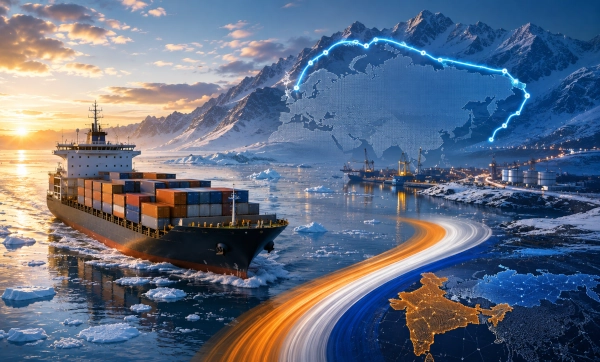
India is preparing to take an important step in its expanding maritime partnership with Russia by planning its first pilot cargo voyage through the Northern Sea Route in 2027, potentially opening a new chapter in commercial connectivity between India, Russia’s Arctic territories and northern Europe.
The proposed voyage comes as New Delhi and Moscow deepen cooperation across shipping, ports, shipbuilding, logistics and Arctic development. For India, the Northern Sea Route offers more than an alternative shipping passage. It could eventually become another component of a broader maritime network connecting Indian ports with Russia’s Far East, Arctic regions and European markets.
The plan was publicly outlined in August 2026 during Indian participation in the Arctic–Regions Forum in Arkhangelsk, where discussions focused on the possibilities for Indian cargo movement through Russia’s northern maritime corridor.
India and Russia are now examining how a pilot shipment could be organised in 2027 to test the commercial and operational viability of the route.
What Is the Northern Sea Route?
The Northern Sea Route, commonly known as the NSR, runs through Arctic waters along Russia’s northern coastline, linking the seas of northern Europe with the Bering Strait and the Pacific.
The principal route stretches for more than 5,500 kilometres through some of the most challenging maritime conditions in the world.
For vessels travelling between northern European and Asian ports, the Arctic passage can substantially reduce sailing distance compared with the conventional route through the Mediterranean Sea, Suez Canal and Indian Ocean.
Russia has spent years developing the Northern Sea Route as a strategic shipping corridor, investing in ports, navigation systems, icebreakers, search-and-rescue infrastructure and Arctic logistics facilities.
The route is also closely connected with Russia’s enormous northern reserves of hydrocarbons, minerals and other natural resources.
India Plans Its First Pilot Voyage in 2027
India’s proposed 2027 voyage is intended primarily as a pilot commercial exercise rather than the immediate establishment of a regular shipping service.
Such a voyage would allow Indian and Russian authorities, shipping companies and logistics operators to examine actual transit times, freight economics, ice-navigation requirements, port facilities, insurance costs and cargo-handling arrangements.
The pilot could also help determine what types of Indian cargo are best suited to the route and whether regular seasonal shipping between India and the Russian Arctic could become commercially viable.
The announcement represents a practical progression from several years of India-Russia discussions concerning Arctic shipping and maritime connectivity.
Arkhangelsk Emerges as a Potential Gateway
One of the most important locations in the emerging cooperation is Arkhangelsk, a historic Russian port city on the White Sea and one of the principal gateways to the Arctic.
During discussions in August 2026, representatives from India and the Arkhangelsk region explored possibilities involving port infrastructure, cargo movement, shipbuilding, ship repair and industrial cooperation.
The proposed development of new deep-water port infrastructure in the Arkhangelsk region has attracted Indian interest because it could provide another logistical entry point into Russia’s northern territories.
Arkhangelsk also offers access to Russia’s extensive northern resource base.
For India, cooperation around such ports could eventually encompass not only transportation but also investment, manufacturing, maritime services and industrial projects associated with Arctic development.
India-Russia Maritime Partnership Expands
The Northern Sea Route initiative should be viewed alongside India’s wider effort to develop new maritime links with Russia.
One of the most important is the Eastern Maritime Corridor connecting Chennai with Vladivostok.
The corridor provides a direct maritime connection between India’s eastern coastline and Russia’s Far East, substantially shortening the journey compared with traditional shipping routes between the two countries through European Russia.
Cargo movement along the Chennai-Vladivostok route has already increased, demonstrating the potential for maritime connectivity to become a larger pillar of India-Russia economic relations.
The Northern Sea Route would not replace the Eastern Maritime Corridor. Instead, the two could eventually function as complementary parts of a broader network.
Cargo could move from India to Russia’s Far Eastern ports before entering Arctic shipping networks, while other shipments could connect Indian ports with northern Russian terminals through alternative maritime combinations.
Building a Chennai-Vladivostok-Arctic Connectivity Network
The strategic possibility created by these developments is larger than any single shipping route.
India could eventually develop a maritime connectivity architecture stretching from Chennai to Vladivostok and onward through Russia’s Arctic maritime system.
Such a network would link Indian manufacturing and consumer markets with the resource-rich Russian Far East and Arctic.
It could also provide Indian companies with access to emerging logistics infrastructure associated with Russian energy, mining, metals, shipbuilding and other industrial projects.
From Russia’s perspective, deeper Indian participation would expand the range of Asian commercial partners using its eastern and northern maritime infrastructure.
Supply-Chain Diversification Gains Importance
India’s interest in the Northern Sea Route also comes at a time when disruptions along established global shipping corridors have highlighted the risks created by excessive dependence on a small number of maritime chokepoints.
Indian trade with Europe and western Russia traditionally depends heavily on shipping lanes running through the Arabian Sea, Red Sea and Suez Canal.
Recent geopolitical tensions have repeatedly demonstrated how conflicts or security incidents around critical waterways can disrupt shipping schedules, increase insurance premiums and force vessels onto longer routes.
Developing additional corridors does not mean abandoning established shipping routes.
Instead, India is increasingly pursuing route diversification, creating alternative options that could provide greater resilience during disruptions.
The Northern Sea Route could eventually become one such supplementary corridor.
Arctic Route Could Reduce Distance to Northern Europe
For certain voyages between Asia and northern Europe, the Northern Sea Route can offer substantial distance savings compared with the Suez Canal route.
Depending on the ports involved, estimates suggest that sailing distances can sometimes be reduced by around 30 to 40 per cent, potentially cutting journeys by roughly two weeks.
The advantage is highly dependent on origin, destination, vessel type and seasonal conditions.
For India, the economics are more complex than for Northeast Asian countries because Indian ports lie farther south.
The route would therefore need to be evaluated on a cargo-by-cargo basis.
Its greatest potential may lie in connecting India with Russia’s Arctic regions rather than functioning simply as a shorter replacement route for all India-Europe trade.
Access to Russia’s Arctic Resources
Commercial shipping is only one element of India’s growing interest in Russia’s Arctic.
The region contains enormous reserves of oil, natural gas, coal, critical minerals and other strategic resources.
Russia is developing major Arctic energy and mining projects alongside the transport infrastructure required to bring their output to international markets.
India, one of the world’s largest and fastest-growing energy consumers, has a strong long-term interest in diversifying sources of hydrocarbons and critical raw materials.
Greater access to Arctic shipping could therefore complement India’s energy and resource partnership with Russia.
Indian companies have already accumulated considerable experience investing in and working with Russian energy projects, particularly in the hydrocarbon sector.
Opportunities in Shipbuilding and Maritime Technology
The Arctic partnership could also create opportunities for Indian shipbuilding.
Operating in polar regions requires vessels with specialised hull structures, navigation equipment, heating systems and other features capable of functioning safely in extreme conditions.
India and Russia have already discussed cooperation involving shipbuilding and the training of Indian seafarers for polar navigation.
Indian shipyards are simultaneously expanding their capacity to manufacture commercial vessels as the government seeks to strengthen the country’s domestic shipbuilding industry.
Participation in Arctic shipping could therefore generate opportunities extending beyond cargo transportation into vessel construction, maintenance, repair and maritime services.
Training Indian Seafarers for Polar Waters
Human expertise will be just as important as ships and ports.
Navigation through Arctic waters involves challenges rarely encountered in conventional commercial shipping.
Crews must deal with sea ice, rapidly changing weather, low visibility, extremely cold temperatures and limited emergency infrastructure across vast stretches of ocean.
India and Russia have therefore identified the training of Indian seafarers for operations in polar waters as another potential area of cooperation.
Developing such expertise would gradually build India’s own human-resource capacity for Arctic shipping.
Russia’s Nuclear Icebreaker Fleet Gives the NSR a Unique Capability
One of the defining features of the Northern Sea Route is Russia’s extensive icebreaker capability.
Russia operates the world’s largest icebreaker fleet and remains the only country operating a fleet of nuclear-powered icebreakers.
These vessels can break pathways through thick Arctic ice, allowing commercial vessels to operate in conditions that would otherwise be inaccessible.
Icebreaker support is consequently central to Russia’s ambition to extend navigation periods along the NSR and eventually make parts of the corridor more accessible throughout the year.
For Indian shipping companies considering Arctic operations, access to Russian icebreaker services would be an essential component of voyage planning.
Significant Challenges Remain
Despite its strategic appeal, the Northern Sea Route remains a difficult and expensive operating environment.
Sea ice remains one of the greatest constraints.
Although Arctic ice coverage has changed over recent decades, conditions remain highly variable and dangerous.
Specialised ice-class ships may be required during many periods, while icebreaker escort can substantially increase voyage costs.
Insurance premiums can also be higher than on conventional routes because of the remoteness of the region and the difficulty of conducting emergency response operations.
Port and repair facilities are considerably less dense than along established shipping corridors.
Satellite communications, hydrographic surveying and search-and-rescue capacity also remain critical requirements.
Economics Will Determine Regular Indian Use
The success of India’s proposed pilot voyage will ultimately depend on economics.
A shorter sailing distance does not automatically produce lower shipping costs.
Ice-class vessels are more expensive to build and operate. Icebreaker assistance can add fees, while insurance and specialised crew requirements can further increase expenses.
Cargo availability is equally important.
A commercially viable shipping corridor requires sufficient cargo moving in both directions so that ships do not regularly make expensive return voyages with limited loads.
The 2027 trial will therefore provide valuable information about whether these costs can be balanced against savings in distance, time and geopolitical risk.
Environmental Considerations Will Remain Important
Expansion of commercial shipping in the Arctic also raises significant environmental concerns.
The Arctic is one of the world’s most environmentally sensitive regions, where accidents or oil spills can have particularly severe consequences because of extreme weather and the difficulty of mounting emergency responses.
Increased shipping can also affect marine ecosystems through underwater noise, emissions and potential disturbances to wildlife.
Any substantial expansion of Indian participation in Arctic shipping will therefore have to operate within applicable international maritime regulations and Russia’s environmental and navigation requirements.
Environmental safeguards will be especially important if the NSR evolves from an experimental corridor into a more regularly used trade route.
India’s Arctic Engagement Is Gradually Becoming More Practical
India’s interest in the Arctic extends well beyond maritime trade.
Indian scientists have conducted Arctic research for years, while New Delhi released its Arctic Policy in 2022, setting out priorities covering science, climate research, environmental protection, economic development, transportation and international cooperation.
Russia occupies a particularly important place in this strategy because it possesses the largest Arctic coastline and controls most of the infrastructure associated with the Northern Sea Route.
The proposed cargo voyage therefore represents a transition from primarily scientific and diplomatic Arctic engagement towards more practical commercial participation.
A New Dimension in India-Russia Relations
India-Russia relations have traditionally been associated with defence, energy, nuclear cooperation and strategic diplomacy.
Maritime connectivity is now emerging as an additional pillar.
The Chennai-Vladivostok Eastern Maritime Corridor connects India with Russia’s Pacific territories. The Northern Sea Route could extend that relationship farther north into the Arctic.
Cooperation around Arkhangelsk could simultaneously create a western Arctic gateway involving ports, shipbuilding, industrial projects and resource development.
Taken together, these initiatives could gradually produce a much broader India-Russia maritime partnership stretching across both Russia’s Pacific and Arctic coastlines.
The 2027 Voyage Will Be an Important Test
India’s planned first Northern Sea Route cargo voyage in 2027 should therefore be viewed as an experimental but strategically important step.
The voyage will provide real-world evidence about sailing times, costs, cargo suitability, port performance, icebreaker requirements and the practical challenges of operating Indian-linked commercial shipping through Arctic waters.
If the economics prove favourable, it could eventually lead to more frequent seasonal voyages and deeper participation by Indian shipping companies, ports and industrial enterprises.
If commercial limitations remain substantial, the NSR could still retain value as a specialised corridor for energy, minerals, bulk commodities and strategic supply-chain diversification.
Either way, India’s decision to test the route demonstrates that its maritime partnership with Russia is expanding beyond traditional trade lanes.
From the Indian Ocean to Vladivostok and increasingly towards the Russian Arctic, New Delhi and Moscow are exploring a new geography of connectivity — one in which ports, shipping corridors, energy resources and Arctic infrastructure could become increasingly important components of their long-standing economic and strategic relationship.
You may also like
-
India’s FY27 GDP Growth Outlook Upgraded to 7–7.2% as Domestic Demand and Investment Gain Strength
-
Foreign Investors Pour ₹30,919 Crore into Indian Equities in August as Overseas Buying Strengthens
-
Ethereal Machines: Building India’s Precision Manufacturing Backbone with Five-Axis CNC Technology
-
Global SFMS: India’s Indigenous Alternative to SWIFT Takes Shape as RBI Pushes Rupee-Based Cross-Border Payments
-
India–Chile CEPA Negotiations Advance as Both Sides Target Conclusion by Year-End
