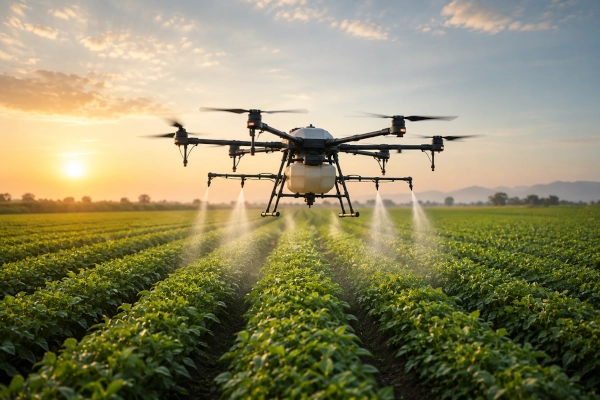
India’s indigenous drone manufacturing ecosystem has gained fresh capacity with Chennai-based Dhaksha Unmanned Systems inaugurating a new manufacturing facility at Aymicheri in Kancheepuram district, Tamil Nadu, while simultaneously introducing two locally developed agricultural UAVs.
The facility, inaugurated on August 24, 2026, represents Dhaksha’s next stage of expansion as it scales its presence across agriculture, defence and enterprise unmanned systems. The company intends to use the new site for larger and increasingly complex UAV programmes while bringing research, manufacturing, integration and operational capabilities into a more closely connected industrial environment.
Dhaksha is part of a growing generation of Indian companies attempting to move the country’s drone sector beyond final assembly towards greater control over critical technologies, components, system integration and production. The new Kancheepuram facility is specifically intended to support increased indigenisation while providing manufacturing capacity capable of responding to both civilian and military requirements.
Two New Indigenous Agricultural Drones
A major part of the inauguration was the unveiling of the DH Agrigator E10 Prime and DH Agrigator E10 Eco, expanding Dhaksha’s established agricultural-drone family.
Both platforms have been developed using indigenous components, reflecting the company’s effort to increase the domestic content of its UAV systems and reduce dependence on imported drone hardware.
The E10 Prime has been positioned to support India’s expanding agricultural-drone ecosystem and is aligned with the Namo Drone Didi programme, which seeks to place drone technology in the hands of women’s self-help groups for agricultural services.
Drone-based spraying can allow rural operators to cover farmland considerably faster than conventional manual methods while reducing direct human exposure to agricultural chemicals. It can also improve access to fields where labour availability is limited or terrain makes manual spraying difficult.
The E10 Eco follows a somewhat different strategy. Instead of concentrating primarily on higher-end capability, it has been designed as a more affordable platform intended to widen access to agricultural drone services among small and marginal farmers and rural entrepreneurs.
This distinction could become important as India’s agricultural drone market matures. Large farms, cooperatives and institutional buyers may be capable of purchasing advanced UAV platforms directly, while smaller farmers are more likely to access drones through shared-service models operated by rural entrepreneurs, farmer organisations or self-help groups.
Dhaksha’s approach therefore combines manufacturing with the creation of a wider service ecosystem in which drones can become agricultural tools rather than specialised equipment accessible only to larger operators.
Building on Dhaksha’s Agricultural Drone Experience
The new Agrigator models are not Dhaksha’s first agricultural UAVs. The company has already supplied drones for large-scale agricultural deployment and has accumulated experience in both manufacturing and field operations.
In 2023, Dhaksha secured an order from IFFCO for 400 agricultural spraying drones. It subsequently began delivering its DH-Agrigator-E10 Plus platform for agricultural use. That system incorporated a 10-litre spraying tank, obstacle and terrain sensing, first-person-view cameras and automated return-to-launch functions.
This existing operational experience gives the new E10 Prime and Eco platforms an important advantage. Agricultural UAV development does not depend only on producing an aircraft capable of carrying a liquid payload. Successful deployment requires understanding spray patterns, battery management, field conditions, operator training, servicing requirements and the practical realities of rural use.
Dhaksha’s relationship with the wider Coromandel agricultural network also gives the company access to real farming environments in which drone services can be tested and deployed. Coromandel’s drone-spraying operations have expanded across several major agricultural states, creating an ecosystem where UAV manufacturing and agricultural application can develop alongside each other.
A Dedicated Defence Production Capability
The importance of the Aymicheri plant extends beyond agriculture. The new facility includes a dedicated production line for defence applications, particularly UAV systems intended for surveillance and logistics missions.
This creates a clear dual-use manufacturing strategy. Agricultural platforms can provide production volume and commercial scale, while defence programmes demand higher levels of ruggedisation, communications security, endurance, payload integration and reliability.
Dhaksha already has experience supplying unmanned systems to the Indian military. In August 2023, the company received an order to supply 200 medium-altitude logistics drones and associated equipment to the Indian Army, a contract that established Dhaksha as a significant domestic player in military UAV logistics.
Logistics drones have become increasingly important for forces operating in mountainous and difficult terrain. Small and medium unmanned aircraft can transport ammunition, medical supplies, food, batteries and other essential stores to forward positions without requiring soldiers or conventional vehicles to repeatedly traverse exposed routes.
The Himalayan environment makes such systems particularly relevant for India. Remote posts may be separated by difficult terrain, poor road access and severe weather, creating circumstances in which unmanned logistics aircraft can complement helicopters, vehicles and human porters.
Surveillance UAVs provide another major opportunity. Modern military units increasingly rely on persistent aerial observation for reconnaissance, border monitoring, artillery support, force protection and situational awareness. Indigenous manufacturing allows such platforms to be adapted more rapidly to Indian requirements while giving domestic companies greater control over upgrades and lifecycle support.
From Drone Assembly to Technology Control
One of the most strategically important elements of Dhaksha’s new manufacturing expansion is its emphasis on greater control over critical UAV technologies.
India’s early commercial drone industry relied heavily on imported motors, flight controllers, communications equipment, sensors, batteries and other subsystems. While assembling these components domestically could create viable products, continued dependence on overseas suppliers left manufacturers vulnerable to supply-chain restrictions and limited India’s control over technology.
The next stage of India’s drone industrialisation is therefore increasingly centred on indigenous components, software, propulsion, communications, payloads and manufacturing processes.
Dhaksha says the new Kancheepuram facility will bring its research and operational capabilities closer together while encouraging collaboration with technology partners across the drone value chain. This could allow specialist Indian firms developing sensors, propulsion systems, electronics and other subsystems to integrate their technologies into complete UAV platforms more efficiently.
Such an ecosystem approach is particularly important because no sophisticated UAV is produced by one engineering discipline alone. A reliable drone combines aerodynamics, propulsion, structures, electronics, navigation, communications, software, payload integration and manufacturing quality control.
Building these capabilities within India can therefore create an industrial base that extends much further than any individual Dhaksha product.
An Indian Drone Company Moving Across Multiple Markets
Dhaksha was incorporated in 2019 and is headquartered in Chennai. The company develops and manufactures unmanned aerial systems for agriculture, defence, surveillance and other applications, while also participating in remote-pilot training activities.
Coromandel International entered the drone sector through investment in Dhaksha and subsequently increased its stake, bringing the UAV company into the wider Murugappa Group industrial ecosystem. Dhaksha has also maintained technology and training links with Anna University.
This combination gives Dhaksha an unusual position within India’s drone industry. It operates at the intersection of two markets experiencing rapid technological change: precision agriculture and unmanned defence systems.
The requirements of these markets are very different, but there are also important technological overlaps. Reliable propulsion, autonomous navigation, obstacle avoidance, communications, lightweight structures, flight-control software and high-volume manufacturing are valuable across both civilian and military UAVs.
A company capable of producing platforms across several applications can therefore distribute research and manufacturing investment across a broader customer base.
Building India’s Drone Manufacturing Base
The opening of the Aymicheri facility comes as drones move from experimental technology towards routine tools across Indian agriculture, defence, infrastructure inspection, mapping and logistics.
For India, the challenge is no longer merely to demonstrate that domestic companies can design UAVs. The larger objective is to establish companies capable of manufacturing reliable systems at scale, maintaining them throughout their operational lives and progressively replacing imported subsystems with Indian alternatives.
Dhaksha’s new facility addresses precisely this transition.
The launch of the Agrigator E10 Prime and E10 Eco strengthens the company’s agricultural portfolio, while the dedicated defence line creates capacity for surveillance and logistics platforms. At the same time, greater integration between R&D, manufacturing, suppliers and service centres could shorten the path from prototype development to large-scale deployment.
The expansion also illustrates how India’s drone industry is beginning to develop specialised manufacturing clusters. Tamil Nadu already possesses a substantial aerospace, automotive, electronics and engineering supply base, providing UAV manufacturers with access to precision manufacturing and technical talent.
For Dhaksha, the Aymicheri plant is therefore more than an increase in factory capacity. It represents an attempt to create an integrated domestic UAV ecosystem spanning indigenous components, agricultural applications, defence platforms, manufacturing, servicing and technology partnerships.
As India increasingly seeks sovereign control over unmanned technologies, companies capable of connecting indigenous engineering with large-scale manufacturing will become strategically important.
Dhaksha’s latest expansion demonstrates how that transition is beginning to take shape: from a young Chennai drone company founded in 2019 to an Indian manufacturer simultaneously supplying agriculture, building military UAV capability and investing in the infrastructure needed for the next generation of autonomous systems.
You may also like
-
DRDO Opens Indigenous Infrared Sapphire Coating Technology to Indian Industry for Missiles and EO/IR Systems
-
India Certifies First 15-Metre Multi-Axle Sleeper Bus as Domestic Coach Engineering Advances
-
Indian Railways Moves to Four-Track 11,000 Km of High-Density Corridors Carrying 41% of National Traffic
-
India and Morocco Target Doubling Bilateral Trade as Both Sides Explore Preferential Trade Agreement
-
India Moves Closer to Major UK-Made Thales LMM Missile Deal for Indian Army
