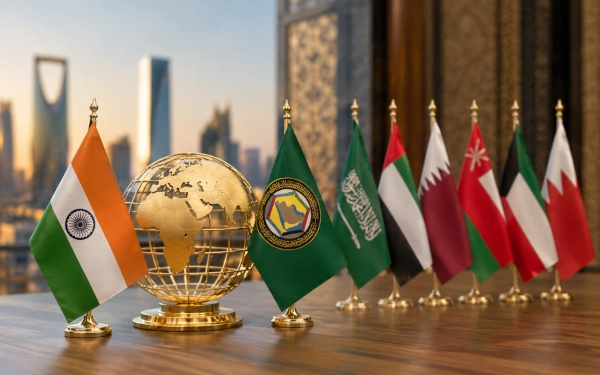
India and the Gulf Cooperation Council are moving ahead with efforts to deepen one of India’s most important economic and strategic partnerships, with fresh discussions in Riyadh focusing on the proposed India-GCC Free Trade Agreement, stronger high-level engagement and developments affecting the wider region.
India’s Ambassador to Saudi Arabia, Vipul, met GCC Secretary-General Jasem Mohamed Albudaiwi at the headquarters of the Gulf Cooperation Council in Riyadh. The two sides reviewed India-GCC relations and discussed ways to expand cooperation while examining progress surrounding negotiations for the proposed Free Trade Agreement. Preparations were also discussed for an India-GCC ministerial meeting scheduled to take place in September.
The latest engagement is significant because India and the six-member Gulf grouping formally revived their long-running effort to establish a comprehensive trade agreement earlier this year. India and the GCC formally launched negotiations in February 2026, creating a framework for discussions intended to produce a broad and mutually beneficial agreement covering trade and economic cooperation.
The economic scale behind the negotiations is considerable. The GCC, comprising Saudi Arabia, the United Arab Emirates, Qatar, Kuwait, Oman and Bahrain, is India’s largest trading partner bloc. Bilateral merchandise trade reached approximately $178.56 billion in FY2024-25, representing more than 15 per cent of India’s global trade. Indian exports to the GCC stood at about $56.87 billion, while imports reached approximately $121.68 billion.
India exports a broad range of products to Gulf markets, including engineering goods, machinery, textiles, rice, gems and jewellery. The GCC, meanwhile, plays a particularly important role in India’s energy security through supplies of crude oil, LNG and petrochemicals, while precious metals such as gold are another major component of imports. This complementarity gives the proposed trade agreement significance beyond conventional tariff reductions.
A comprehensive FTA could provide Indian manufacturers and exporters with improved access to some of the world’s wealthiest consumer markets while creating additional opportunities in engineering, food processing, pharmaceuticals, automobiles, textiles, electronics and services. Gulf countries are simultaneously pursuing major programmes to diversify their economies beyond hydrocarbons, opening opportunities for Indian companies in digital technology, infrastructure, healthcare, renewable energy, logistics, manufacturing and professional services.
Investment ties add another dimension. Cumulative investment from GCC countries into India had exceeded $31.14 billion by September 2025, demonstrating the Gulf’s growing importance not only as a trading partner and energy supplier but also as a source of long-term capital.
The relationship is also supported by one of India’s largest overseas communities. Nearly 10 million Indians live across GCC countries, creating deep commercial, cultural and people-to-people connections. Their presence has helped build networks spanning businesses, professional services, technology, healthcare, construction and retail, while remittance flows continue to connect Gulf economies closely with Indian households.
The proposed FTA therefore fits into India’s wider strategy of expanding access to major global markets while positioning Indian manufacturing and services more deeply within international value chains. India has already implemented a comprehensive trade agreement with the UAE and has concluded a separate Comprehensive Economic Partnership Agreement with Oman, giving New Delhi a growing network of economic arrangements across the Gulf.
The Riyadh discussions also extended beyond commerce. India and the GCC exchanged views on regional and international developments and emphasised continued consultation on issues affecting common interests, security and stability. The Gulf region remains critical to India’s energy supplies, maritime trade routes and overseas population, making political stability in West Asia an important Indian strategic interest.
Progress toward an India-GCC FTA could consequently produce an economic partnership far larger than the trade figures alone suggest. By linking India’s expanding manufacturing base, technology capabilities and enormous consumer economy with the GCC’s capital, energy resources, logistics networks and rapidly diversifying markets, a comprehensive agreement could reshape commercial relations between India and the Gulf.
With bilateral trade already approaching $180 billion annually, the negotiations are not about creating an economic relationship from the ground up. They are about building a more integrated framework around a partnership that has already become one of India’s largest and most strategically important economic relationships.
You may also like
-
India and Mauritius Move to Deepen Cooperation in Civil Service Training, Digital Governance and Capacity Building
-
India and Russia Push for $100-Billion Trade as Economic Partnership Expands Into Technology, Energy and Industry
-
India-Russia Strategic Partnership Deepens as Jaishankar Meets Putin, Pushes Trade, Energy and Economic Cooperation
-
US Ambassador Visits Tata-Lockheed C-130J Facility as India’s Aerospace Manufacturing Role Expands
-
India-Cambodia Trade Jumps 36% to $406.78 Million as Both Sides Push Investment and Digital Payments Linkages
