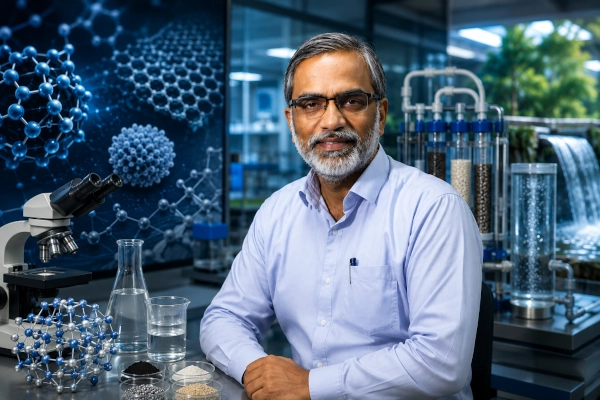
Professor Thalappil Pradeep of the Indian Institute of Technology Madras has been elected as a full member of the European Academy of Engineering (EAE), adding another major international recognition to a scientific career that has combined fundamental nanoscience with technologies designed to provide affordable clean drinking water.
The European Academy of Engineering has officially included Prof. Pradeep among its members elected in 2026. The academy identifies him as an Institute Professor at IIT Madras and highlights his research in nanoscience, nanomaterials, surface science, spectroscopy, ice chemistry, scientific instrumentation and water-purification technologies.
IIT Madras has described Prof. Pradeep as the third Indian scientist to be elected to the EAE, following eminent scientists Prof. C.N.R. Rao and Prof. Biman Bagchi. The recognition places him among an international group that includes distinguished researchers and recipients of some of the world’s most prestigious scientific honours.
Recognition for Science With Direct Societal Impact
Prof. Pradeep’s election is particularly significant because much of his work demonstrates how advanced materials science can move from the laboratory into applications that directly affect human lives.
He is internationally recognised for developing nanotechnology-based approaches to drinking-water purification, particularly for removing contaminants such as arsenic, pesticides, uranium and other toxic substances from water.
IIT Madras describes him as a pioneer in nanotechnology applications for clean water and says his pesticide-removal technologies have benefited millions of people. His research group later developed materials capable of removing arsenic and other toxic contaminants, with the technology receiving approval for national implementation.
The significance of this work lies in its focus on affordability. Water purification technologies developed for wealthy urban markets may not necessarily work in rural communities that lack reliable electricity, sophisticated maintenance networks or high household incomes.
Prof. Pradeep’s research has therefore focused on materials that can deliver effective purification while remaining practical for communities where clean-water infrastructure is limited.
Nanotechnology Taken From Laboratory to Village
One of Prof. Pradeep’s most important contributions has been the development of nanomaterials capable of selectively capturing contaminants from groundwater.
Arsenic contamination is particularly dangerous because prolonged consumption of contaminated water can create serious health risks. Yet removing arsenic economically across large rural populations presents a difficult engineering challenge.
Prof. Pradeep and his collaborators developed affordable materials that can remove arsenic and other heavy metals from groundwater. IIT Madras said while announcing his VinFuture Prize in 2022 that the purification approach could operate through relatively simple designs and was especially useful in remote regions because it did not require electricity.
At that time, IIT Madras reported that technologies associated with his work were delivering clean water to more than 1.2 crore people.
The achievement illustrates an important aspect of engineering research. A laboratory discovery becomes truly transformative only when it can be manufactured, deployed, maintained and used economically by ordinary people.
Prof. Pradeep’s career has increasingly concentrated on bridging that gap.
From Pesticides to Arsenic and Other Contaminants
His clean-water research did not begin with arsenic alone.
Prof. Pradeep initially worked on nanomaterial-based methods capable of dealing with pesticide contamination in water. His research later expanded towards arsenic, uranium and several other toxic contaminants.
This work is part of a broader scientific programme investigating how matter behaves at very small scales and how those properties can be exploited to solve real-world problems.
Nanomaterials can behave differently from conventional bulk materials because their surfaces become extremely important at such small dimensions. By designing those surfaces carefully, scientists can create materials that interact selectively with particular molecules or ions.
That principle can be applied to water purification by developing materials that capture unwanted contaminants while allowing clean water to pass through.
Prof. Pradeep’s work has helped demonstrate that advanced nanoscience does not have to remain confined to expensive laboratories. It can be translated into technologies designed for large-scale public use.
A Career Spanning Fundamental and Applied Science
Water purification represents only one part of Prof. Pradeep’s scientific work.
The European Academy of Engineering lists his research interests across nanoscience and nanotechnology, nanomaterials, surface science, spectroscopy, ice chemistry and scientific instrumentation.
IIT Madras similarly identifies his current research interests as including clean-water technologies, nanomaterials, microdroplets and ice chemistry.
This combination of fundamental and applied science has become one of the defining characteristics of his career. His work examines matter at molecular and nanoscale dimensions while also asking how those discoveries can be converted into technologies that address large societal problems.
He has also worked extensively on atomically precise clusters, extremely small arrangements of atoms whose properties can differ dramatically depending on their exact size and structure.
That research contributed to another major international distinction.
Also Elected to the US National Academy of Engineering
In 2024, Prof. Pradeep was elected as an international member of the United States National Academy of Engineering, becoming the 23rd foreign member from India at that time.
The US academy recognised him specifically for his contributions to cluster chemistry and the discovery and implementation of affordable drinking-water solutions.
Election to both the US National Academy of Engineering and the European Academy of Engineering places Prof. Pradeep among a relatively small group of Indian researchers whose contributions have received recognition across major international engineering academies.
More Than 550 Research Papers and 100 Patents
Prof. Pradeep has also built a substantial body of scientific and technological work.
The Press Information Bureau reported in 2024 that he had published around 550 scientific papers and held more than 100 patents or patent applications. He had also co-founded several companies intended to translate research discoveries into commercially deployable products.
This commercialisation aspect is particularly important in clean-water technology.
Research papers can establish that a material works under controlled conditions, but delivering drinking water to millions of people requires manufacturing capacity, engineering design, supply chains and organisations capable of maintaining systems after installation.
Prof. Pradeep has therefore been closely involved with efforts to convert research into usable technologies.
International Centre for Clean Water
His efforts also contributed to the establishment of the International Centre for Clean Water at the IIT Madras Research Park.
IIT Madras says Prof. Pradeep founded the centre to accelerate the translation of laboratory discoveries into technologies capable of addressing real-world water challenges.
The centre reflects a wider shift in Indian scientific research towards combining academic discovery with engineering, entrepreneurship and deployment.
Water security is an especially suitable field for such an approach because India’s challenges vary enormously across geography. Different communities may face arsenic, fluoride, heavy metals, salinity, microbial contamination or industrial pollutants.
There is therefore unlikely to be one universal purification solution. Materials, sensors and treatment systems must be adapted to local conditions.
A Long List of National and International Honours
Prof. Pradeep’s election to the European Academy of Engineering adds to an already extensive list of honours.
IIT Madras identifies him as a recipient of the Padma Shri, Vigyan Shri, Eni Award and VinFuture Prize. He has also received the Prince Sultan Bin Abdulaziz International Prize for Water, the Nikkei Asia Prize and the Shanti Swarup Bhatnagar Prize, among other distinctions.
In 2023, he received the Eni Award for Advanced Environmental Solutions, recognising his work related to sustainable and affordable water purification. IIT Madras described his pesticide-removal and arsenic-removal technologies as among the important achievements behind the recognition.
He was also awarded the VinFuture Special Prize for Innovators from Developing Countries in 2022 for developing a low-cost filtration system capable of removing arsenic and other heavy metals from groundwater.
European Academy Recognition Extends India’s Scientific Presence
The European Academy of Engineering was established in Gothenburg, Sweden, in 1992 and brings together researchers and engineering professionals working across a wide range of technological and scientific disciplines.
Its 2026 class includes scientists working in fields ranging from engineering and artificial intelligence to energy, materials, medicine and fundamental science. The academy’s official list includes several Nobel laureates and other internationally recognised researchers alongside Prof. Pradeep.
His election therefore provides further international recognition not only for his individual work but also for the growing contribution of Indian research institutions to advanced science and engineering.
Science That Reaches Beyond the Laboratory
The larger importance of Prof. Thalappil Pradeep’s work lies in the connection he has created between fundamental science and human necessity.
Nanoscience can involve extremely sophisticated experiments dealing with structures only billionths of a metre across. Drinking clean water, by contrast, is one of the most basic requirements of everyday life.
Bringing these two worlds together demonstrates what scientific research can achieve when discovery is followed by engineering, manufacturing and deployment.
For IIT Madras, his election to the European Academy of Engineering adds another international recognition to one of its most distinguished researchers. For Indian science, it demonstrates that technologies developed within the country’s universities can move from research papers and laboratories into solutions capable of reaching millions of people.
Prof. Pradeep’s journey also underlines an increasingly important direction for Indian research: science that does not stop at discovery, but continues until the discovery becomes useful to society.
References
European Academy of Engineering: The EAE’s official 2026 Newly Elected Members announcement lists Thalappil Pradeep of IIT Madras as a newly elected member and describes his research in nanotechnology, surface science, spectroscopy, ice chemistry, instrumentation and water purification.
Indian Institute of Technology Madras: IIT Madras officially congratulated Prof. Pradeep on his election to the European Academy of Engineering and identified him as the third Indian to receive the distinction.
IIT Madras — August 7, 2026: The institute’s official profile describes Prof. Pradeep as an Institute Professor and Deepak Parekh Institute Chair Professor and details his research in clean-water technologies, nanomaterials, microdroplets and ice chemistry.
Press Information Bureau / IIT Madras: The Government of India release on Prof. Pradeep’s election to the US National Academy of Engineering documents his research achievements, patents and contributions to affordable drinking-water purification.
IIT Madras — VinFuture Prize: The institute’s official release provides details of his low-cost arsenic and heavy-metal removal technology and its large-scale clean-water impact.
You may also like
-
NMMSS Scholarship Application Deadline Extended to October 31, 2026
-
DGCA Introduces Training Framework for Gyroplane Pilots in India
-
DRDO CASDIC Opens 30 Paid Internships for Engineering and Science Students
-
Duryodhana Wins Shalya Through Hospitality: Gifts, Obligation and Political Leverage Before the Kurukshetra War
-
Krishna’s Private Meeting With Karna: Back-Channel Diplomacy Before the Kurukshetra War
