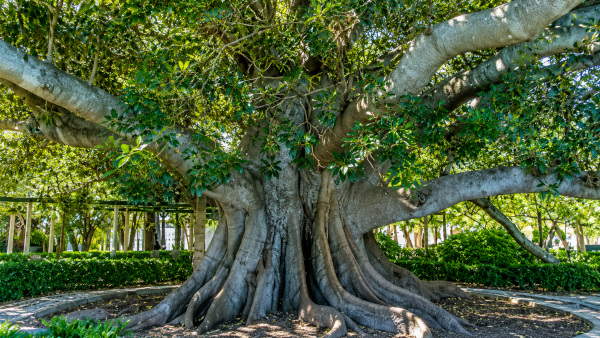
Botanical Name: Ficus benghalensis L.
Sanskrit Names: Vata, Nyagrodha, Bahupada, Dhruva
Common Name: Banyan Tree, Indian Banyan
Family: Moraceae
Hindi: Bargad, Bar
Malayalam: Peral
Tamil: Alamaram
Kannada: Ala Mara
Telugu: Peddamarri
Parts Traditionally Used: Stem bark, aerial roots, leaves, leaf buds, fruits and latex
Few trees represent India as powerfully as the banyan. Its enormous crown, descending aerial roots and ability to create new supporting trunks give a mature banyan the appearance of an entire grove formed from a single living organism.
Ayurveda knows the banyan as Vata or Nyagrodha. Botanically, it is Ficus benghalensis L., an accepted species in the Moraceae family. Kew’s Plants of the World Online identifies its native range as the Indian subcontinent and records medicinal, environmental, food and social uses for the species.
The tree occupies an important place in Ayurvedic medicine. Its bark, aerial roots, leaf buds, fruits and latex have been used in different preparations. Classical descriptions emphasise its astringent, cooling and stabilising qualities, particularly in conditions involving excessive discharge, bleeding, wounds and disturbances of Kapha and Pitta.
Modern researchers are now examining Ficus benghalensis for anti-inflammatory, antidiabetic, antioxidant, antimicrobial and wound-healing activity. Most of this evidence, however, comes from laboratory and animal research rather than large human clinical trials.
Why the Banyan Is Called Nyagrodha
The Sanskrit name Nyagrodha beautifully reflects the unusual growth of the banyan.
Unlike an ordinary tree that grows mainly upward from a central trunk, banyan branches produce aerial roots that descend towards the soil. After reaching the ground, these roots thicken and become supporting columns.
A mature banyan can therefore spread across an extraordinary area while remaining connected to its original structure.
The name Bahupada, meaning “many-footed”, similarly reflects the numerous pillar-like roots supporting an old tree.
Ayurvedic sources also use Vata as a name for Ficus benghalensis. This should not be confused with Vata Dosha. The same Sanskrit word appears in different contexts, but Vata here refers specifically to the medicinal tree.
Botanical Identity of Ficus benghalensis
Ficus benghalensis is a large evergreen or semi-evergreen tree with a broad spreading crown.
Its leaves are simple, broad and leathery. Young branches produce aerial roots that descend vertically. The bark is generally greyish, while damaged tissues release the characteristic white latex found in many members of the genus Ficus.
What appears to be the banyan’s “fruit” is actually a specialised structure called a syconium. The tiny flowers develop inside this enclosed fig-like structure rather than appearing openly on branches.
Kew recognises Ficus benghalensis as an accepted species native to the Indian subcontinent.
The tree’s ability to produce repeated aerial supports allows individual specimens to become enormous.
Ayurvedic Profile of Vata
Traditional descriptions consistently emphasise the Kashaya, or astringent, character of Vata.
| Ayurvedic Property | Vata / Banyan |
|---|---|
| Rasa — Taste | Kashaya, with Madhura described in some traditions |
| Guna — Qualities | Guru, Ruksha — heavy and dry |
| Virya — Potency | Sheeta — cooling |
| Vipaka — Post-digestive effect | Katu — pungent |
| Dosha Action | Primarily Kapha-Pitta Shamaka |
| Important Karma | Grahi, Stambhana, Vranaropana, Shothahara, Mutrasangrahaniya |
Ayurvedic teaching sources describe Vata as having predominantly Kashaya Rasa, Guru and Ruksha qualities, Sheeta Virya and Katu Vipaka.
These properties explain much of its traditional therapeutic use.
Its astringency gives the drug a contracting and stabilising character. The cooling potency makes it particularly relevant where heat and Pitta are prominent, while the dry quality helps counter excessive Kapha.
Kashaya Rasa — The Importance of Astringency
The strong Kashaya Rasa, or astringent taste, is central to understanding Vata.
Astringent substances create a tightening sensation in the mouth. Ayurveda associates this quality with Stambhana, or checking excessive flow, and Grahi, which helps retain substances that are being lost excessively.
This is why banyan bark appears traditionally in preparations for conditions involving diarrhoea, abnormal discharge and bleeding.
This does not mean banyan bark should be used at home for unexplained bleeding or persistent diarrhoea.
Blood in stools, prolonged diarrhoea, abnormal uterine bleeding or recurrent discharge may indicate conditions requiring medical diagnosis.
Vranaropana — Traditional Use in Wound Healing
Vata is traditionally regarded as Vranaropana, meaning supportive of wound healing.
Its bark and latex have both appeared in traditional external applications. Ayurvedic descriptions also associate the tree with Vrana, or wounds.
Modern scientific interest has partly followed this traditional reputation.
Reviews of Ficus benghalensis describe experimental research into wound-healing, anti-inflammatory and antimicrobial actions.
However, raw banyan latex should not be casually applied to deep wounds.
Plant latex can irritate skin and may introduce contamination. Deep cuts, infected wounds, burns, diabetic ulcers and wounds that fail to heal require professional medical care.
Shothahara — Banyan and Inflammation
Ayurvedic descriptions also associate Vata with Shothahara, referring to the reduction of Shotha or swelling.
Modern research has investigated anti-inflammatory compounds and extracts from Ficus benghalensis.
A recent scientific review of F. benghalensis discusses experimental evidence involving inflammatory pathways as well as antioxidant and metabolic effects.
These findings provide interesting support for further investigation.
They do not yet establish banyan preparations as replacements for anti-inflammatory medicines used in arthritis, autoimmune disease or serious inflammatory disorders.
Vata and the Ayurvedic Management of Prameha
One of the better-known traditional uses of banyan concerns Prameha.
Prameha is a broad Ayurvedic disease category involving abnormalities of urine, metabolism and body tissues. Diabetes mellitus overlaps with aspects of this description, but the two terms should not be treated as exact synonyms.
Traditional Ayurvedic sources classify Vata among plants used in Prameha-related conditions.
Modern researchers have consequently studied Ficus benghalensis for possible glucose-lowering activity.
Reviews of the genus Ficus report experimental antidiabetic activity from F. benghalensis, while a 2024 review specifically examined its potential in diabetes-related complications.
Most of this evidence remains preclinical.
Banyan bark or other preparations must not replace insulin, metformin or other prescribed diabetes medicines.
Mutrasangrahaniya — Traditional Action on Excessive Urination
Ayurvedic sources classify Vata as Mutrasangrahaniya, a term associated with checking excessive urinary flow.
This action is consistent with its strong astringent and stabilising character.
However, frequent urination can arise from diabetes, urinary infection, prostate disease, medicines, excessive fluid intake and several other causes.
Suppressing the symptom without identifying its cause can delay appropriate treatment.
The Ayurvedic indication should therefore be understood within a complete clinical assessment rather than converted into a simple home remedy.
Banyan Bark
The stem bark is one of the most important medicinal parts of Vata.
Its astringency explains many of its traditional uses. Decoctions of the bark have historically appeared in Ayurvedic preparations for conditions involving excessive secretion, loose stools, skin disorders and Prameha.
The National Medicinal Plants Board has included Ficus benghalensis in projects involving the pharmacognostic standardisation of Ayurvedic bark drugs.
Such work is important because correct botanical identification and quality control become essential when bark is used medicinally.
Indiscriminate bark harvesting can also damage mature trees. Medicinal raw material should therefore come from responsible and authenticated sources.
Aerial Roots
The hanging roots of the banyan are perhaps its most distinctive feature.
Ayurveda also uses these aerial roots in selected preparations. Contemporary Dravyaguna sources list roots and aerial roots among the useful medicinal parts of Vata.
Traditional practices have used aerial-root preparations in several contexts, including reproductive and tissue-supporting applications.
Such uses should remain under professional guidance.
The chemical composition of an aerial root is not necessarily identical to that of bark, fruit or latex. Different plant parts should not automatically be substituted for one another.
Leaf Buds and Vata Shringa
Young leaf buds of the banyan have their own place in Ayurvedic tradition.
The leaf primordium is sometimes known as Vata Shringa. Pharmacognostic research has examined this material because of its traditional use in Ayurvedic practice.
Historical literature records Vata leaf preparations in particular ritual-medical contexts, including Pumsavana traditions. CCRAS archival research discussing historical Indian medical literature also records banyan fruit and leaf juice in such a context.
Traditional descriptions of procedures intended to influence the sex of a child should not be interpreted as scientifically established methods.
A child’s biological sex is determined genetically, and no herbal nasal preparation has been proven to change it.
Banyan Latex
When banyan bark, leaves or roots are injured, they release a white milky latex.
Traditional medicine has used this latex externally for selected conditions. Ayurvedic descriptions mention applications involving wounds, skin problems and dental complaints.
Latex deserves particular caution.
Natural latex from Ficus species contains biologically active substances and can irritate sensitive skin or mucous membranes.
It should not be placed in the eyes, deep wounds, cavities or other sensitive areas without qualified medical supervision.
“Natural” does not mean chemically inactive.
Banyan Fruit
The small reddish fruits of the banyan are far less conspicuous than those of the common edible fig, but they are ecologically important.
Kew records Ficus benghalensis as a food source for animals as well as a plant with medicinal and social uses.
Ayurvedic traditions also use the fruit in selected preparations.
Ecologically, figs from Ficus species provide food to birds, bats and other animals. This helps explain the importance of mature banyans within tropical landscapes.
The relationship between figs and their specialised pollinating wasps also represents one of the remarkable examples of plant-insect mutualism.
Vata in Panchavalkala
Banyan has an important place within the Ayurvedic group known as Panchavalkala.
Panchavalkala traditionally combines the bark of five latex-bearing trees, largely from the Ficus group. Vata is one of the important members of this combination.
Ayurvedic sources classify Vata within groups such as Nyagrodhadi Gana and formulations including Panchavalkala preparations.
Panchavalkala preparations are traditionally used externally and internally in selected conditions involving wounds, inflammation and excessive secretions.
These are medicinal formulations rather than ordinary beverages.
Their preparation and dose should be determined by a trained Ayurvedic practitioner.
Vata and Skin Disorders
Banyan bark and other parts of the plant have long appeared in traditional remedies for Twak Vikara, or skin disorders.
The Kashaya Rasa, Sheeta Virya and traditional Vranaropana action help explain this use within the Ayurvedic framework.
Modern researchers have investigated antimicrobial, antioxidant and anti-inflammatory activities across Ficus species.
However, the term “skin disease” covers many unrelated conditions.
Eczema, psoriasis, fungal infection, bacterial infection, allergy and autoimmune disorders require different treatments. Persistent lesions should therefore be medically assessed.
Banyan and Diarrhoea
The Grahi and Stambhana qualities of Vata explain its traditional use in Atisara, or diarrhoeal conditions.
Astringent plant substances can produce a contracting effect on tissues, which corresponds with the Ayurvedic understanding of checking excessive intestinal discharge.
Traditional descriptions of Vata include use in dysentery and diarrhoeal disorders.
Modern experimental literature has also investigated antidiarrhoeal activity from Ficus benghalensis.
Persistent diarrhoea, however, can cause dangerous dehydration. Infants, elderly people and anyone passing blood in the stool require prompt medical attention.
Research Into Antioxidant Activity
Different parts of Ficus benghalensis contain phytochemicals including flavonoids, sterols and phenolic compounds.
Ayurvedic teaching sources list compounds such as phytosterolin, bengalenoside, flavonoid glycosides, leucocyanidin and leucopelargonidin among identified constituents.
Scientific reviews have reported antioxidant activity from several Ficus extracts.
Antioxidant activity in a laboratory assay should not be translated directly into claims that banyan prevents cancer, ageing or chronic disease.
The human body is considerably more complex than a laboratory antioxidant test.
Such findings are best regarded as clues for further research.
Modern Antidiabetic Research
The traditional association between Vata and Prameha has made glucose metabolism one of the most frequently investigated areas of banyan research.
Experimental studies and reviews have examined bark, root and other extracts for effects on glucose regulation and oxidative stress.
Some results are promising.
Yet the transition from an animal experiment to a clinically useful medicine requires standardised extracts, toxicity studies, pharmacokinetic research and controlled human trials.
At present, banyan should be viewed as a plant of pharmacological interest, not as a proven substitute for modern diabetes management.
Antimicrobial Research
Modern research has also examined Ficus benghalensis for antimicrobial activity.
Reviews of the Ficus genus describe antibacterial, antifungal and related biological effects from different species and plant parts.
Extracts can behave very differently depending on the solvent, concentration and plant material used.
A laboratory result showing inhibition of microorganisms does not mean that applying crude banyan preparations to an infection will cure it.
Serious bacterial or fungal infections require established medical treatment.
The Banyan as an Ecological Giant
Vata is important not only because it provides medicinal raw material.
A mature banyan creates an entire ecological structure.
Its massive canopy provides shade and habitat. Its figs provide food for wildlife. The branching network offers nesting and resting sites, while aerial roots create additional structural complexity.
Kew describes Ficus benghalensis as a species with environmental, social, medicinal and food uses.
The banyan therefore illustrates an idea deeply familiar to traditional Indian culture: a useful medicinal plant can simultaneously be a major ecological asset.
Destroying an old banyan for medicinal bark would make little sense when the living tree provides value for generations.
Sacred Tree and Living Community Space
Across India, banyan trees have traditionally become natural gathering places.
Their broad crowns create large shaded areas. Temples, village platforms and shrines frequently developed around mature specimens.
Government tourism records continue to document famous old banyans at several Indian religious and historical sites, illustrating the tree’s enduring social role.
Its cultural importance is therefore inseparable from its physical character.
A banyan does not merely occupy space. Over decades and centuries, it can create space.
Its growing canopy becomes a natural pavilion beneath which human activity takes place.
An Important Note About Harvesting
Medicinal interest should never become a reason for damaging old banyan trees.
Removing large sections of bark can seriously injure a tree. Cutting aerial roots can damage its support system, while uncontrolled latex tapping creates additional wounds.
The National Medicinal Plants Board has supported pharmacognostic work involving Ficus benghalensis, reflecting the need for identification and standardisation of medicinal plant material.
Whenever bark or roots are required medicinally, sustainably sourced and properly authenticated material should be preferred.
Preserving a living banyan is itself an important form of medicinal-plant conservation.
Precautions
Banyan is a potent medicinal tree, not an everyday culinary herb.
Internal use of bark, roots, latex or concentrated extracts should therefore be guided by a qualified practitioner.
Particular caution is appropriate for pregnant and breastfeeding women, children, people taking diabetes medicines, those with chronic liver or kidney disease, and anyone using several prescription medicines.
People with latex sensitivity should also exercise caution around the plant’s milky sap.
Anyone using glucose-lowering medicine should be especially careful with concentrated banyan preparations because experimental studies have investigated hypoglycaemic effects.
Herbal treatment should never lead someone to reduce prescribed medication without medical supervision.
Vata Through the Ayurvedic Lens
Vata provides an excellent example of the coherence of Ayurvedic pharmacology.
Its Kashaya Rasa explains its contracting and stabilising tendency.
Its Ruksha Guna opposes excessive moisture and Kapha.
Its Sheeta Virya helps explain its traditional usefulness where heat and Pitta are prominent.
Its Grahi and Stambhana actions correspond with traditional applications involving excessive discharge, while Vranaropana and Shothahara explain its long association with wounds and swelling.
Ayurveda therefore does not describe the banyan through one isolated “active ingredient.”
It understands the plant through an integrated pattern of taste, qualities, potency, post-digestive effect and therapeutic action.
Modern phytochemistry approaches the same tree differently, identifying flavonoids, sterols, glycosides and other molecules.
Both perspectives reveal a remarkably complex plant.
Vata — The Tree That Creates a World Beneath Its Branches
The banyan’s medicinal importance is only one part of its story.
Few plants demonstrate longevity, resilience and physical expansion so dramatically. A single tree sends roots downward, converts them into new supporting columns and gradually widens its living structure.
Ayurveda sees within that remarkable tree a medicine characterised by astringency, cooling action, stability and healing.
Its bark is traditionally valued for Grahi and Stambhana actions. Its aerial roots, leaves, buds, fruit and latex all have specialised uses. Modern laboratories have begun examining its possible anti-inflammatory, antidiabetic, antimicrobial, antioxidant and wound-healing properties.
Yet perhaps the deeper lesson of Vata lies in the whole tree.
Traditional Indian medicine did not view medicinal plants only as substances to be harvested. They were part of landscapes, communities and living ecological relationships.
A banyan may provide medicine.
It may shelter birds and animals.
It may shade generations of travellers.
It may stand beside a shrine or village gathering place for centuries.
And as its roots descend into the earth and become new trunks, the tree seems to renew itself continuously.
That combination of healing, continuity and enduring life makes Vata one of the most extraordinary trees in the Ayurvedic tradition.
References
Royal Botanic Gardens, Kew — Plants of the World Online: Ficus benghalensis is an accepted species native to the Indian subcontinent, with recorded medicinal, environmental and social uses.
National Medicinal Plants Board: NMPB research programmes have included Ficus benghalensis in pharmacognostic and quality-standardisation work involving Ayurvedic medicinal plants and bark drugs.
Ayurvedic Dravyaguna sources: Traditional descriptions identify Vata or Nyagrodha as Ficus benghalensis and record its Kashaya Rasa, Guru-Ruksha Guna, Sheeta Virya, Katu Vipaka and traditional Grahi, Vranaropana and Shothahara actions.
Peer-reviewed research: Modern reviews have examined the phytochemistry and experimental pharmacological activity of Ficus benghalensis, including antioxidant, anti-inflammatory and antidiabetic effects.
CCRAS historical medical research: Archival research documents traditional references to Vata or banyan within historical Indian medical literature.
Health Disclaimer
This article is intended for educational and informational purposes only. It is not medical advice and should not be used to diagnose, treat, cure or prevent any disease. Banyan bark, aerial roots, leaf preparations and latex are medicinal substances and should not be used internally without guidance from a qualified Ayurvedic practitioner or physician. Banyan preparations must not replace prescribed treatment for diabetes, infections, bleeding disorders, diarrhoea, wounds or other medical conditions. Raw latex may cause irritation and should not be applied to the eyes, deep wounds or sensitive tissues. Pregnant or breastfeeding women, children, people with chronic illnesses and those taking prescription medicines should seek professional advice before medicinal use.
You may also like
-
AIIA Launches ‘Garbhini Mitra’ Course to Train Maternal Wellness Support Workers in Ayurveda-Based Care
-
Shigru (Moringa oleifera): Ayurveda’s Drumstick Tree of Nutrition, Digestion and Vata-Kapha Balance
-
Ashvattha — Ficus religiosa: The Sacred Peepal in Ayurveda
-
India Expands Restrictions on Chlorpheniramine-Phenylephrine Cold Medicines for Children Below Four
-
Kadali — Ayurveda’s Nourishing Banana for Strength, Cooling and Digestive Balance
