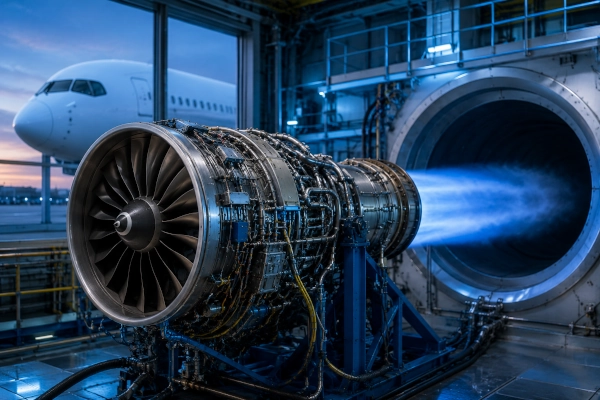
Tata Consultancy Services (TCS) and Rolls-Royce have achieved a major breakthrough in hydrogen-powered aviation by successfully operating a modern aero gas turbine through a simulated full flight cycle using 100 per cent hydrogen fuel.
The demonstration covered key phases of flight, including take-off, cruise and landing. It marks one of the clearest demonstrations yet that hydrogen can be used to power a modern aircraft gas turbine across varying operating conditions.
The milestone forms part of a four-year hydrogen propulsion programme first announced by Rolls-Royce and easyJet in 2022. TCS joined the initiative in 2024 as an engineering and technology partner.
Full Flight Cycle Demonstrated on Hydrogen
During the latest test programme, engineers operated a modified aero engine using only hydrogen as its fuel source.
The trials validated several critical systems needed for hydrogen propulsion, including combustion technology, fuel delivery, engine controls and system integration.
Unlike conventional aviation fuel, hydrogen does not produce carbon dioxide during combustion. However, using it in aircraft engines requires major changes in fuel handling, combustion design and control systems because of its different physical and chemical characteristics.
The successful test therefore represents an important engineering step towards understanding how hydrogen-powered engines could perform under realistic flight conditions.
TCS Supports Engineering, Testing and Validation
TCS played a significant role in the development and validation programme.
Its engineering teams supported Rolls-Royce in areas such as hydrogen combustion analysis, fuel-system integration, engine-control development, test preparation, data analytics, risk management and detailed design.
The company also contributed to the validation of systems needed to ensure stable engine operation throughout different phases of the simulated flight cycle.
According to TCS, the programme demonstrates how digital engineering, software expertise and advanced aerospace development can be combined to accelerate new propulsion technologies.
Rolls-Royce Sees Wider Potential for Future Engines
Rolls-Royce said the trials have provided valuable information about the behaviour of hydrogen in a modern gas turbine.
The company expects the data generated through the programme to support future propulsion development, including technologies linked to its UltraFan engine programme.
Rolls-Royce has been exploring several pathways to reduce aviation emissions, including advanced gas turbines, sustainable aviation fuels and hydrogen propulsion.
The latest demonstration strengthens the case for retaining gas turbine technology as part of the aviation industry’s transition towards lower-emission flight.
Hydrogen Could Help Cut Aviation Emissions
Commercial aviation currently contributes an estimated 2 to 3 per cent of global carbon dioxide emissions.
Hydrogen propulsion is being studied as one possible solution for reducing aviation’s dependence on fossil fuels. When used directly in an engine, hydrogen combustion eliminates carbon dioxide emissions from the fuel itself during flight.
However, significant challenges remain before hydrogen-powered commercial aviation can become widespread.
Aircraft will require specially designed fuel storage systems because liquid hydrogen must be maintained at extremely low temperatures. Airports will also need new production, storage and refuelling infrastructure.
The climate benefits will further depend on how the hydrogen is produced. Hydrogen generated using low-carbon or renewable energy would offer much greater environmental benefits than hydrogen produced from fossil fuels without carbon capture.
International Collaboration Behind the Programme
The demonstration involved expertise from several organisations across the aviation sector.
Alongside Rolls-Royce, TCS and easyJet, the programme involved cooperation with organisations including NASA, the UK Health and Safety Executive and other industry partners.
Such collaboration is important because hydrogen aviation involves more than engine development. It requires new safety standards, fuel systems, materials, infrastructure and certification processes.
The latest test provides engineers with real-world data that can guide the development of these technologies.
A Step Closer to Hydrogen-Powered Flight
The successful full-cycle demonstration does not mean hydrogen-powered passenger aircraft are ready for commercial service. However, it significantly strengthens the technical foundation needed for future development.
By demonstrating stable operation from take-off conditions through cruise and landing, the programme has moved hydrogen propulsion beyond individual component testing towards more complete engine-level validation.
TCS and Rolls-Royce plan to continue their collaboration on hydrogen-related technologies and other advanced propulsion systems.
The achievement highlights the growing role of Indian engineering expertise in global aerospace research while bringing the aviation industry another step closer to evaluating hydrogen as a practical fuel for future aircraft.
Source: Tata Consultancy Services press release, August 14, 2026.
You may also like
-
EON Space Labs and Dhruva Space Advance Indian Space Hardware on Transporter-18 Mission
-
SatLeo Labs’ TAPAS-1 Reaches Orbit, Advancing India’s Private Thermal-Imaging Capability
-
TakeMe2Space’s MOI-1A Reaches Space on Falcon 9 Transporter-18 Mission
-
Bank of Baroda Enters Pension Fund Management After PFRDA Appointment
-
SCI and India’s Push for a Larger Indigenous Maritime Fleet
