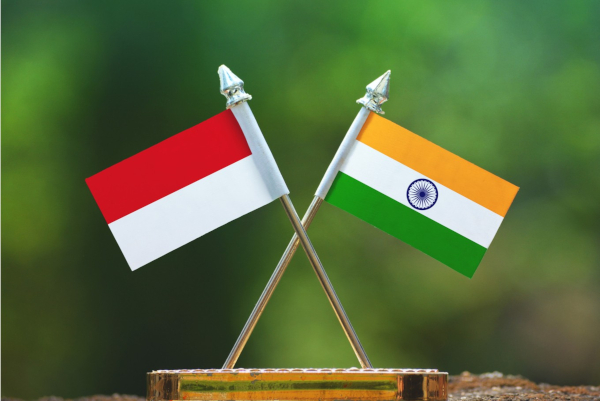
India and Indonesia are moving to deepen their financial and economic partnership, with the two countries discussing local-currency transactions, development of their financial sectors and cooperation in international financial services on the sidelines of the BRICS Finance Ministers and Central Bank Governors meeting in Jaipur.
Union Finance Minister Nirmala Sitharaman met Indonesia’s Vice Minister of Finance Juda Agung during the BRICS gathering on Thursday. According to India’s Ministry of Finance, the discussions covered financial-sector development, stronger trade relations and greater institutional cooperation between the two major Indo-Pacific economies.
A significant part of the talks focused on local-currency transactions, an area that India and Indonesia have already identified as an important mechanism for expanding bilateral commerce while reducing transaction costs and dependence on third-country currencies.
India and Indonesia Advance Local-Currency Transactions
The Jaipur discussions build upon an initiative already being pursued by the Reserve Bank of India and Bank Indonesia.
During Prime Minister Narendra Modi’s state visit to Indonesia in July 2026, the two countries formally welcomed progress towards operationalising guidelines for Local Currency Transactions, or LCT, between the RBI and Bank Indonesia. The two governments said such arrangements could promote bilateral trade and investment while deepening financial integration between their economies.
A functioning LCT mechanism could allow eligible transactions between Indian and Indonesian companies to be settled more directly using the Indian rupee and Indonesian rupiah, rather than requiring conversion through another international currency.
Such arrangements can potentially reduce foreign-exchange conversion costs, simplify settlement and provide businesses with additional options for managing currency risk. They can become particularly significant as bilateral trade volumes increase.
The latest finance-level discussions in Jaipur therefore indicate that local-currency cooperation is becoming part of a broader institutional economic relationship rather than remaining only a central-bank initiative.
Cooperation on International Financial Centres
Another important area discussed by Sitharaman and Juda Agung was cooperation in international financial services, including knowledge exchange on the establishment and operation of financial centres.
India has been developing the Gujarat International Finance Tec-City, or GIFT City, as an international financial services hub. Cooperation with Indonesia could provide opportunities for both sides to exchange regulatory and institutional experience in areas such as cross-border finance, banking, capital markets, fintech and international investment services.
The discussions suggest that India and Indonesia are looking beyond conventional trade promotion and towards creating stronger links between their financial ecosystems.
Such cooperation could become particularly relevant as both economies seek greater participation in Asian and global capital flows while developing domestic financial markets capable of supporting investment, infrastructure and industrial expansion.
Economic and Financial Dialogue Gains Importance
The two ministers also discussed strengthening the India-Indonesia Economic and Financial Dialogue, an institutional mechanism established specifically to expand cooperation between policymakers and financial regulators.
India and Indonesia launched the Economic and Financial Dialogue in 2023 on the sidelines of the G20 Finance Ministers and Central Bank Governors meeting in Gujarat. The mechanism was designed to facilitate cooperation on bilateral and international economic issues, investment, global economic developments and financial-sector matters.
Its importance has increased as the economic relationship between the two countries has expanded into areas including digital commerce, manufacturing, critical minerals, supply chains and financial connectivity.
During Prime Minister Modi’s July 2026 visit, India and Indonesia agreed to make greater use of bilateral economic mechanisms, including the Economic and Financial Dialogue, to address trade and investment issues and advance cooperation in finance, digital economy, industry and supply chains.
Modi’s Indonesia Visit Provides Fresh Momentum
Sitharaman described Prime Minister Modi’s recent visit to Indonesia as having taken the India-Indonesia Comprehensive Strategic Partnership into a new phase of engagement.
The July summit significantly expanded the economic agenda between the two countries. Apart from local-currency transactions, the two sides discussed stronger cooperation in critical minerals, rare earths, steel supply chains, digital commerce and financial architecture.
The visit also saw Indonesia reaffirm its support for India’s 2026 BRICS Chairship, while both countries agreed to increase engagement through BRICS, the G20 and the Indian Ocean Rim Association.
That wider strategic framework gives the Jaipur finance discussions additional significance. India and Indonesia are two large, fast-growing Indo-Pacific economies with substantial domestic markets, expanding manufacturing ambitions and an increasing interest in strengthening economic ties across the Global South.
From Trade Partnership to Financial Integration
The emerging India-Indonesia economic relationship increasingly extends beyond the movement of goods.
Trade remains an important foundation, but the focus is gradually broadening towards payment mechanisms, financial-market cooperation, investment flows, digital connectivity and institutional links between the two financial systems.
Local-currency transactions could become an important element of this transformation. If their use expands, Indian and Indonesian companies could gain another settlement option for bilateral trade and investment. At the same time, cooperation involving financial centres could encourage closer links between financial institutions and investors in the two countries.
The Jaipur meeting therefore represents another step towards converting the India-Indonesia strategic partnership into a deeper economic architecture.
For New Delhi, stronger financial links with Jakarta also complement India’s wider effort to build more resilient commercial and financial relationships across Southeast Asia. For Indonesia, closer engagement with India provides greater access to one of the world’s largest and fastest-growing major economies.
As the two governments move towards operationalising local-currency transactions and strengthening the Economic and Financial Dialogue, India-Indonesia ties appear to be evolving from a primarily trade-driven relationship towards broader financial and economic integration.
References
Ministry of Finance, Government of India: Official communication on the meeting between Finance Minister Nirmala Sitharaman and Indonesian Vice Minister of Finance Juda Agung, August 13, 2026.
Press Information Bureau – India-Indonesia Joint Statement, July 2026: Confirms progress towards operationalising RBI–Bank Indonesia guidelines on Local Currency Transactions and states that the arrangement is intended to promote trade, investment and financial integration.
Press Information Bureau – India-Indonesia Economic and Financial Dialogue: Official government release announcing the establishment of the bilateral Economic and Financial Dialogue and outlining cooperation in economic, investment and financial matters.
You may also like
-
PM-MKSSY Targets 1.70 Lakh Jobs as Government Strengthens India’s Fisheries Value Chain
-
India Retrieves 662 Antiquities from Four Countries, US Accounts for 589 Returns
-
India Expands Youth Development Push Across Education, Skills, Jobs, Sports and Health
-
75% of Rural Habitations Get Sujal Gaon IDs as Jal Jeevan Mission Expands Digital Water Governance
-
Over 5.63 Lakh Indian Villages Now Covered by Liquid Waste Management Under SBM(G) Phase II
