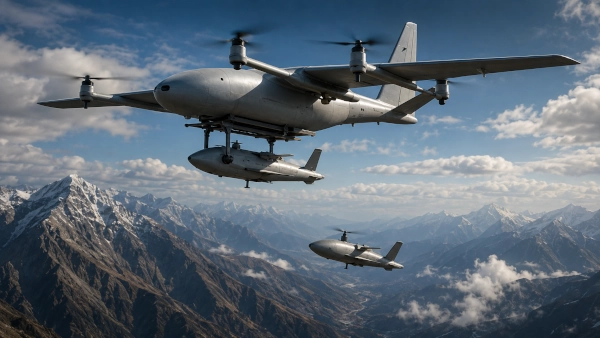
India’s unmanned warfare ecosystem is beginning to move beyond the conventional idea of a drone as a single aircraft performing a single mission.
Indian drone manufacturer ideaForge Technology has developed and flight-demonstrated Project ALE — Air-Launched Effects — an indigenous capability in which one unmanned aerial vehicle carries another UAV into the air, positions it near its intended operating area and releases it in flight.
The deployed aircraft can subsequently continue its mission independently.
ideaForge describes Project ALE as an exploration of “UAV-to-UAV aerial deployment”, designed to extend a mission beyond what a single unmanned platform could accomplish on its own. The company has confirmed that the concept has already been developed and flight-demonstrated, although it remains an experimental technology rather than an operationally deployed weapon system.
At first glance, the demonstration may appear to be simply a drone carrying another drone.
Its military implications, however, are considerably larger.
Project ALE points towards an emerging battlespace architecture in which a larger unmanned aircraft operates as an airborne mothership, carrying smaller specialised autonomous systems towards the battlefield before deploying them closer to their targets.
Instead of forcing every small UAV to expend its own limited battery or fuel simply reaching the battlefield, the carrier performs part of the journey.
The smaller aircraft begins its independent mission only after being released.
That can fundamentally change the operational radius of small unmanned systems.
Taking the Launchpad Into the Sky
Traditional tactical UAV operations generally begin from a ground position.
A drone is assembled or prepared, launched and then spends a portion of its endurance travelling towards the area where it is actually needed.
For small electrically powered UAVs, every kilometre travelled in transit consumes energy that could otherwise have been used for reconnaissance, target observation or other operations.
Project ALE changes this equation.
The launch point itself becomes mobile.
A larger carrier UAV can potentially transport a smaller aircraft across difficult terrain, mountains, rivers or defended areas before releasing it at altitude.
The deployed UAV therefore begins its independent flight considerably closer to the objective.
The result could be greater effective range without necessarily requiring a dramatic increase in the battery size, propulsion system or physical dimensions of the smaller drone.
ideaForge itself says the concept is intended to allow missions to extend beyond the reach of an individual platform.
This is why air-launched effects are becoming increasingly relevant to modern warfare.
The important capability is not merely the aircraft.
It is the ability to project autonomous systems forward from another autonomous system.
The Mothership-Effector Model
The architecture potentially separates the battlefield mission into two elements.
The first is the carrier or mothership UAV.
Its job is to provide range, altitude, transportation, communications and potentially battlefield awareness.
The second is the air-launched effect.
That aircraft can be smaller, cheaper and optimised for one particular mission.
Depending upon future payloads and configurations, such systems could conceivably be used for reconnaissance, electronic surveillance, communications relay, decoy operations, target designation or other specialised missions.
Those are potential applications of the architecture rather than capabilities that ideaForge has specifically announced for Project ALE.
That distinction is important.
Project ALE remains an experimental programme.
ideaForge explicitly cautions that the capability is under active development and should not be interpreted as a finalised product, feature or operational deployment.
But the technological direction is unmistakable.
The company is exploring how multiple autonomous aircraft can cooperate rather than treating every UAV as an isolated platform.
A Smaller Drone Can Become Much More Dangerous When It Does Not Have to Fly From Home
Consider a hypothetical battlefield.
A small reconnaissance UAV may have enough endurance to conduct useful surveillance over an enemy position, but the position lies tens of kilometres from the friendly launch site.
A significant percentage of the aircraft’s battery would therefore be consumed simply reaching the target and returning.
Now place the same aircraft beneath a larger carrier UAV.
The carrier transports it most of the way.
The smaller aircraft separates near the objective with most of its energy reserve still available.
It can spend more time searching, observing or performing its specialised mission.
The mother aircraft need not necessarily expose itself directly over the target.
It could release the smaller platform at stand-off distance.
This creates another advantage.
Risk becomes distributed.
An expensive surveillance UAV does not necessarily need to enter every dangerous pocket of airspace itself.
Smaller expendable or attritable aircraft could eventually be sent forward instead.
That distinction is becoming increasingly important as battlefield airspace fills with electronic warfare systems, air-defence weapons, counter-UAV equipment and hostile drones.
Electronic Warfare Could Make the Concept Even More Important
Modern drone warfare increasingly revolves around the electromagnetic spectrum.
GNSS jamming can deny satellite navigation.
Spoofing can feed an aircraft false positioning information.
Communication jamming can break the link between the operator and the UAV.
The ability to deploy several autonomous systems therefore becomes considerably more useful when combined with resilient navigation and communications.
And this is where the wider direction of ideaForge’s research becomes particularly interesting.
In its FY2025-26 investor presentation, the company listed several technologies being developed or demonstrated by ideaForge Labs.
Among them were:
- Operations in electronic-warfare environments
- Swarming and multi-UAV flight
- Air-Launched Effects
- Grenade dropping
- Take-off and landing from moving seaborne platforms
- ZOLT ready for flight
The fact that multi-UAV flight, EW operations and air-launched effects appear together is significant.
It suggests an R&D trajectory moving progressively from individual remotely operated UAVs towards networked, resilient and increasingly autonomous unmanned formations.
From One Drone to a Network of Drones
This is ultimately where Project ALE becomes strategically interesting.
Imagine a future system in which one carrier UAV does not transport only one secondary aircraft.
Instead it carries several specialised unmanned systems.
One could perform reconnaissance.
Another could establish a communications relay.
Another could investigate an area where satellite navigation is being jammed.
Others could potentially act as decoys or carry specialised mission payloads.
Multiple carrier aircraft could in turn deploy multiple smaller systems.
The resulting force would no longer behave like a conventional drone flight.
It would resemble a distributed aerial network.
The loss of one small vehicle would not necessarily destroy the entire mission.
Information could potentially be shared between platforms, allowing the formation to observe a much larger area than one aircraft could cover.
The battlefield then changes from:
one pilot — one UAV — one sensor
to:
multiple autonomous platforms — multiple sensors — one connected mission.
Project ALE should therefore be viewed less as a new drone and more as experimentation with a new method of employing drones.
Where Does ZOLT Fit Into This?
ideaForge’s development of Project ALE is occurring alongside another major programme — the ZOLT tactical UAV.
ZOLT is considerably larger and more capable than many of ideaForge’s existing small UAV systems.
According to the Department of Defence Production, Ministry of Defence, the aircraft offers an operational range of 50 km, flight endurance of up to 180 minutes and payload capacity of 10 kg.
It is designed to operate from launch locations above 14,700 feet or approximately 4,500 metres above mean sea level, making the platform particularly relevant to India’s mountainous frontiers.
The UAV supports electro-optical, thermal, dual-sensor, mapping and LiDAR payloads.
More importantly for military operations, the government product listing states that ZOLT incorporates resilience against GNSS jamming and spoofing as well as communication jamming and interception, along with autonomous navigation, terrain avoidance and waypoint operations.
These characteristics make ZOLT representative of the type of larger tactical UAV architecture that could eventually complement technologies such as air-launched effects.
However, an important qualification must be maintained.
ideaForge has not publicly confirmed that ZOLT was the carrier UAV used to conduct the Project ALE demonstration.
Indeed, the company’s investor presentation lists “ZOLT Ready for Flight” and “Air-Launched Effects” separately.
Therefore, until ideaForge explicitly confirms integration, it would be inaccurate to state that ZOLT itself launched the secondary UAV.
What can be said is that ZOLT and Project ALE represent complementary elements in ideaForge’s rapidly expanding tactical-UAV technology portfolio.
ZOLT Has Already Attracted the Indian Army
Unlike Project ALE, which remains experimental, ZOLT has already moved towards military procurement.
ideaForge confirmed in January 2026 that it had secured approximately ₹100 crore worth of Indian Army orders covering its next-generation ZOLT and SWITCH V2 tactical UAVs equipped with electronic-warfare resilience capabilities.
The company’s FY26 investor presentation subsequently described ZOLT as ready for flight, alongside its experimental work on swarming, electronic warfare and air-launched systems.
This creates an important technological progression.
ideaForge is no longer confined to building conventional battlefield surveillance quadcopters.
It is developing:
longer-endurance tactical UAVs,
EW-resistant navigation,
multi-UAV operations,
maritime UAV operations,
and now,
airborne deployment of one unmanned aircraft from another.
Taken together, these technologies begin forming the building blocks of a much more sophisticated unmanned combat ecosystem.
Particularly Relevant to India’s Northern Borders
Air-launched UAVs could eventually have particular relevance to India because of geography.
The Himalayan frontier imposes severe restrictions on conventional UAV operations.
Mountain ridges obstruct communications.
Valleys create difficult flight paths.
High altitude reduces aircraft performance.
Suitable launch and recovery areas can be limited.
Distances between military positions can be substantial.
An airborne carrier can potentially overcome some of those limitations by transporting smaller UAVs to altitude and releasing them closer to isolated valleys, mountain passes or surveillance areas.
ZOLT’s stated ability to launch from locations exceeding 14,700 feet demonstrates that high-altitude operations are already an important part of ideaForge’s design philosophy.
Combining high-altitude tactical UAVs with future air-launched autonomous systems could consequently offer the Indian Armed Forces interesting options along both the Line of Actual Control and other mountainous frontiers.
A Response to the Drone-Saturated Battlefield
Recent conflicts have demonstrated that UAVs are no longer peripheral equipment.
They have become integral to reconnaissance, artillery correction, communications, electronic warfare, precision attack and tactical situational awareness.
But the next technological competition will not simply be about who possesses more drones.
It will be about who can make drones cooperate most effectively.
Individual UAVs have limitations.
Networks of UAVs can compensate for them.
A carrier can provide range.
A smaller aircraft can provide access.
A relay drone can provide communications.
Another platform can provide sensing.
Software can connect them.
Electronic-warfare resilience can keep the network functioning when satellite navigation and radio links are attacked.
Project ALE represents an early Indian step towards precisely this kind of distributed unmanned architecture.
The Bigger Story Is Indigenous Systems Engineering
There is also a strategic industrial dimension.
Air-launched effects require considerably more than physically attaching one UAV beneath another.
The carrier aircraft must remain aerodynamically stable with the additional load.
The release mechanism must function safely in flight.
The two systems must separate without collision.
Navigation systems have to transition correctly.
Communications must remain reliable.
Flight-control software must manage changing aircraft weight and aerodynamic characteristics before and after deployment.
Eventually, autonomous mission-management software would have to coordinate several aircraft simultaneously.
Mastering these technologies inside India creates knowledge extending well beyond Project ALE itself.
It contributes to indigenous capabilities in autonomy, flight controls, mission computers, secure communications, swarm algorithms, payload integration and unmanned systems engineering.
Those technologies can subsequently migrate into numerous military applications.
References
- ideaForge — Project ALE: Air-Launched Effects announcement and flight-demonstration statement.
- ideaForge Technology FY2025-26 Investor Presentation — Air-Launched Effects, Multi-UAV Flight, EW Operations and ZOLT development.
- Department of Defence Production, Ministry of Defence — ZOLT specifications and capabilities.
- ideaForge Technology — FY26 Q3 results and Indian Army ZOLT/SWITCH V2 orders.
You may also like
-
India Earmarks ₹1.39 Lakh Crore for Domestic Defence Procurement in 2026–27
-
India’s First Port-Based e-Methanol Plant at Kandla to Supply Green Fuel to Global Shipping
-
India’s Recent Oil and Gas Discoveries: New Finds, Offshore Frontiers and How Much Crude India Produces at Home
-
India’s Hidden Gold Mountain: How Households Came to Own an Estimated 31,000 Tonnes of Gold
-
India–Afghanistan Air Cargo Corridor Returns to Focus as Both Sides Push for Stronger Trade Connectivity
