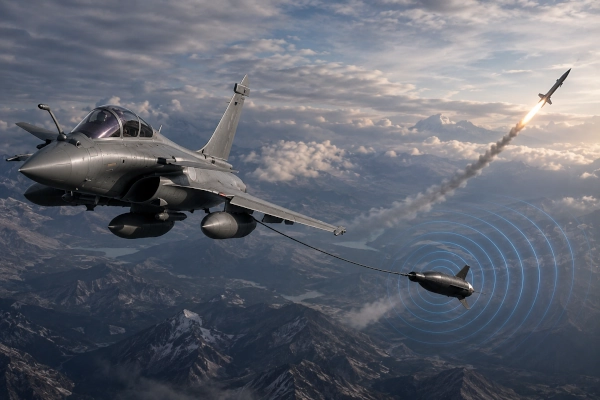
A modern fighter aircraft facing an incoming radar-guided missile has only seconds to survive. It may turn sharply, descend, release chaff or activate powerful electronic jammers, but advanced missile seekers are increasingly designed to resist these traditional countermeasures.
Another defensive concept places the electronic decoy outside the aircraft itself.
A compact device is released from a pod and towed hundreds of metres behind the fighter through a strong cable. Connected to the aircraft’s electronic-warfare system, the device transmits a carefully controlled radar response designed to appear more attractive to the missile than the aircraft towing it.
Instead of guiding towards the fighter, the missile’s seeker may transfer its tracking solution towards the decoy trailing behind it.
The aircraft continues flying. The missile passes towards the false electronic target and detonates at a safer distance.
One of the best-known systems using this principle is X-GUARD, a reusable fibre-optic towed decoy developed by Israel’s Rafael Advanced Defense Systems.
Rafael X-Guard
Rafael markets X-GUARD as a towed electronic decoy that can be adapted to fighter aircraft and integrated with their onboard electronic-warfare suites. The company does not publicly identify every fighter type on which the system is operational.
Official information about the Rafale describes its SPECTRA self-protection system as combining radar-warning, laser-warning and missile-warning receivers with electronic jamming and chaff-and-flare dispensers. Neither Dassault Aviation nor the SPECTRA developers publicly list X-GUARD as standard Rafale equipment.
Claims that Indian Rafales carry X-GUARD may refer to alleged Indian-specific enhancements, but no authoritative public confirmation has established that integration. The capability should therefore be discussed as technically possible rather than an officially verified feature of the Indian Rafale fleet.
Not Really a Drone
A towed decoy is sometimes loosely described as a drone, but it is not an independently flying unmanned aircraft.
It has no conventional pilot, propulsion system or autonomous flight path. It remains physically attached to the fighter and follows behind it like a highly sophisticated electronic lure.
The system normally consists of:
- An external pod mounted under the aircraft
- A deployable electronic decoy
- A reel and tow cable
- Fibre-optic communications
- Electrical power connections
- Integration with the aircraft’s electronic-warfare system
When the aircraft approaches a threatened region—or when its warning sensors detect an imminent attack—the decoy is released from the pod.
The towing mechanism allows it to remain behind the aircraft while continuing to exchange information with the fighter. After the danger has passed, a reusable system can be reeled back into the pod instead of being abandoned.
Rafael states that X-GUARD maintains fibre-optic and electrical connectivity during flight and can be deployed or recovered through an automatic reel mechanism. The company describes it as reusable and compatible with fighter manoeuvring across a broad operational envelope.
Why the Missile Sees the Decoy
Radar-guided missiles do not physically “see” an aircraft in the same way that the human eye does.
Their seekers examine reflected or transmitted radio-frequency energy and use that information to calculate the target’s direction, distance, speed and predicted future position.
A fighter aircraft naturally reflects radar energy. Its shape, materials, external weapons and viewing angle determine the strength and character of the return.
The towed decoy produces an additional electronic signal.
When coordinated with the aircraft’s electronic-warfare suite, it can reproduce, amplify or manipulate the radar energy received from the attacking system. The objective is to create a false target that appears more attractive or more reliable than the real aircraft.
The missile may consequently interpret the decoy as the centre of the target it has been ordered to destroy.
This process does not necessarily require the decoy to reproduce every physical characteristic of the fighter. It needs to provide enough convincing information to disrupt the seeker’s tracking logic and pull its calculated aim point away from the aircraft.
Creating a More Attractive Target
A simple jammer broadcasts electromagnetic energy to interfere with radar reception.
A sophisticated towed decoy can do something more deceptive: it can influence the radar or missile seeker into tracking the wrong point in space.
Modern digital radio-frequency technology can receive an incoming waveform, analyse it and transmit a modified response. The returning signal can be adjusted to alter the seeker’s perception of range, angle, velocity or signal strength.
The decoy may therefore appear:
- Closer to the seeker’s expected aim point
- Larger or more reflective than the aircraft
- More stable than the aircraft during manoeuvres
- Better aligned with the seeker’s tracking gate
- More attractive to a missile operating in home-on-jam mode
Once the seeker begins favouring the towed target, the physical separation between the aircraft and decoy becomes critical.
An onboard jammer remains inside the aircraft. A missile successfully following that transmission would still be heading towards the fighter.
A towed jammer places the transmitting source behind the aircraft. Even when the missile homes directly on the electronic emission, it is being drawn towards a separate object.
Why Physical Separation Matters
The tow cable creates distance between the fighter and the false target.
Should the missile strike or pass close to the decoy, its warhead detonates behind the aircraft rather than beside its engines, fuel tanks, cockpit or weapons.
The decoy does not need to survive the engagement to protect the fighter. Even a damaged or destroyed decoy is far less costly than the loss of a combat aircraft and its pilot.
This becomes particularly valuable against missiles with proximity fuzes. Such weapons do not always require a direct impact. They can detonate when they calculate that they are sufficiently close to the target and project fragments through its structure.
By shifting that closest point of approach rearwards, a towed decoy can place the explosion outside the missile’s most lethal distance from the aircraft.
Countering Advanced Tracking Radars
Rafael says X-GUARD is intended to defeat sophisticated tracking systems, including monopulse radars and other advanced radar types. It employs a high-effective-radiated-power solid-state antenna array and operates in coordination with the aircraft’s electronic-warfare equipment.
Monopulse radar technology can determine a target’s angle from a single radar pulse and is generally more resistant to older forms of electronic deception.
This resistance created the need for improved countermeasures capable of producing coherent and accurately controlled responses.
A modern towed decoy is not merely releasing metallic strips into the air. It is participating in an electronic contest with the attacking seeker, continuously adapting its transmitted response as the geometry of the engagement changes.
Against Air-to-Air and Surface-to-Air Missiles
X-GUARD is promoted for protection against radar-guided air-to-air and surface-to-air missiles. It may be deployed before entering a dangerous area or released after the aircraft detects an imminent threat.
An air-to-air missile may be launched by an enemy fighter from beyond visual range. A surface-to-air missile may rise from a mobile battery, naval vessel or fixed air-defence installation.
Although their launch platforms differ, both may use radar information during part of the engagement.
Some weapons receive guidance updates from the launching platform before activating their own radar seekers. Others rely on reflected energy from a ground or airborne illuminator. The most advanced systems may combine inertial navigation, datalinks and active terminal guidance.
A towed decoy must therefore operate as part of a wider defensive sequence rather than as an isolated device.
The aircraft first has to recognise and classify the threat. Its self-protection system then selects an appropriate combination of jamming, manoeuvring, chaff and external decoying.
It Does Not Defeat Every Seeker
A radio-frequency towed decoy is primarily intended for radar-guided threats.
It would not automatically deceive a missile using an imaging-infrared seeker, which tracks heat and visual characteristics rather than radar energy.
Infrared-guided weapons are normally countered with other methods, including:
- Flares
- Directed infrared countermeasures
- Reduced engine signatures
- Missile-warning sensors
- Defensive manoeuvres
The Rafale’s SPECTRA system reflects this layered approach. It incorporates radar, laser and missile warning with electronic jamming and dispensers for electromagnetic and infrared decoys. Its DDM-NG missile-warning component uses imaging-infrared technology to detect approaching threats around much of the aircraft.
An aircraft facing a modern mixed-seeker environment therefore needs several types of protection. No single decoy can defeat every missile under every condition.
X-GUARD’s Published Performance Envelope
Rafael’s public brochure lists the combined X-GUARD pod and decoy at approximately 65 kilograms.
The company states that the system is designed for deployment at altitudes of up to 50,000 feet, speeds of up to Mach 1.6 and accelerations reaching 7g. These are manufacturer-stated figures rather than independently verified operational results.
Such an envelope is important because a fighter cannot afford to become slow or predictable whenever its decoy is released.
The protective system must remain stable while the aircraft turns, accelerates or changes altitude. It must also prevent the cable from striking the aircraft, becoming entangled with weapons or breaking under aerodynamic load.
The tow body needs to remain sufficiently steady for its electronic response to be useful while surviving intense vibration, temperature changes and airflow.
Fibre Optics Connect the Decoy to the Fighter
The fibre-optic link gives the external device a high-speed connection to the aircraft’s electronic-warfare suite.
Onboard receivers can detect and analyse the hostile radar transmission. The defensive computer can then command the decoy to generate a suitable response.
Fibre optics offer high data capacity and resistance to electromagnetic interference. Because the connection is physical, the aircraft can communicate with the decoy without relying entirely on a radio datalink that might itself be jammed or detected.
Electrical conductors can also provide power to the decoy, allowing it to operate a stronger transmitter than would be possible using a small internal battery alone.
The arrangement turns the towed object into a remote extension of the aircraft’s electronic-warfare architecture.
The fighter performs the sensing, classification and tactical decision-making. The decoy places the active transmission at a safer location behind it.
How It Could Work With an Integrated Suite
A platform equipped with a system like SPECTRA already has many of the components needed to support sophisticated electronic self-protection.
SPECTRA detects electromagnetic, infrared and laser threats, identifies their nature and helps locate their sources. It can then recommend or automatically coordinate jamming, decoys and evasive manoeuvres.
In principle, integrating a fibre-optic towed decoy would add another external countermeasure to this defensive architecture.
The aircraft’s sensors would detect the hostile radar or missile. Its threat library would identify the system and select a response. The towed decoy would then transmit from behind the aircraft while the pilot manoeuvred to widen the separation between the real and false targets.
However, such integration is not simply a matter of attaching a pod.
It would require:
- Aircraft-carriage and separation trials
- Flight-envelope certification
- Software integration
- Electromagnetic compatibility testing
- Threat-library development
- Cockpit-interface changes
- Validation against representative missile seekers
- Approval from the aircraft manufacturer and operating air force
This is why compatibility with fighter aircraft generally does not prove compatibility with every fighter model.
Chaff Versus a Towed Decoy
Chaff consists of numerous small radar-reflective fibres or strips released into the air.
These create a cloud of radar returns intended to confuse tracking systems or offer the missile an alternative target. Chaff is lightweight, relatively inexpensive and can be dispensed rapidly.
Its limitations are that the cloud disperses, slows down and becomes separated from the aircraft’s flight characteristics. Advanced radars may distinguish it from a manoeuvring fighter.
A towed decoy remains attached to the aircraft and travels with it. Its position, movement and transmitted signals can remain coordinated with the fighter throughout the engagement.
Chaff is expendable. A reusable towed decoy can potentially remain deployed through a threat zone and then be recovered.
The two systems are complementary rather than mutually exclusive. An aircraft may employ electronic jamming, chaff and a towed decoy in sequence or together.
Protecting an Extremely Valuable Platform
The financial calculation strongly favours such protection.
A modern fighter represents an investment of many millions of dollars, while the training and operational experience of its pilot may be even harder to replace.
An external decoy need only prevent a small number of aircraft losses to justify its procurement and integration cost.
The concept is especially attractive during deep-penetration missions against an opponent equipped with long-range surface-to-air missiles and modern fighter aircraft.
The towed decoy allows the fighter to retain its weapons and mission equipment while adding another layer between the missile and the aircraft.
It also creates uncertainty for the attacker. A missile may appear to have maintained a strong lock, yet its seeker may be following an electronic target positioned behind the intended aircraft.
A Continuing Contest Between Seeker and Countermeasure
Towed decoys do not make aircraft invulnerable.
Missile designers study electronic countermeasures and develop seeker logic intended to identify false signals. They may use improved spatial resolution, multiple radar frequencies, inertial comparison, home-on-jam modes or data from other sensors.
Defensive-system designers then develop more realistic decoys, better signal processing and coordinated responses.
The result is a continuing contest.
A successful decoy must not simply be powerful. It must produce a believable response at the correct moment, from the correct position and with characteristics that the missile accepts as genuine.
The missile, meanwhile, must determine whether the most attractive signal belongs to the aircraft or to a device specifically designed to exploit its tracking logic.
An Electronic Target That Saves the Real Aircraft
The central idea behind a towed decoy is simple even though its technology is highly complex.
The missile is offered two targets.
One is a fighter carrying a pilot, fuel, sensors and expensive weapons.
The other is a small electronic device trailing behind it.
The defensive system tries to persuade the missile that the small device is the target it has been seeking all along.
Should the deception succeed, the missile spends its speed, energy and warhead chasing an electronic body double while the real aircraft escapes.
In the modern air battle, survival may depend not merely on becoming invisible, but on ensuring that the enemy’s most advanced weapon sees exactly what the defender wants it to see.
You may also like
-
DRDO Moves 30 kW Laser Weapon Towards Production, Industry Partner Selection Planned Within Six Months
-
IG Defence Validates KAL Long-Range Strike Drone’s Integrated Systems in Pokhran Trial
-
Vajra Air Defence Warriors Validate AKASHTEER Sensor-to-Shooter Network in Day-Night Firing Drills
-
INS Sahyadri and INS Kulish Reach Philippines for ADMM-Plus Maritime Cooperation
-
India’s Defence Production Hits Record ₹1.78 Lakh Crore as Private-Sector Share Rises to 24%
