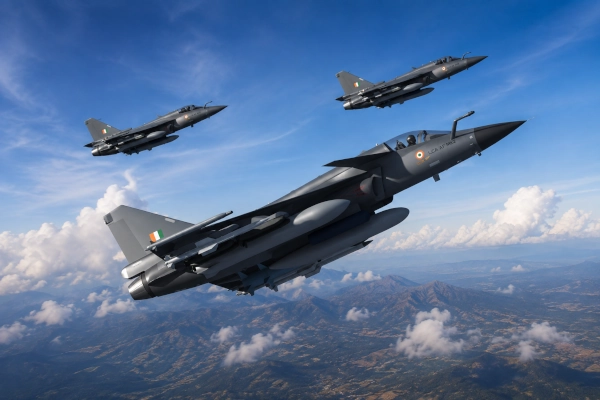
India’s indigenous combat-aircraft programme is preparing for a major new milestone, with the first prototype of the Tejas Mk2 expected to roll out by March 2027.
Hindustan Aeronautics Limited Chairman and Managing Director Ravi Kota confirmed during the company’s Q4 FY 2025–26 earnings call that structural assembly of the aircraft was underway. HAL expects the prototype to emerge from the assembly line during the final quarter of the 2026–27 financial year, with March identified as the current target.
The rollout will mark the first public emergence of India’s new Medium Weight Fighter in its assembled aircraft form. It will also signal the programme’s transition from component manufacturing and structural integration to an intensive phase of ground evaluations, system checks, engine testing and preparation for flight trials.
The milestone should not be confused with the aircraft’s maiden flight. A rollout confirms that the prototype has reached a sufficiently complete configuration to begin integrated testing; the aircraft must subsequently pass several technical and safety assessments before it can be cleared to fly.
Structural Assembly Underway
HAL has confirmed that assembly of the Tejas Mk2 structures is progressing in coordination with the Aeronautical Development Agency.
Major aircraft sections must be manufactured separately before being joined through specialised assembly fixtures. The integration process involves the fuselage, wings, canards, landing gear, flight-control equipment, electrical systems, hydraulic lines, fuel systems and cockpit assemblies.
Once the airframe is structurally complete, engineers can begin checking whether the aircraft’s individual subsystems operate correctly as an integrated platform.
HAL described the Mk2 as a joint programme requiring coordination with the design agency and indicated that some technical matters must be resolved during the ongoing integration process. The March 2027 schedule should therefore be treated as a development target rather than an unconditional ceremonial date.
More Than a Larger Tejas
Although it carries the Tejas name, the Mk2 is substantially more ambitious than a routine upgrade of the Tejas Mk1 or Mk1A.
The aircraft has evolved into a medium-weight, multirole combat platform intended to offer greater range, endurance, weapon-carrying capacity and sensor capability. Its enlarged airframe and canard foreplanes distinguish it visually from the smaller Tejas variants.
The Mk2 is being developed to undertake a broad range of missions, including:
- Air-defence and interception
- Beyond-visual-range air combat
- Precision attacks against ground targets
- Maritime strike missions
- Suppression of hostile air defences
- Battlefield interdiction
- Reconnaissance and networked combat operations
The aircraft is expected to occupy the operational space between the lightweight Tejas Mk1A and heavier twin-engine fighters. This would give the Indian Air Force an indigenous platform capable of performing missions that require more fuel, weapons and endurance than a conventional light fighter can provide.
Aeronautical Development Agency Leads the Design
The Aeronautical Development Agency is responsible for managing the design and development of the Tejas family. HAL serves as its principal design partner and manufacturing agency.
This partnership combines ADA’s aircraft-design, systems-engineering and programme-management capabilities with HAL’s experience in prototype construction, aircraft integration, manufacturing and maintenance.
The arrangement follows the development model established for the original Tejas programme, which brought together the Indian Air Force, DRDO laboratories, HAL, certification agencies, research institutions, universities and private manufacturers.
The experience accumulated during the Tejas Mk1 and Mk1A programmes is expected to reduce some of the development risks associated with the Mk2. However, the larger aircraft, more powerful engine and advanced mission systems will still require an extensive new validation and flight-testing campaign.
Powered by the GE F414 Engine
One of the defining changes in the Tejas Mk2 is its more powerful General Electric F414 engine.
The lighter Tejas variants use the GE F404 engine. The F414 was selected for the Mk2 because the larger airframe, increased fuel capacity and heavier weapon load require substantially greater thrust.
More than ₹9,000 crore has been sanctioned for the development of the LCA Mk2. India has also pursued arrangements for manufacturing the F414 engine domestically through technology transfer involving HAL and GE Aerospace.
Domestic manufacture of the engine would have significance beyond the Tejas Mk2. The F414 family is also connected with other Indian combat-aircraft plans, making local production important for supply security, maintenance, life-cycle support and the development of India’s aero-engine manufacturing base.
The prototype aircraft will still require extensive engine-integration work. Engineers must validate air intake performance, engine controls, cooling, fuel supply, electrical generation and the interaction between the power plant and flight-control system across the aircraft’s intended operating envelope.
A New-Generation Digital Cockpit
The Tejas Mk2 cockpit is being designed around a high level of automation, integrated information display and reduced pilot workload.
A simulator publicly demonstrated by the development team showed a Large Area Display with a touch-enabled interface, a side-stick controller and fewer conventional switches than earlier fighters.
The cockpit concept also incorporates Hands-On Throttle and Stick controls, allowing the pilot to manage key functions without repeatedly moving their hands between different panels.
Sensor fusion is intended to combine information from radar, electronic-warfare equipment, navigation systems and other sensors into a unified tactical picture. Instead of examining separate displays, the pilot would receive prioritised information through a common interface.
The simulator also demonstrated simplified weapon selection and engagement functions intended for a new generation of precision weapons and networked combat operations.
Advanced Sensors and Electronic Warfare
The Tejas Mk2 is expected to carry a modern electronically scanned radar, an integrated electronic-warfare suite and advanced communication systems.
An Active Electronically Scanned Array radar can rapidly search and track several targets, support beyond-visual-range missile engagements and provide high-resolution mapping for ground-attack missions.
The electronic-warfare system will be responsible for detecting hostile radar emissions, warning the pilot of threats and supporting countermeasures against radar-guided weapons.
The platform is also being designed for network-centric operations. Secure data links can allow the aircraft to exchange information with other fighters, airborne early-warning aircraft, ground stations and command centres.
Such connectivity is becoming increasingly important because modern air combat depends on the speed with which information can be detected, processed and shared across multiple platforms.
What Happens After the Rollout?
The rollout will begin rather than conclude the aircraft’s most demanding development phase.
Following structural completion, the prototype is expected to undergo progressive ground evaluations. These normally include electrical power-on checks, software validation, hydraulic-system testing, fuel-system assessments, flight-control verification and integration of cockpit displays and mission computers.
The F414 engine will then have to undergo ground runs at different power settings. Engineers will examine engine response, vibration, temperature, fuel delivery and the performance of associated systems.
The aircraft must also complete low-speed and high-speed taxi trials. These tests evaluate braking, steering, landing-gear behaviour and directional control while the fighter moves along the runway.
Data collected during ground testing will be examined by the development team and military airworthiness authorities before the prototype receives clearance for its maiden flight.
HAL has confirmed the rollout target, but an updated official date for the first flight has not yet been announced. The maiden-flight schedule will depend on the completion of assembly, subsystem integration, ground trials and certification requirements.
Flight Testing Will Be the Decisive Phase
Once airborne, the Tejas Mk2 will enter a multi-stage flight-development programme.
Initial sorties will generally concentrate on basic handling qualities, flight-control behaviour, landing-gear operation and engine performance. The aircraft’s speed, altitude, angle-of-attack and manoeuvring envelope can then be expanded gradually.
Later testing will evaluate radar performance, electronic warfare, air-to-air refuelling, external fuel tanks and different weapon configurations.
Missile, bomb and precision-weapon integration requires separate carriage, separation and firing trials. Each weapon must be tested to ensure that it leaves the aircraft safely and functions correctly within the specified launch conditions.
Software will also continue to evolve during the test programme as engineers analyse flight data and introduce improvements.
The aircraft can enter series production and operational service only after completing the required development, safety and certification stages.
Strategic Importance for the Indian Air Force
The Tejas Mk2 forms an important part of India’s long-term effort to modernise its fighter fleet while reducing dependence on imported combat aircraft.
The Indian Air Force requires a combination of light, medium and heavy fighters to conduct air defence, deep-strike, maritime and battlefield-support missions.
The Tejas Mk1A is intended to strengthen the lighter section of this fleet. The Tejas Mk2 would provide a more powerful indigenous platform in the medium-weight category, while the planned Advanced Medium Combat Aircraft will eventually introduce stealth and fifth-generation capabilities.
This layered approach is designed to create an indigenous fighter-aircraft family rather than depend on a single platform for every mission.
The Tejas programme has already established technologies and industrial capabilities in composite structures, digital flight controls, avionics, cockpit systems and aircraft integration. At an ADA seminar in January 2026, the Government stated that the Tejas programme had completed more than 5,600 successful flight trials, demonstrating the depth of experience now available to support future aircraft projects.
Opportunities for India’s Aerospace Industry
The Mk2 programme can also expand opportunities for Indian private companies, public-sector manufacturers, research organisations and micro, small and medium enterprises.
A modern fighter contains thousands of structural parts, electronic units, sensors, actuators, cables, pipes, fasteners and software components. Developing these through Indian suppliers can create long-term capabilities extending beyond one aircraft programme.
Manufacturers involved in the Mk2 may later contribute to the Advanced Medium Combat Aircraft, the Twin Engine Deck Based Fighter and other military or civil aviation projects.
Domestic production also improves access to spare parts and technical support throughout the aircraft’s service life. This can reduce dependence on overseas vendors and provide greater freedom to introduce upgrades according to Indian operational requirements.
A Critical Milestone, but Not the Finish Line
The planned March 2027 rollout will be one of the most visible achievements in India’s indigenous fighter-development effort.
It will show that the Tejas Mk2 has progressed from digital designs and individual components into an integrated aircraft prototype. At the same time, it will open a demanding period of ground and flight evaluation.
Programme schedules have changed previously, and the complexity of integrating a new engine, airframe, flight-control system, sensors and mission software means that further adjustments remain possible.
The significance of the rollout lies not merely in unveiling a new aircraft, but in demonstrating India’s ability to design and assemble an increasingly sophisticated combat platform.
Successful ground trials, a safe maiden flight and an efficient certification programme will determine how quickly the Tejas Mk2 can move from the development hangar to the Indian Air Force’s operational squadrons.
References
Hindustan Aeronautics Limited, Q4 FY 2025–26 Earnings Conference Call, May 15, 2026. HAL management confirmed that structural assembly of the Tejas Mk2 was underway and identified March 2027 as the targeted rollout period.
Press Information Bureau, Government of India. “Tejas-1 and Tejas Mk2 Aircrafts.” Ministry of Defence, December 2, 2019.
Press Information Bureau, Government of India. “Prime Minister Flies in the Indigenously Designed, Developed and Manufactured Twin-Seater Fighter Aircraft LCA Tejas.” Ministry of Defence, November 25, 2023.
Press Information Bureau, Government of India. “ADA’s Two-Day National Seminar ‘Aeronautics 2047’ Begins in Bengaluru.” Ministry of Defence, January 4, 2026.
The Economic Times. “Large Touch Screen, Side Joystick and Less Switches: Tejas Mk2 Simulator Provides First Detailed Look of India’s 4.5-Generation Fighter.” August 19, 2025.
You may also like
-
INS Sahyadri and INS Kulish Reach Philippines for ADMM-Plus Maritime Cooperation
-
India’s Defence Production Hits Record ₹1.78 Lakh Crore as Private-Sector Share Rises to 24%
-
Former DRDO Chief Samir Kamat Confirms Akash Missile Exports to Tajikistan and Turkmenistan
-
MoD Signs ₹586 Crore Contract for Indigenous Auxiliary Power Units for T-72 and T-90 Tanks
-
India–Mongolia Joint Military Exercise Nomadic Elephant 2026 Begins in Pithoragarh
