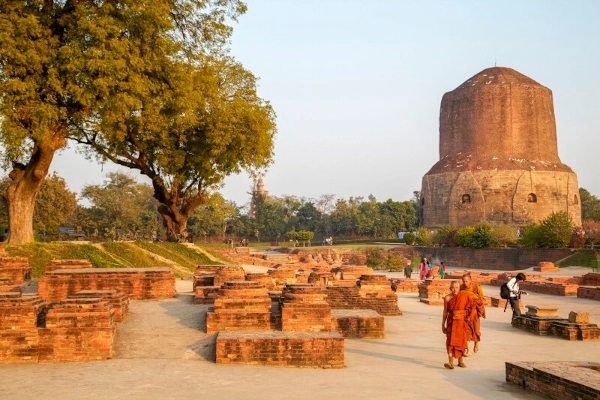
Sarnath, the sacred place where Gautama Buddha delivered his first sermon after attaining enlightenment, has been inscribed on the UNESCO World Heritage List. The decision was announced on July 25, 2026, during the 48th Session of the World Heritage Committee in Busan, Republic of Korea. The inscription raises India’s total number of World Heritage Sites to 45 and places one of Buddhism’s most important pilgrimage centres among the cultural treasures recognised as possessing Outstanding Universal Value.
The achievement comes more than 28 years after the Archaeological Survey of India submitted Sarnath to UNESCO’s Tentative List on July 3, 1998. The long journey from tentative recognition to full inscription involved archaeological documentation, conservation planning, preparation of the nomination dossier and evaluation of the site’s historical significance, authenticity and long-term protection arrangements.
Located near Varanasi in Uttar Pradesh, Sarnath occupies a foundational place in Buddhist history. According to Buddhist tradition, Gautama Buddha travelled to the ancient Deer Park after attaining enlightenment at Bodh Gaya. There, he met five former companions and delivered his first discourse, traditionally known as the Dharmachakra Pravartana or “Turning of the Wheel of Dharma.” The event marked the beginning of the public dissemination of Buddhist teachings and the formation of the earliest Buddhist Sangha.
Over the following centuries, Sarnath developed into an influential centre of pilgrimage, monastic education, philosophy and artistic activity. Rulers, monks, merchants and devotees supported the construction of stupas, temples, monasteries and commemorative structures. The surviving remains reflect several phases of Indian history, extending from the Mauryan period through the Kushana, Gupta and medieval eras. Sarnath eventually declined as a major institutional centre during the medieval period before its archaeological rediscovery and systematic excavation in modern times.
UNESCO has recognised Sarnath as a serial heritage property consisting of two principal archaeological zones. The first is the Chaukhandi Stupa, traditionally associated with the place where Buddha encountered his first five disciples. The second contains the main archaeological remains of Sarnath, including the monumental Dhamek Stupa, the remains of the Dharmarajika Stupa, monastic complexes, temples, votive stupas and the remains of the Ashokan pillar.
The Dhamek Stupa remains one of the most prominent structures at the site and is closely associated with the memory of Buddha’s first sermon. The archaeological complex also preserves evidence of successive monasteries and religious buildings constructed over many centuries, illustrating the continuing importance of Sarnath to Buddhist communities from India and abroad.
Sarnath also holds a unique place in the national identity of modern India. The celebrated Lion Capital discovered at the site once crowned an Ashokan pillar erected during the third century BCE. Its four lions were adopted as the State Emblem of India, while the Dharma Chakra represented on the capital became the Ashoka Chakra at the centre of the Indian national flag. The archaeological heritage of Sarnath therefore connects India’s ancient civilisational history with the symbols of the modern Republic.
With the new inscription, Sarnath becomes the fourth World Heritage Site in Uttar Pradesh. The state’s three earlier properties—the Taj Mahal, Agra Fort and Fatehpur Sikri—are located in the Agra region. Sarnath expands Uttar Pradesh’s UNESCO World Heritage presence into eastern Uttar Pradesh and gives formal global recognition to the state’s extensive Buddhist heritage.
The inscription is also expected to strengthen India’s Buddhist pilgrimage network, particularly the circuit connecting Sarnath with Bodh Gaya, Kushinagar, Shravasti, Sankisa and other places associated with the life and teachings of Buddha. Greater international visibility could encourage cultural tourism, academic research and longer pilgrimage journeys, while creating fresh responsibilities for conservation authorities and local administrators.
UNESCO World Heritage status requires sustained protection of the archaeological remains, careful management of surrounding development and preservation of the historical landscape. Visitor facilities, transport links and tourism infrastructure will have to be developed in a manner that respects the authenticity and spiritual character of the site. UNESCO has emphasised that safeguarding Sarnath’s stupas, temples and monasteries is a shared responsibility owed to present and future generations.
The recognition of Sarnath extends beyond the preservation of ancient monuments. It honours a place from which teachings centred on compassion, wisdom, ethical conduct and harmony travelled across Asia and eventually reached communities around the world. Nearly 2,500 years after Buddha’s first sermon, Sarnath continues to function as a living centre of pilgrimage and reflection. Its entry into the World Heritage List acknowledges both its importance to India’s civilisational story and its enduring contribution to the shared spiritual heritage of humanity.
Reference:
UNESCO — Ancient Buddhist Site of Sarnath Inscribed on UNESCO World Heritage List
https://www.unesco.org/en/articles/ancient-buddhist-site-sarnath-inscribed-unesco-world-heritage-list
UNESCO — World Heritage Committee 2026: Ancient Buddhist Site, Sarnath, Varanasi
https://www.unesco.org/en/world-heritage/committee-2026
UNESCO World Heritage Centre — Ancient Buddhist Site, Sarnath, Varanasi, Uttar Pradesh: Tentative List
https://whc.unesco.org/en/tentativelists/1096/
UNESCO World Heritage Centre — 48th Session of the World Heritage Committee
https://whc.unesco.org/en/sessions/48COM/
UNESCO World Heritage Centre — Sarnath Property Maps and Component Areas
https://whc.unesco.org/en/list/927/maps/
Press Information Bureau — UNESCO World Heritage Sites in India and Sarnath Nomination
https://www.pib.gov.in/PressReleasePage.aspx?PRID=2243788
You may also like
-
Rare Stone Features Emerge as Kerala Archaeology Department Restores Megalithic Kudakkals at Karivellur
-
Vidarbha in the Mahabharata: The Ancient Kingdom of Damayanti in Eastern Maharashtra
-
Abhira in the Mahabharata: The Pastoral People of Western India and the Northern Deccan
-
Nasikya in the Mahabharata World: The Ancient Nashik Region on the Upper Godavari
-
Bharukachchha in the Mahabharata: The Ancient Port of Bharuch at the Mouth of the Narmada
