Industrial robots are exceptionally precise when every movement, component and working condition has been defined in advance. A robotic arm can repeat the same welding path, lift an identical component or place a part into the same fixture thousands of times with remarkable speed and accuracy. Its performance becomes far less reliable when objects arrive in random positions, change shape, reflect light, overlap with other components or differ from the examples used during programming.
Bengaluru-based robotics company CynLr is working to overcome this limitation by developing what it calls Visual Object Intelligence—a combination of specialised vision hardware, perception software and robotic manipulation systems intended to help machines perceive, grasp, study, reorient and place unfamiliar objects. The company’s central idea is that robots should learn through physical interaction with objects rather than requiring engineers to build a separate recognition model, fixture and motion sequence for every product variant.
CynLr, short for Cybernetics Laboratory, was founded by Gokul N.A. and Nikhil Ramaswamy and operates from Bengaluru, with an international presence that includes Switzerland. The company describes itself as a Visual Object Intelligence platform for industrial robots and is pursuing a long-term vision in which manufacturing systems can adapt to changing products with far less reprogramming and mechanical reconfiguration.
Why Today’s Industrial Robots Struggle with the Unknown
Most conventional factory robots perform predefined movements within highly organised work cells. Components are delivered through feeders, trays, conveyors and mechanical fixtures that ensure each part appears at a known location and orientation. Cameras may verify the position, while the robotic arm follows a programmed path to pick up the component and place it elsewhere.
This approach works efficiently in high-volume production, where a factory manufactures the same item repeatedly. It becomes expensive and inflexible when production involves smaller batches, frequent design changes or several variants moving through the same line. A new component may require fresh camera calibration, specialised gripping fingers, a redesigned fixture, new robot trajectories and additional safety validation.
Objects also create complex visual challenges. A highly polished metal component may reflect its surroundings and appear different under changing illumination. Transparent glass or plastic can be difficult for ordinary cameras and depth sensors to reconstruct. Flexible packaging may change shape each time it is handled, while objects placed in a cluttered container may obscure one another.
Humans solve many of these problems almost instinctively. A person can look at an unfamiliar object, estimate where it can be held, lift it, rotate it for a better view and adjust the grip according to its weight and movement. CynLr aims to give industrial robots a comparable capacity to explore and understand objects through vision and physical interaction.
The company states that its system can enable robots to grasp objects without object-specific pre-training, learn their different appearances across orientations and make controlled placements needed for industrial tasks.
Visual Object Intelligence
CynLr distinguishes between simply capturing an image and developing an actionable understanding of an object. A camera may record colour and shape, while a robot performing a physical task also needs to determine where the object begins and ends, which surfaces can be gripped, how it is oriented, whether it may slip and how it should be moved into the required final position.
The company describes its technology as creating a richer visual-physics model by combining information about shape, colour, depth, motion, reflectivity and the physical effects observed during interaction. Its vision platform uses techniques that include optical convergence, liquid-lens systems, temporal imaging, hierarchical depth mapping and force-correlated visual mapping. According to CynLr, this integrated approach allows the system to perceive depth, colour and movement through the same visual platform rather than depending entirely on a collection of separately calibrated sensors.
CynLr compares the process with the way a child encounters a new object. A child may initially possess limited knowledge of the item, yet can reach towards it, grasp it, turn it and gradually learn its properties. The company’s robot similarly uses an initial visual estimate to make contact, observes how the object responds and builds a more useful representation through manipulation.
In practical terms, the robot may detect a previously unseen part in a cluttered environment, identify a possible grasping region, lift it and rotate it to expose previously hidden surfaces. It can then estimate the object’s complete structure and determine how to place or assemble it.
At the unveiling of its commercial-ready Object Intelligence platform in 2026, CynLr said robots using the system could begin adapting to unknown objects within approximately 10 to 15 seconds. This figure remains a company-reported performance claim, and independent results across different factories, object classes and operating conditions will be important for evaluating its broader reliability.
CLX: The Object-Intelligence Stack
At the centre of CynLr’s technology is its CLX platform, which brings together the visual system, computing hardware, perception software and manipulation intelligence required to guide robotic arms.
CLX is designed to examine an object as a combination of geometry, texture, colour, reflectance and possible grasping points. Rather than searching only for an exact match within a stored object library, the platform attempts to interpret the physical features relevant to manipulation.
This distinction is important. An ordinary object-recognition system may label an item as a bottle, bracket or gear. A robot must answer a different set of questions: where can it safely grip the object, which direction is it facing, how much force should be applied and how can it be moved into the orientation required for the next operation?
CynLr’s system is intended to combine perception and action. The robot observes the object, performs a movement, evaluates the result and updates its understanding. This action-based perception can be especially valuable when an object’s original position reveals only part of its geometry.
Reflective and transparent objects remain among the most difficult cases in robotic vision because their visible appearance depends heavily on lighting and surrounding surfaces. CynLr has demonstrated its technology with objects such as wrapped glass bottles, metallic components and irregular consumer items to show how the system responds to visual conditions that challenge traditional machine-vision methods.
CyRo: A Robot Built Around Object Intelligence
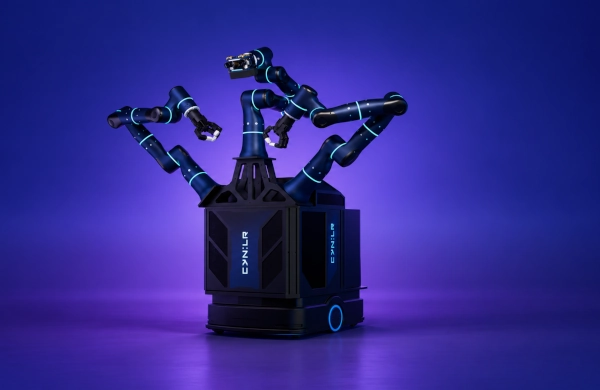
CynLr has demonstrated its technology through a robotic platform called CyRo. Rather than treating the robot merely as an arm that receives instructions from an external camera, CyRo is designed as an integrated physical-intelligence system capable of observing and manipulating unfamiliar objects in real time.
The robot has been presented with a human-like upper-body arrangement, including two visual units and robotic arms that allow it to observe an object from different perspectives. Its behaviour is intended to resemble an exploratory process: detect an object, identify a workable grasp, lift it, reposition it and learn how it should be handled.
During demonstrations, objects can be placed before the robot without a prearranged tray or dedicated fixture. CyRo then attempts to locate, grasp and move them based on its Object Intelligence platform. CynLr has showcased this capability at technology and industrial events, including the India AI Impact Summit 2026 and international demonstrations organised through Swissnex.
The important innovation lies less in the physical shape of the robot than in the perception architecture guiding it. Standard robotic arms from different manufacturers could potentially use CynLr’s intelligence stack, allowing the company to operate as a technology-platform provider alongside developing complete robotic systems.
Learning to Reorient Objects
Picking up an unfamiliar object represents only the first step in useful industrial automation. A robot assembling a machine must place each component at a precise angle and location. A randomly oriented part may therefore have to be turned, flipped or transferred between grippers before insertion.
CynLr’s system is designed to learn how an object’s appearance changes as it rotates. The same component may look rectangular from one direction, circular from another and irregular from an oblique angle. Rather than treating these views as unrelated objects, the robot attempts to connect them into a unified model.
Once the system has developed this representation, it can determine how to move the component from its initial orientation to the orientation needed for assembly or inspection. The robot may also reposition the object to obtain a clearer view before performing a precise operation.
This capability could help automate processes known as part mating, where two components must be aligned and joined. Examples include inserting connectors, positioning gears, placing electronic parts, loading machine tools and fitting automotive components.
CynLr’s broader objective is to allow a robot to convert an unknown situation into a known one. The machine first explores and reorients the object, then carries out the repeatable industrial operation once the necessary pose has been established.
Applications in Automotive Manufacturing
Automotive manufacturing is one of the clearest markets for adaptive object manipulation. Modern vehicles contain thousands of components supplied in multiple shapes, finishes and model variants. Many parts arrive in bins or containers and must be identified, oriented and loaded into assembly systems.
Traditional automation often requires specialised feeding equipment to ensure that each component reaches the robot in an exact position. CynLr’s technology could allow robots to select parts directly from less structured containers, identify their orientation and prepare them for assembly.
Potential applications include handling metal castings, brackets, connectors, interior fittings, wiring components, fasteners and drivetrain parts. The system could also support machine tending, in which robots load and unload components from computer numerical control machines, presses and inspection stations.
CynLr has discussed automotive applications and has reported engagement with manufacturers seeking more adaptable automation. As with other commercial deployments, the actual industrial value will depend on cycle time, accuracy, uptime and the ability to operate continuously within demanding production environments.
Electronics and Precision Assembly
Electronics manufacturing presents another large opportunity. Factories assembling mobile phones, computers, appliances and communication equipment frequently handle small parts with complex shapes and delicate surfaces.
Product designs also change rapidly. A rigid automation line built for one model can require costly modifications when a new version enters production. An adaptable robot capable of learning new objects could reduce the engineering work required during such transitions.
Possible tasks include placing connectors, moving circuit-board components, handling housings, inserting modules and sorting parts for assembly. Precision remains a major challenge because electronics operations may require millimetre-level or sub-millimetre-level alignment.
Visual Object Intelligence could assist with identifying and orienting the part, while force sensing, motion control and specialised end-effectors would remain essential for final insertion and assembly.
Warehousing and Logistics
Warehouses contain a far greater variety of objects than most manufacturing lines. Packages differ in size, shape, weight, material and surface appearance. Products may arrive in cardboard boxes, plastic wrapping, bottles, pouches or irregular consumer packaging.
Traditional warehouse robots perform well when moving standardised shelves, pallets or containers. Picking individual products from mixed bins remains substantially harder.
A robot that can interpret unfamiliar items could support order fulfilment, parcel sorting, returns processing and mixed-bin picking. It may reduce the need to train a separate model for every product code, especially when new items continuously enter a warehouse catalogue.
CynLr has discussed potential warehouse-automation applications with major technology and logistics organisations. During a visit by Amazon’s chief technology officer, the company said the discussions included possible uses of its Object Intelligence stack for object handling within warehouses. The visit and discussion indicate interest rather than a confirmed commercial deployment.
The Universal Factory
CynLr’s long-term vision is based on what it calls the Universal Factory. Conventional factories are commonly designed around a particular product. Their conveyors, fixtures, tools and robot programmes are customised for that item, and major changes can require rebuilding large parts of the line.
A Universal Factory would consist of flexible manufacturing cells capable of handling many products. Robots equipped with object intelligence could understand new components, change tasks through software and reorganise production without extensive mechanical redesign.
CynLr compares this approach with modular building blocks. Instead of constructing a large, specialised line for every product, manufacturers could combine adaptable robotic cells according to current production requirements.
Such factories could be particularly valuable for low-volume, high-mix manufacturing, where customers demand several variants in relatively small quantities. Aerospace components, specialised machinery, medical devices, electronics and customised consumer products often follow this model.
A more adaptable factory could also support decentralised production. Smaller facilities located closer to customers might manufacture several product categories using a shared collection of robotic cells. This could reduce inventory, transport requirements and dependence on extremely large centralised plants.
The Universal Factory remains a long-term industrial concept. Its practical implementation will require progress across robotics, end-effectors, artificial intelligence, safety, production software, tooling and quality control.
Collaboration with the Indian Institute of Science
CynLr has collaborated with the Centre for Neuroscience at the Indian Institute of Science in Bengaluru to investigate how biological vision may inform robotic perception.
Human and animal vision involves far more than image classification. The brain continuously combines eye movement, depth cues, motion, past experience and physical interaction to understand objects and guide action.
The collaboration seeks to study these processes and translate insights from neuroscience into robotic vision systems. Researchers have examined how primates perceive and respond to objects, with the aim of understanding the mechanisms that allow biological systems to behave effectively in unfamiliar environments.
The partnership also contributes to research training by supporting doctoral work and developing talent across neuroscience, robotics and machine vision.
This interdisciplinary approach reflects a broader shift within artificial intelligence. Language models learn patterns from enormous collections of text, while physical intelligence requires machines to understand space, contact, movement and cause-and-effect relationships. Robotics must therefore connect computation with the physical world.
From Artificial Intelligence to Physical Intelligence
Much of the recent progress in artificial intelligence has occurred in digital environments. AI systems can generate text, interpret images and analyse data because the inputs and outputs remain within computers.
Robots face additional difficulties. A small error in a digital prediction may be inconvenient, while a similar error in a robotic system can damage equipment, drop a component or endanger a worker. Physical AI must operate under gravity, friction, uncertainty, changing lighting and mechanical wear.
Object manipulation requires a continuous loop between sensing, reasoning and movement. The robot observes the scene, plans an action, moves, measures the result and corrects its behaviour.
CynLr argues that object intelligence is a foundational layer of physical AI. A machine must develop an understanding of objects before it can use tools, assemble products or work effectively within an unstructured environment.
The company’s approach differs from systems that rely mainly on collecting enormous object datasets. Rather than attempting to show the robot every item in advance, CynLr wants it to develop the ability to investigate unfamiliar objects when it encounters them.
Advantages for Indian Manufacturing
India’s manufacturing expansion creates a significant potential market for adaptable robotics. Industries are increasing production while managing a wide mix of products, changing demand and pressure to improve quality.
Large manufacturers can afford highly customised automation, while small and medium enterprises frequently find traditional robotic integration expensive. The cost of the arm may form only one part of the investment; fixtures, feeders, cameras, engineering, programming and maintenance can add substantially to the total.
A generalised object-handling platform could reduce some of these integration costs by allowing the same robotic cell to work with several products. It may also help factories reconfigure production more quickly.
Domestic development of robotic intelligence carries strategic value. India currently depends heavily on imported industrial robot hardware, precision components, sensors and control systems. Companies such as CynLr can contribute locally developed intellectual property in machine vision, perception software and robotic control.
The technology could complement the production-linked incentive programmes and broader efforts to increase electronics, automotive, aerospace and advanced manufacturing within India.
Funding and International Expansion
CynLr raised US$10 million in a Series A funding round led by Pavestone and Athera Venture Partners, formerly known as Inventus India. The round brought the company’s reported total funding to approximately US$15.2 million.
Earlier and participating investors have included Speciale Invest and Info Edge-backed Redstart Labs. The company said the funds would support research, product development, manufacturing, workforce expansion and entry into international markets.
CynLr has expanded its presence beyond India, including operations and demonstrations in Switzerland and the United States. International industrial customers represent an important market because automotive, electronics and logistics companies worldwide face similar automation challenges.
The company has indicated that it is working with or conducting pilots for manufacturers in India, Europe and the United States. Publicly available information provides limited detail about the commercial terms, scale and performance of individual deployments, making customer-validated case studies an important next stage.
The Engineering Challenges Ahead
Handling a few unfamiliar objects during a controlled demonstration differs significantly from operating continuously on a factory floor. Industrial systems are evaluated through reliability, speed, safety and cost rather than visual novelty alone.
A manufacturing robot may need to complete thousands of cycles every day while maintaining extremely low failure rates. It must withstand dust, vibration, temperature changes, inconsistent lighting and variations in component quality.
The robot must also recognise when it has made an uncertain prediction. A safe industrial system needs procedures for rejecting an object, requesting human assistance or attempting a different grasp when confidence is low.
Cycle time will be another key measure. A system that learns an unknown object within 10 to 15 seconds may be useful in flexible or lower-volume operations, while high-speed production lines may require much faster handling. Once an object has been learned, the system would need to store and reuse that knowledge efficiently.
Gripper design also remains important. Vision can identify a grasping point, yet the robot still requires the appropriate mechanical tool to hold the object. Soft goods, fragile electronics, heavy castings and slippery glass products may need different grippers.
Generalisation represents the largest scientific challenge. A platform that handles a broad range of ordinary objects may still encounter extreme shapes, deformable materials, tangled components or objects with hidden moving parts. Transparent, reflective and partially occluded items remain active areas of robotics research worldwide.
CynLr’s claims will become more persuasive as the company publishes detailed benchmarks covering grasp success, placement accuracy, cycle time, failure recovery and performance across previously unseen object sets.
Employment and Human–Robot Collaboration
Adaptable robotics may alter the type of work performed within factories. Repetitive sorting, loading and material-handling tasks could increasingly be automated, especially when they involve physical strain or hazardous environments.
At the same time, flexible robots require engineers, technicians, system integrators, maintenance teams, data specialists and production planners. Human workers may shift towards supervision, quality control, exception handling and skilled assembly.
The effects will vary by industry and region. Companies adopting such systems will need to invest in workforce training and develop processes through which employees can work safely alongside adaptable machines.
CynLr’s technology is primarily directed towards industrial environments, where robots operate within controlled work cells. Broader use in public or household settings would require a higher level of safety, dexterity and social awareness.
CynLr Solving Most Persistent Problems
CynLr is attempting to solve one of robotics’ most persistent problems: enabling machines to act effectively when the physical world fails to match a predefined programme.
The company’s Visual Object Intelligence platform aims to give robots the ability to perceive unfamiliar objects, find possible grasps, explore them through movement, understand their orientation and place them accurately. Its CLX technology and CyRo platform demonstrate how perception, manipulation and learning can be brought together within a single robotic system.
The approach could reduce dependence on rigid fixtures and product-specific programming, making automation more useful for factories that manufacture several products or frequently change designs. Automotive components, electronics, logistics, machine tending and precision assembly represent some of the most promising early applications.
CynLr’s vision of a Universal Factory remains ambitious. Realising it will require robust performance across millions of industrial cycles, integration with existing production systems and proof that adaptable robots can deliver economic value beyond demonstrations.
Even so, the company represents an important part of India’s growing deep-technology ecosystem. By developing foundational robotic-vision technology in Bengaluru and pursuing customers across major global manufacturing markets, CynLr is working to move Indian robotics from programmed repetition towards machines capable of learning through interaction.
References:
- CynLr. “Visual Object Intelligence for Robotics.”
https://www.cynlr.com/ - CynLr. “Applications — Flexible Robotics Automation for Manufacturing.”
https://www.cynlr.com/applications - CynLr. “Meet CyRo at Swissnex San Francisco.”
https://www.cynlr.com/swissnex-san-francisco - CynLr. “CynLr at Automate 2025.”
https://www.cynlr.com/discover/cynlr-at-automate - CynLr. “Object Computers.”
https://www.cynlr.com/object-computers - CynLr. “Factories as a Product.”
https://www.cynlr.com/factories-as-a-product - CynLr. “Amazon CTO Visits CynLr.”
https://www.cynlr.com/amazon-cto-visits-cynlr - World Economic Forum. “CynLr.”
https://www.weforum.org/organizations/cynlr/ - NASSCOM Centre of Excellence for IoT and AI. “CynLr: Making Manufacturing Simple with Visual Robots.”
https://www.coe-iot.com/blog/cynlr-making-manufacturing-simple-with-visual-robots/ - Business Today. “CynLr Raises the Curtain on Commercial-Ready Robotics Platform.” 13 February 2026.
https://www.businesstoday.in/tech-today/news/story/cynlr-raises-the-curtain-on-commercial-ready-robotics-platform-516124-2026-02-13 - Analytics India Magazine. “CynLr Launches Intelligence Platform, Helps Robots Learn in Seconds.” 12 February 2026.
https://analyticsindiamag.com/ai-news/cynlr-launches-intelligence-platform-helps-robots-learn-in-seconds - The Economic Times. “Visual Robotics Platform CynLr Raises $10 Million in Round Led by Pavestone and Athera Venture Partners.”
https://economictimes.indiatimes.com/tech/funding/visual-robotics-platform-cynlr-raises-10-million-in-round-led-by-pavestone-athera-venture-partners/articleshow/115022837.cms - ET Manufacturing. “CynLr Secures $10 Million Series A Funding to Expand Robotics Innovation.”
https://manufacturing.economictimes.indiatimes.com/news/hi-tech/cynlr-secures-10-million-series-a-funding-to-expand-robotics-innovation/115068398 - ThePrint. “Can Monkeys Teach Robots? Bengaluru’s CynLr and IISc Lab Are Making Automation Smarter.” 6 October 2025.
https://theprint.in/ground-reports/can-monkeys-teach-dumb-robots-bengalurus-cynlr-iisc-lab-are-making-automation-smarter/2757019/ - Machine Design. “Machine Vision Experts Develop a Visual Object Intelligence Platform.” 12 August 2024.
https://www.machinedesign.com/automation-iiot/video/55131392/cynlr-machine-vision-experts-develop-a-visual-object-intelligence-platform - Express Computer. “Creating Smarter Industrial Robots with Visual Intelligence Technology.” 25 June 2021.
https://www.expresscomputer.in/news/creating-smarter-industrial-robots-with-visual-intelligence-technology/77109/ - Modern Manufacturing India. “CynLr Debuts Human-Like Learning Robots.”
https://www.mmindia.co.in/article/3320/cynlr-debuts-human-like-learning-robots
You may also like
-
When Trade Routes Become Weapons: Why BRICS Needs a Resilient Supply-Chain Architecture
-
India’s Trade With BRICS More Than Doubles to $417 Billion as Export Opportunity Expands
-
Structural Optimisation Reportedly Cuts HAL LUH Vibration by Up to 50%
-
India and Uruguay Agree Trade and Connectivity Roadmap as Montevideo Ratifies International Solar Alliance
-
The Return of Multipolarity: Why the World Is Moving Beyond a Single Centre of Power
