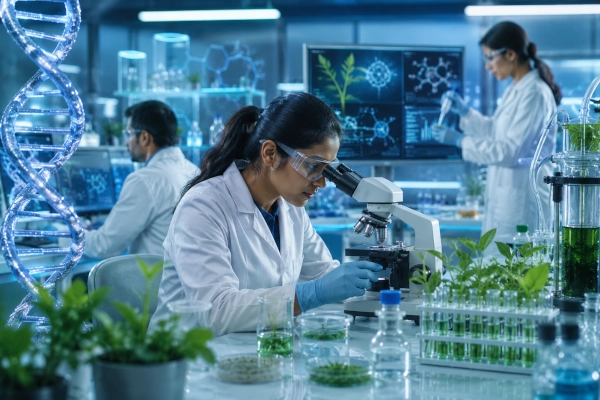
The Government of India will introduce the country’s first academic course in engineering biology, creating a new pathway for students to work at the intersection of biology, engineering, computation and advanced healthcare technologies.
Union Minister of State for Science and Technology Jitendra Singh announced the initiative at an event organised by NITI Aayog in New Delhi on July 16, 2026. He said the programme would help India develop an independent talent ecosystem capable of supporting the country’s rapidly expanding bioeconomy.
Engineering biology applies engineering principles to living systems. The field combines biology with disciplines such as electronics, artificial intelligence, data science, materials engineering, robotics and chemical engineering. Its applications range from advanced medicines and diagnostic systems to sustainable materials, agricultural biotechnology, biofuels and industrial manufacturing.
Preparing Students for Converging Technologies
The proposed course reflects the growing convergence between medicine, biology and engineering.
Healthcare equipment such as ultrasound machines, magnetic resonance imaging systems and automated diagnostic platforms increasingly depends on electronics, software, sensors and artificial intelligence. Their development and operation require collaboration between doctors, biologists, engineers and data specialists.
Jitendra Singh said future medical procedures may involve electronics engineers working alongside radiologists and other healthcare professionals. Such collaboration will become increasingly important as diagnostic and treatment systems grow more automated and technologically advanced.
An engineering biology curriculum could introduce students to areas such as molecular biology, genetics, bioinformatics, biomedical instrumentation, synthetic biology, computational modelling and bioprocess engineering.
This multidisciplinary approach would help create professionals capable of designing biological systems, medical devices, diagnostic tools and industrial biotechnology processes.
IITs and IISc Explore Medical Education
The minister also said that Indian Institutes of Technology and the Indian Institute of Science have submitted proposals for establishing medical schools.
Such institutions already possess strong capabilities in engineering, computing, materials science and biotechnology. Medical schools within these campuses could encourage greater collaboration between clinical researchers and technology developers.
The model could support the creation of new medical devices, imaging systems, robotic surgery platforms, artificial intelligence-based diagnostics and personalised treatment technologies.
Greater interaction between engineers and medical professionals could also shorten the path from laboratory research to clinical applications.
Supporting India’s Bioeconomy Ambition
The engineering biology course will form part of India’s broader effort to become a global bioeconomy leader.
The government has outlined a long-term objective of expanding India’s bioeconomy to approximately USD 2.6 trillion by 2047. Achieving this scale will require skilled professionals, research institutions, manufacturing capacity and a supportive innovation ecosystem.
India’s bioeconomy includes biotechnology medicines, vaccines, diagnostics, agriculture, food processing, industrial enzymes, biofuels, waste-to-value technologies and biological manufacturing.
Engineering biology could create new opportunities in areas such as lab-grown materials, precision fermentation, gene-based therapies, climate-resilient crops and sustainable chemical production.
It could also help Indian companies develop advanced biological products domestically and reduce dependence on imported technologies.
Building a Domestic Talent Ecosystem
A major objective of the initiative is to create specialised talent within India rather than relying heavily on expertise developed abroad.
Universities will need trained faculty members, modern laboratories and partnerships with hospitals, biotechnology companies and research centres. Practical training will be essential because engineering biology involves laboratory experimentation, data analysis, equipment design and biological manufacturing.
Industry participation could help institutions design courses around emerging workforce requirements. Students may also benefit from internships in biotechnology firms, medical-technology companies, pharmaceutical manufacturers and research laboratories.
The introduction of the course could encourage other universities to develop related undergraduate, postgraduate and professional programmes.
A New Academic Discipline for Emerging Industries
Engineering biology is expected to become increasingly important as biological systems are used to manufacture medicines, food ingredients, fuels, chemicals and new materials.
Unlike conventional biotechnology programmes that often focus mainly on biological science, engineering biology places greater emphasis on designing, modifying and scaling biological processes for practical use.
The new course could therefore prepare students for careers in synthetic biology, biomedical engineering, biomanufacturing, computational biology and healthcare technology.
India’s first engineering biology programme represents an effort to align higher education with the future needs of science, medicine and industry. Its curriculum, institutional structure and links with industry will determine how effectively it contributes to the country’s ambition of building a globally competitive bioeconomy by 2047.
References
DD India. “NITI Aayog Roadmap Targets USD 691 Billion Bioeconomy by 2035; Jitendra Singh Says India Ready to Lead Biotech Revolution.” July 16, 2026.
https://ddindia.co.in/2026/07/niti-aayog-roadmap-targets-usd-691-bn-bioeconomy-by-2035-jitendra-singh-says-india-ready-to-lead-biotech-revolution/
NITI Aayog. “Roadmap for Building India as a Leading Bioeconomy Powerhouse by 2035.” Government of India, July 2026.
https://niti.gov.in/sites/default/files/2026-07/Roadmap-for-Building-India-as-a-Leading-Bioeconomy-Powerhouse.pdf
Rediff Money Desk. “Government to Introduce India’s First Engineering Biology Course.” July 16, 2026. Based on a Press Trust of India report.
You may also like
-
Krishna’s Last Peace Mission: The Five Villages That Could Have Prevented Kurukshetra
-
The Frog King and the Serpent: The Enemy Invited Into the Well
-
The Serpent and the Meaning of Violence: When Grief Turned Ruru Against Every Snake
-
The Hawk and the Smaller Birds: Bhishma’s Lesson on Surviving Greater Powers
-
The Birds and the Destruction of Their Forest Home: A Mahabharata Lesson on Foresight, Leadership and the Duty to Protect
