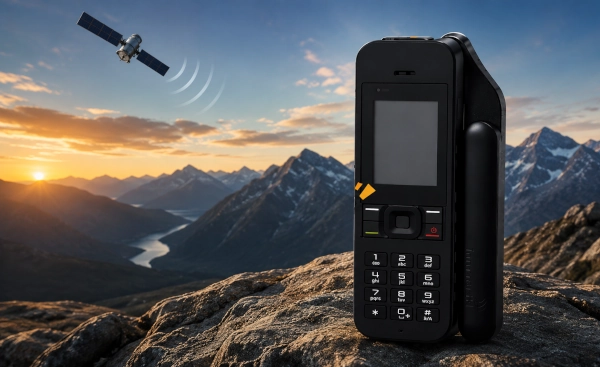
BSNL has brought renewed attention to its satellite phone offering in India, with the handset priced at ₹1,34,166 inclusive of taxes. The device is meant for users who operate beyond the reach of normal mobile towers, including defence personnel, maritime users, disaster-response teams, mining operations, remote field workers and adventure travellers. BSNL’s official posts describe the phone as suitable for challenging environments and list satellite connectivity, voice calls, emergency support and long battery life among its key features.
The service sits within BSNL’s Global Satellite Phone Service, or GSPS, which has been available to the public and enterprises since 2018. According to the Ministry of Communications, BSNL provides voice call and SMS services through GSPS, and the communication is transferred in encrypted form under Department of Telecommunications guidelines.
Unlike ordinary smartphones, the BSNL satellite phone is designed for situations where terrestrial mobile networks are unavailable or disrupted. This makes it useful in high-altitude regions, coastal and maritime zones, forested areas, disaster-hit districts, border areas, mining belts and remote project sites. In such places, the priority is not entertainment, camera quality or internet browsing, but reliable voice communication when coordination becomes critical.
The official framework also shows why satellite phones are treated differently from regular mobile devices in India. DoT rules require BSNL to complete the customer acquisition process and obtain details from subscribers, including the place of use, period of use and purpose for which the satellite handset will be used. This keeps satellite communication accountable while allowing authorised users to access connectivity in remote and emergency conditions.
BSNL’s tariff structure for GSPS has separate government and commercial plans. As per the official tariff plan effective from January 1, 2026, post-paid government plans begin at ₹3,500 per month, while commercial post-paid plans are listed at ₹11,670 per month. Pre-paid options include monthly and annual plans, with additional call and SMS charges after free usage. All listed tariff charges in the official annexure are excluding GST.
The satellite phone is especially important for disaster management. During floods, cyclones, landslides, earthquakes or major infrastructure failures, mobile towers and fibre networks can be damaged or overloaded. A satellite handset gives field teams another communication path, helping rescue teams, district authorities, medical responders and logistics units stay connected when conventional networks are strained.
For defence and security users, such devices support field coordination in difficult terrain where mobile coverage is limited. For maritime users, they provide communication support away from coastal network coverage. For remote workers and adventure travellers, the device can become a safety tool during expeditions, pilgrim routes, mining assignments or isolated infrastructure projects.
BSNL has also shared a dedicated contact route for more details, asking interested users to call 9768866652 or visit the nearest BSNL office.
The BSNL satellite phone is not a mass-market smartphone. It is a specialised communication device built for places where network absence can become an operational risk. Its real value lies in keeping voice communication alive when ordinary mobile networks stop being available.
Official source block:
Ministry of Communications / PIB: BSNL GSPS availability, encrypted voice and SMS, DoT usage disclosure rules and tariff annexure.
DoT PDF version of the PIB release: GSPS tariff plan effective from 01.01.2026.
BSNL official X profile snippets: handset price, features, contact number and intended use cases.
You may also like
-
When Trade Routes Become Weapons: Why BRICS Needs a Resilient Supply-Chain Architecture
-
India’s Trade With BRICS More Than Doubles to $417 Billion as Export Opportunity Expands
-
India and Uruguay Agree Trade and Connectivity Roadmap as Montevideo Ratifies International Solar Alliance
-
The Return of Multipolarity: Why the World Is Moving Beyond a Single Centre of Power
-
The Financial Chokepoint: Why BRICS Can No Longer Depend on SWIFT and the Dollar Alone
