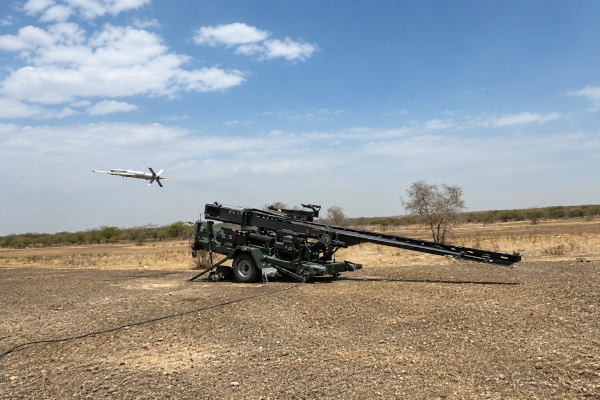
India’s battlefield drone ecosystem is entering a decisive new phase, with Tata Advanced Systems Limited and NIBE Defence emerging as the leading bidders in a major Indian Army procurement for one-way attack drones, also known as loitering munitions. The reported deal, valued at around ₹1,500–₹1,600 crore, covers about 840–850 loitering munitions with a range of over 100 km, aimed at strengthening the Army’s long-range precision strike capability.
The procurement is significant because it marks one of the Army’s first major fast-track moves to acquire large numbers of indigenous one-way attack drones. These systems are designed to locate, track and strike battlefield targets with precision, giving field commanders a cost-effective option between conventional artillery and larger missile systems. According to reports, Tata Advanced Systems has emerged as the lowest bidder, while NIBE Defence has come in as the second-lowest bidder.
Moneycontrol, citing ANI and defence sources, reported that the Army tender is for 840 loitering munitions. Tata Advanced Systems is expected to supply 64% of the requirement, while NIBE Defence may supply the remaining 36%. The same report placed Tata’s likely order value at around ₹1,000 crore and NIBE’s share at around ₹600 crore.
The Economic Times reported a similar development, placing the order at around 850 drones and ₹1,500 crore. It also said supplies are expected to begin within six months of contract signing under the fast-track procedure. This timeline is important because the fast-track route is meant to quickly deliver urgent operational capability to the armed forces.
The new drones are expected to support the Indian Army’s Artillery arm. Their primary battlefield role will be deep precision strikes against targets such as enemy artillery positions, command nodes, logistics points and other high-value tactical assets. Reports also say these systems have been designed with resistance to jamming and spoofing, reflecting lessons from recent conflicts where electronic warfare has become central to drone operations.
Loitering munitions are different from ordinary strike missiles. They can fly toward a target area, remain airborne for a period, transmit live imagery to the operator and then strike when a suitable target is identified. This gives commanders a valuable combination of surveillance and attack capability. In battlefield terms, it compresses the sensor-to-shooter cycle by allowing the same platform to search, identify and engage.
Tata Advanced Systems’ platform is linked to its Advanced Loitering System, or ALS. Tata describes ALS as an indigenously designed, developed and manufactured loitering munition system for surveillance and combat roles. The company says the system is adapted for Indian terrain and weather conditions, can carry different types of warheads, and provides live electro-optical and infrared video feed for guidance.
NIBE’s reported platform in the tender is Vayuastra, linked to the Vayu Astra loitering munition family. Earlier reports said NIBE’s Vayu Astra-1 completed No-Cost No-Commitment demonstrations in both mountain terrain near Malari in Joshimath and desert terrain at Pokhran. The system was reported to have a range of up to 100 km and the ability to carry anti-tank and anti-personnel warhead configurations.
This dual-vendor structure is important for India’s defence manufacturing base. It prevents dependence on a single supplier, builds industrial depth and creates competitive pressure in a fast-growing battlefield technology segment. Tata brings scale, aerospace experience and systems integration capability. NIBE brings a rising defence manufacturing profile, with its own focus on defence platforms, electronics, aeronautics and mission-ready systems.
The timing of the procurement is also strategic. The Russia-Ukraine war and West Asian conflicts have shown that loitering munitions can impose heavy costs on armour, artillery, radars, command posts and logistics units. They are cheaper than many conventional missiles, easier to deploy in numbers and useful for precision strikes in contested environments. For India, such systems are relevant along both western and northern fronts, where artillery duels, mountain warfare, surveillance gaps and dispersed targets can shape battlefield outcomes.
The Army’s wider drone modernisation is already moving in this direction. Reports say dedicated drone batteries and drone-focused formations are being raised or equipped for precision strike roles. Moneycontrol also reported that the Army may procure drones across ranges from 50 km to 1,000 km over the next 12–18 months under fast-track procedures.
This shows that the current Tata-NIBE procurement is only one layer of a larger unmanned warfare roadmap. Shorter-range drones can support battalion and brigade-level operations. Medium-range loitering munitions can assist artillery and corps-level strike missions. Longer-range systems can reach deeper enemy targets and complement missile, rocket and air power options.
For the Indian Army, the key advantage lies in precision at scale. Conventional artillery can saturate an area, while loitering munitions allow a more selective strike. A drone can observe a target, wait for the right moment and then attack with greater accuracy. This is valuable against mobile artillery, air defence systems, ammunition dumps, temporary camps and battlefield vehicles that may shift position quickly.
The reported 100 km-plus range also gives commanders greater flexibility. A system in this class can operate beyond immediate line-of-sight ground engagements and reach targets deep inside the tactical battle area. When combined with surveillance drones, battlefield radars, electronic intelligence and ground observers, loitering munitions can become a powerful part of an integrated strike network.
The procurement also supports India’s Atmanirbhar Bharat defence push. Instead of relying entirely on foreign loitering munition imports, the Army is building an Indian vendor base that can design, manufacture, improve and scale such systems domestically. This matters because drone warfare evolves rapidly. Indigenous suppliers can modify systems faster based on field feedback, electronic warfare threats, terrain requirements and operational lessons.
However, execution will decide the true success of the programme. The drones must prove reliable across deserts, mountains, plains, high temperatures, dust, wind and electronic warfare environments. They must also meet delivery timelines, maintain accuracy, sustain secure communication links and support quick training for operators. Fast-track procurement brings urgency, but battlefield credibility comes only through consistent performance in field conditions.
The Tata-NIBE development therefore represents more than a procurement story. It signals the Indian Army’s transition toward massed unmanned precision firepower. Artillery is no longer limited to guns, rockets and missiles. It is increasingly becoming a networked strike arm where drones, sensors, communication links and precision munitions operate together.
If the contract is finalised and delivered on schedule, this order could become a landmark moment for India’s private defence industry. It would place Tata Advanced Systems and NIBE Defence at the centre of India’s next-generation loitering munition ecosystem, while giving the Army a stronger tool for future high-intensity warfare.
India’s drone warfare capability is moving from trials and demonstrations to large-scale induction. The battlefield of the future will reward forces that can see faster, decide faster and strike faster. The Army’s one-way attack drone push is a major step in that direction.
You may also like
-
Structural Optimisation Reportedly Cuts HAL LUH Vibration by Up to 50%
-
IAF Opens Race to Develop Indigenous High-Altitude Pseudo Satellite for Persistent Surveillance
-
BDL Confirms ASRAAM Missile Facility Fully Operational as Major IAF Requirement Looms
-
DRDO’s Junput Missile Test Facility Back on Track as Bengal Clears 8.73-Acre Coastal Range
-
Pune-Based N3X Labs Flies Scaled WRATH Prototype as Autonomous Aerial Programme Moves Into Hardware Testing
