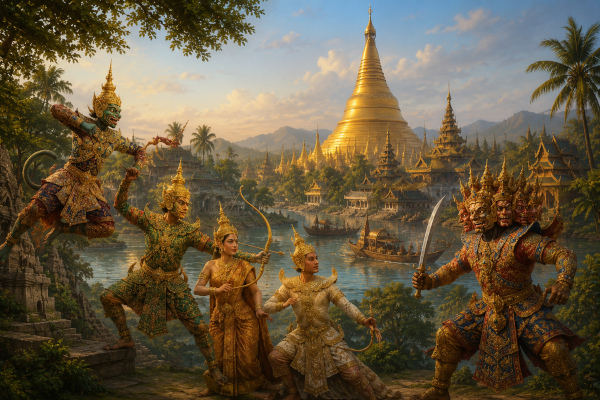
Myanmar holds one of the most beautiful Southeast Asian expressions of the Ramayana tradition. In Burmese culture, the Ramayana appears as Yama Zatdaw, also known as Yamayana, a performance and literary tradition that blends the Indian epic with Buddhist thought, royal theatre, local music, dance, masks and Myanmar’s own sacred imagination. It is one of the strongest examples of how the Ramayana travelled beyond India and became part of the cultural life of neighbouring civilisations.
The name itself reflects this adaptation. Yama Zatdaw is the Burmese version of the Ramayana and the Dasaratha Jataka. The term Yamayana refers to the story, while Zatdaw refers to an acted play or a story connected with the Jataka tradition of Theravada Buddhism. This makes the Myanmar Ramayana both an epic drama and a Buddhist cultural retelling.
The Ramayana entered Myanmar through several cultural routes. Early traditions connect the Rama story with the Bagan period, especially the age of King Anawrahta. Later, the Burmese Ramayana also absorbed influence from Thailand’s Ramakien, especially after the Konbaung-era interactions with Ayutthaya. This created a layered tradition: Indian in origin, Buddhist in interpretation, Burmese in performance and Southeast Asian in artistic exchange.
One of the most important early signs of Hindu presence in Myanmar is found at Nathlaung Kyaung Temple in Bagan. This temple is dedicated to Vishnu and is among the rare surviving Hindu monuments in the Bagan archaeological zone. It shows that Vaishnava and broader Hindu sacred ideas were known in Myanmar’s early religious landscape.
The Myanmar Ramayana tradition also preserves the names of the epic characters in Burmese form. Rama becomes Yama, Sita becomes Thida, Lakshmana becomes Lakhana, Hanuman remains Hanuman, Ravana appears as Yawana or Datha-giri, and Vibhishana becomes Bibi-thana. These names show how Sanskritic epic memory was localised into Burmese sound, theatre and storytelling.
The story grew deeply in Burmese court culture. Literary and musical works connected with the Ramayana developed strongly in the 18th century. U Aung Phyo’s Rama sā-khyan is believed to have been composed in 1775, while Yama yakan and Thida yakan were written in 1784. The Yama pyazat, or Ramayana ballet, appeared in 1789, and Kalay Yama wutthu, or Young Rama’s Life, appeared around 1800.
In Burmese royal culture, Yama Zatdaw became more than a borrowed story. It was reshaped through Burmese songs, costumes and performance styles. Court records and literary accounts mention that Queen Thakin Min Mi encouraged Ramayana performances and introduced Burmese music and songs into the Yama Zatdaw tradition, helping the epic take on a stronger local identity.
The performance tradition is especially important. Yama Zatdaw came alive through dance-drama, masks, costumes, music and stage movement. The costumes often combined Bamar and Thai elements, while the character masks of Ravana, Hanuman and other figures became part of Myanmar’s theatre culture. This made the Ramayana visible, musical and dramatic for the public.
The Hindu deity comparison is especially rich. In the Indian Ramayana, Rama is understood as an avatar of Vishnu, the protector of cosmic order. In Myanmar’s Yama Zatdaw, Yama retains the image of the righteous prince and ideal king, while Buddhist retellings also connect Rama with the Bodhisatta ideal through the Dasaratha Jataka. Thus, the Hindu idea of dharma and the Buddhist idea of moral perfection meet in the same heroic figure.
Sita, known in Myanmar as Thida, carries the same central values of purity, loyalty, dignity and inner strength. In Indian tradition she is revered as the daughter of Janaka and the embodiment of steadfast virtue. In Myanmar’s performance culture, Thida became a graceful royal heroine whose suffering, patience and dignity gave emotional depth to the stage tradition.
Lakshmana, known as Lakhana, represents brotherly devotion and service. In Hindu tradition, Lakshmana stands beside Rama as a symbol of loyalty. In Myanmar’s dramatic form, Lakhana continues this role, showing the value of faithful companionship, discipline and honour in royal and family life.
Hanuman is one of the strongest bridges between the two worlds. In India, Hanuman is the heroic devotee of Rama, the embodiment of strength, courage, intelligence and bhakti. In Myanmar’s Yama Zatdaw, Hanuman remains a powerful and energetic stage figure. His leaps, gestures, wit and martial energy make him one of the most visually striking characters in performance.
Ravana, known as Yawana or Datha-giri, represents the misuse of power. In the Indian epic he is the mighty king of Lanka whose strength is defeated by arrogance and adharma. In Myanmar theatre, the many-headed demon king became a dramatic figure of grandeur, danger and moral warning. Through him, the performance teaches that power without righteousness becomes destructive.
Another important comparison is between Indra and Thagyamin. In Hindu tradition, Indra is the king of the devas and lord of the heavens. In Myanmar’s religious culture, Thagyamin stands at the head of the 37 nats and incorporates elements of the Hindu deity Indra and the Buddhist deva Sakka. This shows how Myanmar absorbed Indic divine ideas into its own nat and Buddhist worldview.
Myanmar’s nat tradition also helps us understand how Hindu and local sacred systems interacted. Nat worship is an older indigenous belief system in Myanmar, involving spirits connected with places, people, trees, rocks and areas of life. Under King Anawrahta, the nat pantheon was organised into 37 nats, with Thagyamin placed at the head. This created a religious structure where Buddhist practice, local spirit worship and Indic divine symbolism could coexist.
This is where the civilisational idea of Akhand Bharat can be understood in a positive cultural sense. Here, Akhand Bharat is not a political claim over modern borders. It is the vision of a shared civilisational zone where Bharatiya ideas travelled through stories, trade, monks, artists, temple builders, performers and scholars. Myanmar’s Yama Zatdaw shows that India’s cultural influence moved eastward not through force, but through beauty, memory and moral storytelling.
The Ramayana in Myanmar proves that Bharatiya civilisation had a deep soft-power presence across Asia. The epic was not copied mechanically; it was lovingly adapted. Myanmar gave Rama a Burmese voice, Sita a Burmese stage presence, Hanuman a Burmese theatrical energy and Ravana a Burmese mask. This is the finest form of cultural exchange: the root remains Indian, while the flower blooms in local colours.
In this sense, Myanmar became one of the eastern cultural gateways of the Ramayana world. Its Buddhist monasteries, royal courts, performance halls and traditional theatres preserved a story born in India and made it meaningful for Burmese society. The Ramayana became a bridge between Hindu dharma and Buddhist ethics, between Sanskritic memory and Burmese art, between India’s sacred geography and Myanmar’s golden pagoda landscape.
Yama Zatdaw also shows why the Ramayana has survived across centuries. It speaks of righteous leadership, family duty, loyalty, courage, sacrifice, self-control and the victory of truth over arrogance. These values are universal, which is why the epic could cross mountains, rivers, languages and kingdoms.
The Myanmar Ramayana is therefore an important chapter in the wider story of Bharatiya civilisation. It reminds us that India’s ancient cultural world extended far beyond political frontiers through shared epics, sacred language, performing arts and moral imagination. In Myanmar, the Ramayana did not remain a foreign tale; it became Yama Zatdaw, a living Burmese tradition.
Through Yama, Thida, Lakhana, Hanuman and Datha-giri, Myanmar continues to echo the voice of the Ramayana. The epic’s journey from India to Myanmar stands as a shining example of Akhand Bharat in its noblest meaning: a civilisational unity built on dharma, art, respect and shared cultural memory.
You may also like
-
Rare Stone Features Emerge as Kerala Archaeology Department Restores Megalithic Kudakkals at Karivellur
-
Vidarbha in the Mahabharata: The Ancient Kingdom of Damayanti in Eastern Maharashtra
-
Abhira in the Mahabharata: The Pastoral People of Western India and the Northern Deccan
-
Nasikya in the Mahabharata World: The Ancient Nashik Region on the Upper Godavari
-
Bharukachchha in the Mahabharata: The Ancient Port of Bharuch at the Mouth of the Narmada
