India is sending a 40-member Army contingent to Mongolia for Exercise Khaan Quest 2026, a major multilateral military exercise focused on peace support operations, interoperability and joint tactical readiness. The exercise will be conducted from 20 June to 3 July 2026 at the Five Hills Training Area near Ulaanbaatar, Mongolia, bringing together military forces from different countries for coordinated training under the framework of Chapter VII of the United Nations Charter.
This year’s Indian contingent is being represented mainly by troops from a battalion of the JAT Regiment, along with personnel from other arms and services of the Indian Army. Their participation reflects India’s growing emphasis on international peacekeeping, professional military exchange and strategic engagement with Mongolia.
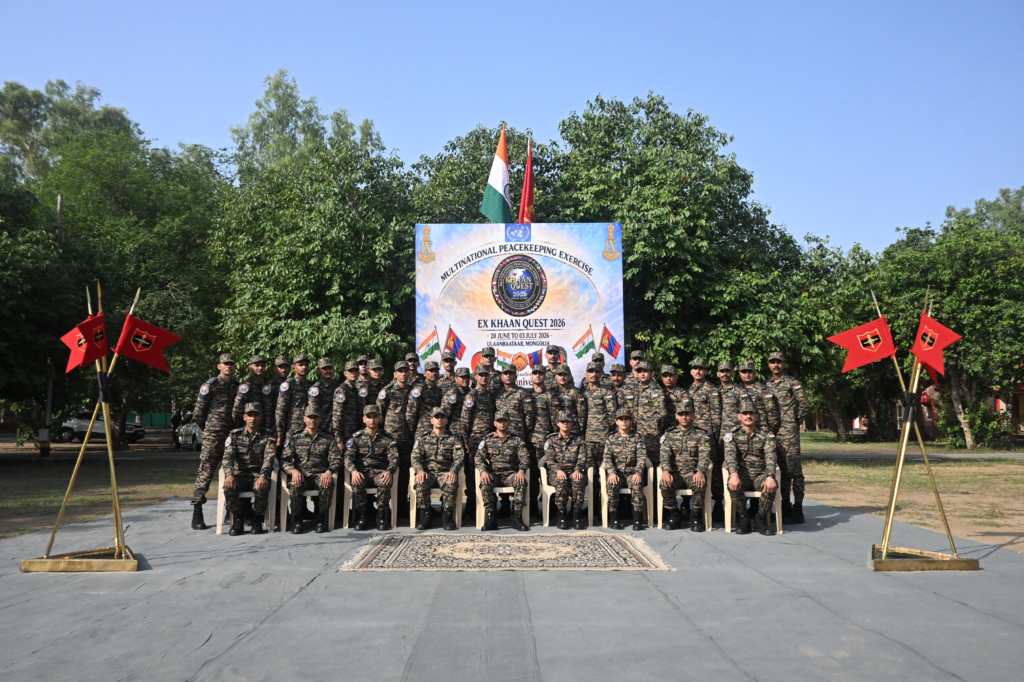
Exercise Khaan Quest has grown into one of Asia’s important multinational peacekeeping exercises. It began in 2003 as a bilateral exercise between the United States and the Mongolian Defence Forces. From 2006, it expanded into a multilateral peacekeeping exercise, and the 2026 edition marks its 23rd iteration.
The training will focus on real-world peacekeeping scenarios that soldiers may face in multinational operations. These include joint planning, establishment of static and mobile checkpoints, cordon and search operations, patrolling, civilian evacuation from hostile areas, counter-IED drills, combat first aid and casualty evacuation. These drills are crucial because modern peacekeeping missions demand a combination of combat discipline, humanitarian sensitivity, situational awareness and coordination with foreign forces.
For the Indian Army, Exercise Khaan Quest offers a valuable opportunity to sharpen operational readiness in a multinational environment. Peacekeeping missions often involve soldiers from different countries working under a common mandate, where procedures, communication systems and tactical habits must align quickly. Exercises of this kind help build that shared understanding before troops are deployed in actual mission areas.
India has a long and respected record in United Nations peacekeeping, and participation in Khaan Quest strengthens that legacy. The exercise also supports India’s wider defence diplomacy, especially with Mongolia, a country with which India shares historical, civilisational and strategic ties. Military exercises such as Khaan Quest help convert diplomatic goodwill into practical cooperation on the ground.
The 2026 edition also carries importance because peacekeeping environments across the world are becoming more complex. Troops may have to operate in areas affected by insurgency, civil disorder, humanitarian crises, improvised explosive devices and hostile armed groups. The focus on evacuation, casualty care, patrolling and checkpoint control makes the exercise directly relevant to these modern challenges.
Khaan Quest 2026 will also allow soldiers from participating countries to exchange tactics, techniques and procedures. This professional exchange strengthens mutual trust, builds camaraderie and improves the ability of different armed forces to work together during peace support missions.
For India, the exercise is more than a training deployment. It is a signal of responsibility, readiness and partnership. By sending its troops to Mongolia for a UN-oriented peacekeeping exercise, India is reinforcing its role as a steady contributor to global stability and a reliable military partner in the Indo-Pacific and beyond.
Source: PIB
You may also like
-
Astra Microwave Expands Counter-Drone Capabilities with Layered Detection and Neutralisation Systems
-
MDL Begins Development of Indigenous Lithium-Ion Battery System for Project-75(I) Submarines
-
Tarang Shakti Delegates from 28 Countries Visit HAL and BEL to Explore India’s Defence Manufacturing Ecosystem
-
India’s 114 Rafale Fighter Jet Programme Moves Towards Final Decision with Focus on Indigenous Integration
-
Embraer and Mahindra Identify Nagpur as Potential C-390 Millennium Assembly Hub in India
