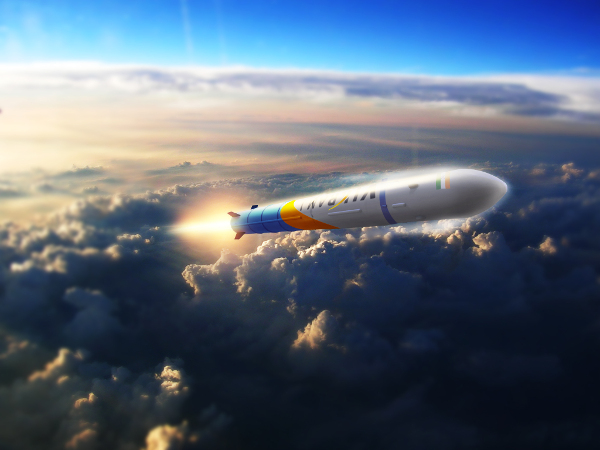
India’s space sector is entering a new industrial phase, and Skyroot Aerospace stands at the centre of that change. The Hyderabad-based company is building the Vikram series of launch vehicles with a strong focus on carbon composite structures, rapid manufacturing, 3D-printed engine components and small-satellite launch flexibility. Its work shows how India’s private space ecosystem is moving from component supply and support services to full launch-vehicle development.
The phrase “carbon fibre rocket” is important because it points to a major shift in how modern launch vehicles are designed. Traditional rockets use metallic structures such as aluminium alloys and steel in many major sections. These materials are strong and proven, but they add weight. In rocketry, every kilogram matters. A lighter structure means more performance, better payload capability, lower fuel burden and improved mission economics. Carbon fibre composites offer high strength with lower weight, making them attractive for launch vehicles designed to place small satellites into orbit at competitive cost.
Skyroot’s Vikram-S proved the basic concept first. Launched in November 2022 under Mission Prarambh from Sriharikota, it became India’s first privately launched rocket. The suborbital mission validated solid propulsion, avionics, telemetry and carbon composite structures. That flight was more than a demonstration. It showed that a private Indian company could design, build, qualify and fly a rocket with support from India’s space ecosystem. Vikram-S became the opening act of India’s private launch industry.
The larger story is Vikram-I, Skyroot’s first orbital-class launch vehicle. Vikram-I is designed for the small satellite market, especially customers that need rapid, dedicated and customised access to orbit. Skyroot lists the rocket with capability of carrying up to 350 kg to Low Earth Orbit and up to 260 kg to Sun-synchronous Orbit. This places it in the growing small-launcher segment, where customers want faster mission timelines instead of waiting for rideshare slots on larger rockets.
Vikram-I uses an all-carbon composite structure. This is a major technological decision. Carbon composite rocket bodies are lighter than many conventional metallic structures and can be designed with high stiffness, high strength and lower mass. For a small launch vehicle, this matters even more because the payload margins are tight. A lighter airframe allows more of the rocket’s performance to go toward useful payload and orbital precision.
The first three stages of Vikram-I use solid propulsion, while the upper stage uses a liquid engine for orbital insertion and mission flexibility. This architecture gives the vehicle a practical balance. Solid stages are simpler, rugged and suitable for rapid readiness. The liquid upper stage allows more precise orbital placement. This is important for customers launching Earth observation, communications, research and technology-demonstration satellites.
Skyroot’s Kalam series motors are central to Vikram-I’s development. Kalam-250, the second-stage motor, underwent static testing at ISRO’s Satish Dhawan Space Centre in March 2024. ISRO provided test infrastructure, technical assessment, safety systems, instrumentation and post-test data support. The test used around 196 measurements across thrust, pressure, strain, temperature, vibration, acoustics and other parameters. This level of testing shows that private launch vehicles still require the discipline of deep engineering validation.
The most significant propulsion milestone came with the Kalam-1200 motor. This is the first stage of Vikram-I. ISRO reported its successful static test at Sriharikota in August 2025. The motor is 11 metres long, 1.7 metres in diameter and carries 30 tonnes of solid propellant. It is a monolithic composite motor, making it one of the most important privately developed rocket-stage achievements in India. A first-stage motor is the hardest part of the launch vehicle because it must lift the entire rocket from the ground and survive extreme loads, vibration, pressure and thermal stress.
The carbon composite motor case is a major part of the story. A solid rocket motor is not just a tube filled with propellant. It must contain enormous internal pressure during combustion. It must resist heat through insulation and thermal protection. It must maintain structural integrity while the rocket accelerates through atmosphere. A composite case must be wound, cured, inspected and qualified with very high precision. Any flaw in structure, bonding, insulation or material behaviour can become mission-critical. Skyroot’s progress in this area shows that Indian private industry is learning to handle aerospace-grade composite manufacturing at launch-vehicle scale.
Carbon fibre manufacturing also changes the industrial base behind rockets. It needs specialised materials, robotic winding systems, curing processes, non-destructive testing, quality control and repeatable production techniques. This is where Skyroot’s work becomes important beyond one rocket. Once India develops private industrial capability in composite motor cases, airframes, interstages and structural systems, the knowledge can support satellites, aircraft, drones, missiles, launch vehicles and future reusable platforms.
The Vikram programme also uses 3D-printed components, especially in engine systems. Additive manufacturing can reduce part count, shorten production cycles and allow complex shapes that are difficult to manufacture through traditional machining. In rocketry, fewer joints and fewer parts can improve reliability when properly designed and tested. Combined with carbon composites, 3D printing helps Skyroot pursue a faster launch-vehicle manufacturing model.
Skyroot’s business model is built around speed and flexibility. The company wants to offer on-demand launch services for small satellites. In the global market, many small satellite operators face a common problem. They can buy a rideshare slot on a large rocket, but then they must accept the larger mission’s timing, orbit and deployment conditions. A dedicated small launcher gives them more control. It can place satellites into preferred orbits, support mission-specific timelines and reduce dependence on crowded rideshare schedules.
This is why Skyroot describes Vikram-I as a fast-track route to orbit. The company is not trying to compete with heavy-lift rockets. It is targeting a specific market where responsiveness matters. Earth observation companies, defence users, climate-monitoring missions, university satellites, technology demonstrators and communication startups often need small payloads placed into specific orbits. A reliable Indian private launch vehicle can serve that market.
The defence and national security angle is also important. Modern military and strategic capability depends heavily on satellites. Border surveillance, ocean monitoring, secure communication, navigation support, disaster response, weather data and battlefield awareness all rely on space infrastructure. A country that can launch small satellites quickly gains strategic resilience. It can replace damaged satellites, deploy new sensors, support urgent missions and reduce dependence on foreign launch windows. Skyroot’s rockets are commercial launch vehicles, but the capability they represent has national security value.
Skyroot’s rise also reflects the success of India’s space-sector reforms. IN-SPACe was created to authorise, facilitate and promote private participation in space activities. ISRO opened its facilities, testbeds and expertise to private companies. This changed the environment for startups. Instead of building every test facility from zero, private players could use national infrastructure under supervision. Skyroot’s Kalam-250 and Kalam-1200 testing at Sriharikota shows this new model in action.
The company’s Infinity Campus in Hyderabad adds another layer to the story. The facility is designed for launch-vehicle design, development, integration and testing, with capacity to support regular rocket production. This is important because launch vehicles become commercially meaningful only when they can be produced repeatedly. A single successful rocket creates pride. A factory that can build rockets regularly creates an industry.
Skyroot’s financial rise also shows investor confidence in India’s space market. In 2026, the company became India’s first space-tech unicorn after a fresh funding round that pushed its valuation above one billion dollars. This matters because rockets are capital-intensive. They require long development cycles, expensive testing, specialised talent and tolerance for technical risk. Investor backing gives Skyroot the runway to move from test flights to commercial launch cadence.
The challenge ahead remains serious. Rocket development is unforgiving. Every stage, nozzle, actuator, separation system, avionics package, flight computer, software loop and thermal protection layer must work correctly under extreme conditions. A static fire test proves a stage on the ground. An orbital launch proves the full vehicle in flight. Vikram-I’s first orbital mission will therefore be a historic test of India’s private launch capability.
Skyroot’s own journey shows the correct engineering sequence. First came suborbital validation through Vikram-S. Then came stage-level testing. Then came motor qualification, flight hardware movement, integration and orbital mission preparation. This step-by-step approach is essential in rocketry. Spaceflight rewards ambition only when ambition is matched with testing discipline.
The carbon fibre aspect gives the Vikram programme a special identity. India is not merely building another small rocket. It is building a modern composite launch vehicle that reflects the direction of global aerospace engineering. Light structures, modular architecture, additive manufacturing and rapid launch services are becoming central to the new space economy. Skyroot is trying to place India inside that future.
If Vikram-I succeeds, it will mark a major transition for India. ISRO will remain the backbone of the national space programme, but private companies will begin adding launch capacity, innovation speed and commercial flexibility. This is how mature space economies grow. National agencies build deep capability and scientific missions, while private companies create specialised services, new business models and faster industrial cycles.
Skyroot’s carbon fibre rockets therefore represent more than one company’s achievement. They represent India’s move toward a wider space manufacturing ecosystem. They bring together private entrepreneurship, ISRO’s technical support, IN-SPACe regulation, composite materials, solid propulsion, 3D-printed engines and the global small-satellite market. This combination can help India become not only a country that launches satellites, but a country that sells launch access to the world.
The story began with Vikram-S crossing the edge of space. It now moves toward Vikram-I and orbital launch. The carbon composite body of the rocket carries more than propellant and payload. It carries the ambition of India’s private space age.
You may also like
-
Indian Semiconductor Companies Propose New Manufacturing and Chip Design Investments in Madhya Pradesh
-
CSIR-CRRI Partners with Industry to Develop Advanced Indigenous Airport Runway and Pavement Materials
-
Paras Semiconductors Secures 43 Acres in Madhya Pradesh for Proposed ₹6,200 Crore Advanced Chip Packaging Facility
-
Petronet LNG Plans ₹1,200 Crore Joint Venture for Ten Compressed Biogas Plants Across India
-
Indian Army Special Forces Depart for Indonesia for Exercise Garuda Shakti 2026
