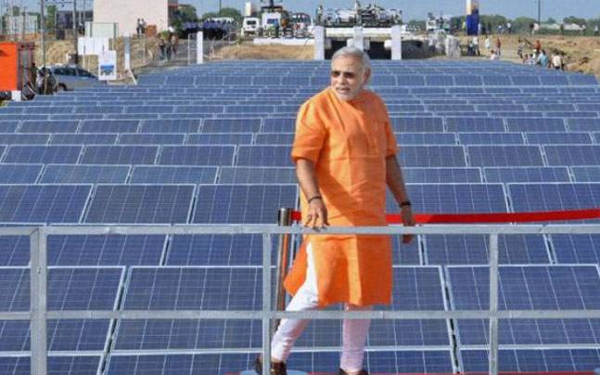
India has crossed a major clean-energy milestone by surpassing the United States in annual solar capacity additions in 2025, becoming the world’s second-largest solar growth market after China. The development shows how rapidly India’s renewable energy sector has moved from policy ambition to large-scale deployment, with solar power now standing at the centre of the country’s energy transition. IBEF reported the achievement on 4 June 2026, while News On AIR carried the update on 3 June 2026.
The numbers show the scale of the shift. India has crossed 155 GW of installed solar capacity, strengthening its progress towards the national goal of achieving 50 percent of installed power capacity from non-fossil fuel sources. This also supports India’s Nationally Determined Contributions under the global climate framework, where the country has committed to a cleaner and more sustainable power mix.
The annual comparison is particularly important. Business Standard reported, citing IRENA data, that India added 37 GW of solar capacity in 2025, ahead of the United States, which added 34 GW. China remained far ahead as the world leader with 315 GW of solar additions in 2025. This places India firmly in the top tier of global solar expansion and shows that the country is now competing with the world’s largest energy economies in yearly clean-power deployment.
India’s rise has been driven by a combination of policy support, large-scale solar parks, stronger transmission planning, rooftop solar adoption, domestic manufacturing efforts and growing investor confidence. The country’s solar story is no longer limited to utility-scale plants in desert regions. It now includes homes, villages, industries, commercial buildings, agricultural feeders and distributed energy systems that bring power generation closer to the consumer.
The PM Surya Ghar: Muft Bijli Yojana has become a major driver of this household-level solar movement. According to the official update, more than 40 lakh households have already benefited from rooftop solar under the programme. This gives the solar mission a direct social dimension, because rooftop systems can reduce household electricity bills, lower pressure on the grid and turn ordinary homes into small clean-power producers.
The achievement also carries economic meaning. A fast-growing solar sector creates demand for modules, inverters, mounting structures, cables, batteries, smart meters, grid equipment, skilled technicians, project developers and maintenance services. As solar capacity expands, India gains an opportunity to build a wider domestic manufacturing and employment ecosystem around clean energy.
There is also a strategic energy-security angle. Every gigawatt of solar capacity reduces long-term dependence on imported fossil fuels and protects the economy from global fuel-price shocks. Solar power also supports India’s broader plan to combine renewable energy with battery storage, green hydrogen, electric mobility and modern grid management. In this larger picture, solar becomes more than an electricity source; it becomes the foundation of a cleaner industrial future.
India still has important challenges ahead. Grid stability, storage deployment, land availability, domestic manufacturing depth, financing speed and distribution-company reforms will decide how smoothly the next stage of solar expansion moves. The gap with China also remains very large, showing that India’s solar journey has entered a higher league while still leaving vast room for growth.
Even so, the 2025 milestone marks a powerful turning point. By overtaking the United States in annual solar additions, India has shown that its clean-energy transition is gathering real speed. From large solar parks to rooftop systems, from national climate targets to household savings, the solar mission is becoming one of the strongest pillars of India’s energy future.
You may also like
-
India Overtakes Hong Kong to Become Asia’s Fourth-Largest REIT Market
-
Banaras Langda Aam — Kashi’s Green-Skinned Summer Treasure and the Mango Heritage of the Gangetic Plain
-
ONGC Strikes Gas in Mahanadi Deepwater Basin Off Odisha Under Samudra Manthan Campaign
-
India–New Zealand FTA to Take Effect From October 20, Opening Duty-Free Access for All Indian Exports
-
Sintez-PKZh Expands Carbonyl Iron Supplies to India With Inlab Chemicals
