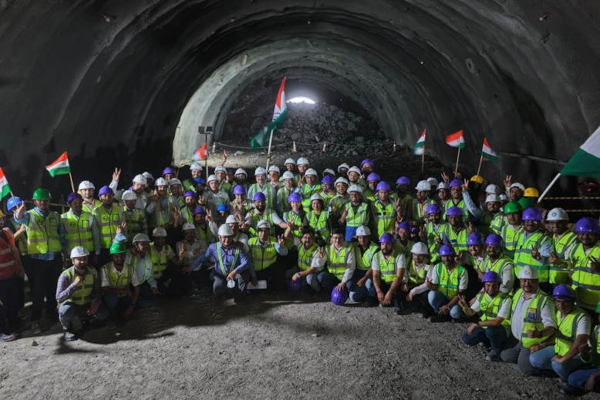
India’s first bullet train corridor has recorded another major engineering milestone with the successful breakthrough of the third mountain tunnel in Maharashtra. The tunnel, identified as MT-07, is located at Ambesari village in Dahanu Taluka of Palghar district and forms part of the Mumbai–Ahmedabad High Speed Rail corridor. The breakthrough was announced by the Ministry of Railways on 2 June 2026.
The MT-07 tunnel is 417 metres long and 14.4 metres wide. It has been designed to carry both up and down tracks of the bullet train corridor, allowing high-speed trains to pass through the mountain section with the required safety clearance and structural stability. The tunnel was excavated through controlled drilling and blasting from both ends, supported by continuous engineering supervision and safety protocols.
This breakthrough is important because it marks the third mountain tunnel breakthrough in Maharashtra within just five months. The first was MT-05, a 1.5-km tunnel near Saphale in Palghar district, completed on 2 January 2026. The second was MT-06, a 454-metre tunnel completed on 3 February 2026 using the New Austrian Tunnelling Method. With MT-07 now completed, the Maharashtra section of the project has gained visible speed in one of its most difficult construction zones.
The Mumbai–Ahmedabad bullet train corridor spans 508 km and is being developed as India’s first high-speed rail project. The route will connect Maharashtra and Gujarat through a modern transport corridor designed for fast inter-city mobility, industrial connectivity and future-ready passenger movement. The project includes 12 stations, with NHSRCL listing Sabarmati, Ahmedabad, Anand-Nadiad, Vadodara, Bharuch, Surat, Bilimora, Vapi, Boisar, Virar, Thane and Mumbai as stations on the corridor.
The tunnel section in Palghar carries special significance because of the terrain. Mountain tunnelling requires precise geological assessment, controlled blasting, vibration monitoring, ventilation, drainage planning, worker safety systems and careful measurement of rock behaviour. In MT-07, real-time monitoring was carried out through Surface Settlement Points, 3D targets, strain gauges and seismographs. These systems helped track vibrations, tunnel movement and surrounding structural behaviour during excavation.
Worker safety formed a major part of the tunnelling process. The project team used ventilation systems, fire-safety arrangements, controlled access and continuous geotechnical supervision inside the excavation zone. This shows the growing use of advanced construction discipline in Indian rail infrastructure, where speed, safety and engineering accuracy have to move together.
Among the seven mountain tunnels under construction in Maharashtra, MT-05, MT-06 and MT-07 have now achieved breakthroughs. MT-08, measuring 350 metres, had already achieved breakthrough on 5 October 2023. MT-03 has crossed 80 percent excavation progress, MT-04 has reached nearly 60 percent progress, while MT-01 and MT-02 are also moving ahead. Out of the total eight mountain tunnels in the Mumbai–Ahmedabad Bullet Train Project, seven are in Palghar district of Maharashtra and one is in Valsad district of Gujarat, where tunnelling work has already been completed.
The latest achievement also completes the excavation of all three mountain tunnels between the Vapi and Boisar bullet train stations. This section passes through an important industrial belt between Gujarat and Maharashtra, and faster construction progress here strengthens the corridor’s role as a future high-speed link between business centres, ports, manufacturing zones and urban clusters.
The wider significance of this breakthrough goes beyond one tunnel. It shows that India is steadily building domestic experience in high-speed rail tunnelling, instrumentation, safety monitoring and project execution. Bullet train construction demands a higher level of precision than conventional railway work because track geometry, tunnel alignment, vibration control and operational safety have to meet strict high-speed standards.
The Mumbai–Ahmedabad High Speed Rail corridor is therefore becoming a training ground for India’s next generation of rail engineers, tunnelling specialists, project managers and construction technology providers. Each tunnel breakthrough adds confidence to the project’s execution capacity and strengthens India’s long-term ability to build high-speed rail corridors in other regions.
The MT-07 breakthrough stands as a clear marker of progress in India’s most ambitious railway modernisation project. With three Maharashtra tunnel breakthroughs in five months, tunnelling work between Vapi and Boisar completed, and other tunnel packages advancing, the bullet train corridor is moving from blueprint to visible infrastructure. It represents a shift toward faster mobility, advanced rail engineering and a new standard of transport construction in India.
You may also like
-
India Overtakes Hong Kong to Become Asia’s Fourth-Largest REIT Market
-
Banaras Langda Aam — Kashi’s Green-Skinned Summer Treasure and the Mango Heritage of the Gangetic Plain
-
ONGC Strikes Gas in Mahanadi Deepwater Basin Off Odisha Under Samudra Manthan Campaign
-
India–New Zealand FTA to Take Effect From October 20, Opening Duty-Free Access for All Indian Exports
-
Sintez-PKZh Expands Carbonyl Iron Supplies to India With Inlab Chemicals
