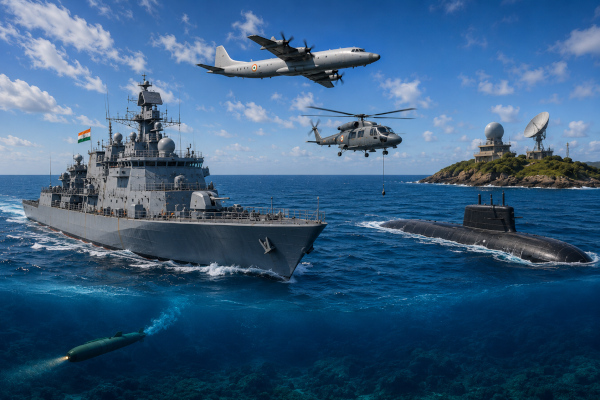
The Indian Navy is sharpening its anti-submarine warfare and maritime surveillance network across the Indian Ocean at a time when undersea activity, strategic competition and long-range naval deployments are increasing across the region. Navy Chief Admiral Dinesh K Tripathi has underlined that the service is following a capability-based and threat-informed approach, using niche technologies and new programmes to strengthen India’s maritime awareness and combat readiness.
This focus is important because the Indian Ocean is no longer a quiet trade highway. It is now a crowded strategic theatre carrying energy shipments, commercial cargo, naval patrols, submarine deployments, undersea cables and grey-zone activity. The Navy’s task has expanded from coastal protection to a layered oceanic watch that covers sea lanes, choke points, island territories, offshore assets and the wider maritime neighbourhood.
Anti-submarine warfare has become one of the most demanding parts of this mission. Submarines operate silently, exploit depth and distance, and can threaten warships, ports, energy routes and undersea infrastructure. Detecting them requires a networked system rather than a single platform. Aircraft, ships, helicopters, sonars, underwater sensors, satellites, maritime patrol aircraft and information-fusion centres must work together to track faint acoustic signatures and unusual movement patterns across vast waters.
The Navy’s 2026 Maritime Security Strategy also reflects this wider shift. Released by Admiral Tripathi during the Naval Commanders’ Conference, the document lays out a decade-long action plan to secure India’s maritime interests in a changing security environment. It is built around geopolitical shifts, disruptive technologies, higher defence reforms and the changing character of warfare, with the aim of keeping the Navy combat-ready, credible, cohesive and future-ready.
The Indian Ocean Region gives this strategy real urgency. Developments in West Asia, the Red Sea, the Gulf of Aden, the Strait of Hormuz and the wider Indo-Pacific directly affect India’s energy security and trade flows. The Navy has already been operating at a higher tempo to protect maritime interests and respond to instability. At the April 2026 Naval Commanders’ Conference, Admiral Tripathi highlighted energy security, increased operational tempo, inter-service synergy, combat readiness and emerging technologies as key priorities.
India is also strengthening the hardware side of its undersea warfare grid. The commissioning of INS Anjadip, the third ship of the eight-vessel Anti-Submarine Warfare Shallow Water Craft project, shows how the Navy is building specialised platforms for coastal and littoral submarine detection. Built by Garden Reach Shipbuilders & Engineers, Anjadip is designed for shallow-water ASW operations and carries indigenous systems such as Hull Mounted Sonar Abhay, lightweight torpedoes and ASW rockets.
Such vessels are crucial because coastal waters are among the hardest areas for submarine detection. Shallow seas produce cluttered acoustic conditions, heavy traffic, fishing activity and complex seabed reflections. A dedicated ASW shallow-water craft gives the Navy a nimble platform that can patrol approaches to ports, naval bases, island chains and sensitive coastal zones. Anjadip’s 77-metre design, water-jet propulsion and 25-knot top speed also make it suitable for rapid response, coastal surveillance, low-intensity maritime operations and search-and-rescue duties.
The larger goal is to create a layered surveillance shield. In this model, shore-based sensors watch the coastline, ASW ships patrol littoral waters, helicopters dip sonar into suspicious zones, maritime patrol aircraft sweep larger ocean spaces, satellites observe surface activity, and information networks combine the data into a coherent maritime picture. The value of such a network lies in continuity. A submarine may avoid one sensor, but a layered grid increases the chance that its movement, support vessel, communication pattern or acoustic trace will be detected.
This also fits India’s wider push toward indigenous naval capability. The ASW-SWC project is part of the Navy’s effort to move from buyer to builder, with Indian shipyards, sensors and weapons becoming central to fleet expansion. Every new indigenous platform adds operational capacity while also strengthening design knowledge, maintenance depth and wartime supply resilience.
The strategic meaning is clear. India is preparing for a maritime environment where threats may appear below the surface, beyond the horizon and across multiple domains at once. A stronger anti-submarine and surveillance network allows the Navy to protect sea lanes, monitor foreign deployments, secure island territories, defend undersea infrastructure and maintain credible presence across the Indian Ocean.
Admiral Tripathi’s emphasis on niche technologies and threat-informed capability building shows that India’s naval planning is moving beyond traditional ship numbers. The future fleet will depend on sensors, data fusion, unmanned systems, acoustic intelligence, cyber resilience, space-based support and joint operations with the Air Force, Army and friendly foreign navies. In the Indian Ocean, awareness itself becomes deterrence, and surveillance becomes the first line of maritime defence.
You may also like
-
Astra Microwave Expands Counter-Drone Capabilities with Layered Detection and Neutralisation Systems
-
MDL Begins Development of Indigenous Lithium-Ion Battery System for Project-75(I) Submarines
-
Tarang Shakti Delegates from 28 Countries Visit HAL and BEL to Explore India’s Defence Manufacturing Ecosystem
-
India’s 114 Rafale Fighter Jet Programme Moves Towards Final Decision with Focus on Indigenous Integration
-
Embraer and Mahindra Identify Nagpur as Potential C-390 Millennium Assembly Hub in India
