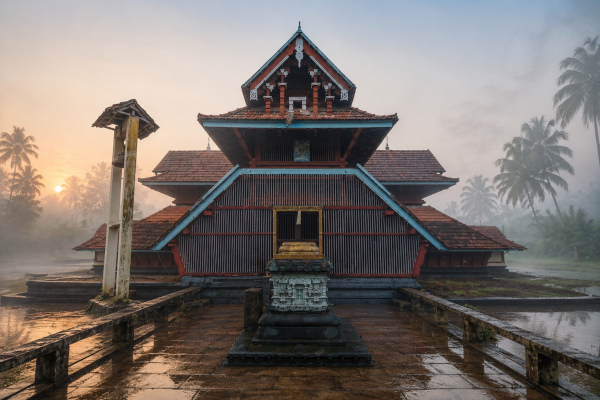
Vazhappally Mahadeva Temple at Changanassery in Kottayam district is one of those Kerala temples where worship, architecture, language and political history meet in one sacred courtyard. At first sight, it appears as a traditional Shiva temple of central Kerala, with sloping tiled roofs, wooden structures, a calm temple compound and the deep silence of an old kshetram. Yet Vazhappally is far more than a local place of worship. It is one of the important memory-sites of early Kerala, associated with Chera-period authority, ancient temple administration, early Malayalam writing and the living devotional culture of Lord Shiva.
The temple is located at Vazhappally, close to Changanassery town, in the fertile cultural belt between Kottayam and Alappuzha. This region has long carried the marks of old Kerala civilisation: waterways, paddy fields, Brahmin settlements, temple-centred villages, political chieftaincies and trading routes. Vazhappally Mahadeva Temple stands within this historical landscape like an anchor. Its sacred presence connects the everyday rhythm of worship with the larger story of how Kerala’s political and cultural institutions took shape.
The presiding deity is Lord Shiva, worshipped as Mahadeva. The deity is believed to be centuries old, and the temple is traditionally counted among the ancient Shiva shrines of Kerala. The sacred atmosphere of the shrine is strengthened by its association with the Parasurama tradition, a recurring sacred geography in Kerala temple legends. According to local belief, the installation of the Shiva presence at Vazhappally is connected to the divine intervention of Parasurama, the sage-warrior avatar who is traditionally associated with the creation and consecration of many Kerala kshetras.
The temple’s uniqueness begins with its structure. Vazhappally Mahadeva Temple is noted for having two nalambalams and two flag masts, a rare feature in Kerala temple architecture. The nalambalam is the enclosed structure around the sanctum that shapes the inner devotional space of a Kerala temple. It separates the sacred core from the outer courtyard and gives the temple its ritual geometry. The presence of two such sacred enclosures gives Vazhappally a distinct identity and reflects the layered ritual importance of the shrine.
The temple is also associated with the Ardhanarishwara concept, the profound form in which Shiva and Parvati are understood as one cosmic reality. This idea is central to the temple’s inner symbolism. Shiva represents stillness, consciousness, ascetic power and cosmic dissolution. Parvati represents energy, fertility, compassion and the creative pulse of the universe. In the Ardhanarishwara vision, these two principles become inseparable. Vazhappally therefore expresses a deeply philosophical understanding of divinity: creation and stillness, masculine and feminine, tapas and grace, all held within one sacred field.
The legend preserved around the temple connects Vazhappally with Neelamperoor and an old episode involving the movement of a Shiva lingam. Local tradition says that during the time of Pallibana Perumal, religious and political changes affected the Neelamperoor region. The story speaks of Brahmin families bringing the Shiva lingam from Neelamperoor to Vazhappally, where it became part of the temple’s sacred history. Parasurama then appears in the tradition as the divine guide who advises the construction of the shrine in the Ardhanarishwara concept. This legend gives the temple a dramatic sacred biography: a deity protected, moved, consecrated and placed within a larger cosmic design.
The historical importance of Vazhappally becomes even greater when one turns to its inscriptional record. The Vazhappally copper plate, often referred to as the Vazhappally Sasanam, is among the most important early records connected with Kerala’s language and polity. It is written in an early form of Malayalam using Vattezhuthu, with Grantha characters where required. The record is linked to the Chera ruler Rama Rajasekhara and refers to a temple committee resolution concerning land and resources for daily worship. This makes Vazhappally a crucial site for understanding how temples functioned as administrative, economic and ritual institutions in early medieval Kerala.
The inscription is not merely a linguistic curiosity. It opens a window into a whole world. It shows that temples were organised institutions with land, paddy income, ritual obligations, committees, local assemblies and royal oversight. Worship required regular resources. Daily offerings required agricultural support. Temple servants had defined responsibilities. Local authorities and the ruler had a role in protecting the continuity of ritual. In this way, Vazhappally becomes a living document of early Kerala governance, where the sacred and the administrative existed together.
The copper plate also reveals the prestige of the temple in the Chera period. A royal presence in a temple-related resolution shows that Vazhappally was part of a wider political network. The temple was not standing outside history; it was inside the machinery of early Kerala society. The king, local elites, Brahmin authorities and temple functionaries all appear in the background of this sacred institution. Through Vazhappally, one can see how the temple became a centre of order, memory, economy and legitimacy.
This is why Vazhappally Mahadeva Temple is important to both devotees and historians. For devotees, it is a powerful Shiva shrine where worship has continued across centuries. For historians, it is a rare doorway into the Chera age, early Malayalam, temple administration and Kerala’s social formation. Many temples preserve legends. Vazhappally preserves legend and record together. It carries the warmth of bhakti and the authority of epigraphy.
Architecturally, the temple reflects the classical Kerala style. The sloping tiled roofs protect the structures from monsoon rains. The wooden framework gives the shrine a soft, organic beauty. The temple courtyard allows space for processions, lamps, rituals and festival gatherings. The layered roofs, inner enclosures, flag masts and sanctum arrangement create the familiar Kerala kshetra experience: movement from the outer world into a quieter, denser sacred centre. Every architectural element serves both climate and ritual.
Kerala temple architecture often avoids overwhelming height and spectacle. Its beauty lies in proportion, woodwork, shadow, lamp light and sacred enclosure. Vazhappally follows this grammar. The temple does not need massive towers to create grandeur. Its power comes from age, rhythm and layered sanctity. The red earth of the courtyard, the dark wooden beams, the coppery tone of old tiled roofs, the lamps before Shiva and the stillness around the sanctum create a devotional atmosphere that is deeply Kerala in character.
The sub-shrines and associated deities enrich the temple’s sacred layout. Traditions connected with the temple speak of Parvati, Dakshinamurthy, Ganapathi and Sastha within the larger ritual field. Dakshinamurthy represents Shiva as the silent teacher, the guru who transmits knowledge beyond words. Ganapathi stands at the threshold of auspicious beginnings. Sastha links the temple to Kerala’s wider guardian-deity traditions. Together, these presences create a complete sacred universe around Mahadeva.
The annual festival of the temple is held in the Malayalam month of Meenam, roughly between mid-March and mid-April. Like many Kerala temple festivals, it is not only a religious occasion but also a community gathering. The festival season brings together rituals, processions, lamps, music, offerings and the emotional participation of devotees. The temple courtyard becomes a living stage where memory and worship are renewed. Such festivals are one of the ways Kerala temples remain socially alive across generations.
Shivaratri is another important occasion for Shiva temples, and at Vazhappally the night of Shiva carries the same spiritual intensity associated with Mahadeva worship across India. Devotees approach Shiva as the destroyer of ignorance, the giver of inner stillness and the lord who stands beyond time. In Kerala’s temple culture, Shiva worship often carries a mood of gravity and inwardness. At Vazhappally, that mood is deepened by the antiquity of the shrine.
The temple’s connection to early Malayalam adds another layer of cultural pride. Malayalam did not emerge as a literary and administrative language in isolation. It grew through temple records, land grants, local assemblies, royal orders, religious institutions and regional social life. The Vazhappally record reminds us that language becomes history when it enters public memory. The inscription is a sign that Kerala’s own linguistic identity was beginning to take recorded form in a temple-centred world.
This makes Vazhappally a temple of language as much as a temple of worship. The sacred syllables of “Namah Shivaya” meet the early written forms of Malayalam. Devotion and language stand side by side. A devotee may come seeking Mahadeva’s grace, while a historian may come seeking the roots of Kerala’s written past. The same temple satisfies both forms of seeking.
Vazhappally’s political importance also continued beyond the Chera age. After the decline of Chera power, the region came under later rulers, including Thekkumkur and Travancore. The temple’s own historical tradition remembers periods of conflict, political change and instability, yet the shrine endured. This endurance is itself a form of history. Dynasties changed, local powers rose and fell, social structures shifted, but the temple continued to hold the community together through ritual continuity.
The presence of Vazhappally in Changanassery’s cultural landscape is also significant. Changanassery has long been an important centre in central Kerala, associated with education, religious institutions, waterways, agriculture and political memory. The temple adds an older layer to this landscape. It reminds visitors that the region’s identity was shaped long before the modern town took its present form.
For a heritage traveller, Vazhappally Mahadeva Temple offers a layered experience. It is a place where one can observe Kerala temple architecture, understand the role of temples in early governance, connect with the Chera past, and experience living Shiva worship. The temple is especially valuable for those interested in Kerala history, early Malayalam, epigraphy, Shaiva traditions and the relationship between sacred institutions and political authority.
The best way to experience the temple is slowly. One should enter the compound without hurry, observe the traditional roofs, the flag masts, the nalambalam layout and the old-world silence of the courtyard. The temple is not a monument frozen for visitors; it is a living shrine. Its deepest meaning comes through the sound of bells, the fragrance of oil lamps, the movement of devotees and the quiet dignity of Mahadeva’s presence.
Vazhappally Mahadeva Temple stands as one of Kerala’s precious sacred-historical sites. Its importance lies not in a single legend or one architectural feature alone. It is important because many streams meet here: Shiva bhakti, Parasurama lore, Ardhanarishwara symbolism, Chera political history, early Malayalam inscription, temple economy, local governance and Kerala architecture. Few temples carry such a combination with such quiet strength.
In the story of Kerala, Vazhappally is a reminder that temples were not only places of prayer. They were centres of language, law, land, memory, art and social order. In the story of devotion, it remains a powerful Mahadeva kshetram where Shiva is worshipped with reverence across generations. Between these two worlds — the historian’s archive and the devotee’s lamp — Vazhappally Mahadeva Temple continues to shine.
How to Reach
Vazhappally Mahadeva Temple is situated near Changanassery in Kottayam district. Changanassery town is the nearest major access point, and the temple is only a short drive from the town centre. Changanassery railway station connects the region with major towns in Kerala and beyond. Road access is convenient from Kottayam, Thiruvalla, Alappuzha and nearby central Kerala towns. The nearest major airports are Cochin International Airport and Thiruvananthapuram International Airport, depending on the visitor’s route.
Best Time to Visit
The temple can be visited throughout the year, but the Malayalam month of Meenam is especially important because of the annual festival. Early mornings and evenings are ideal for experiencing the temple’s atmosphere, when the lamps, rituals and quiet courtyard bring out the full spiritual beauty of the shrine.
You may also like
-
Samatata — The Low-Lying Deltaic Realm of Southeastern Bengal
-
Tamralipta — The Maritime Gateway of the Lower Ganga
-
Suhma — The River-and-Forest Country of Southwestern Bengal
-
Gauda — The Western Bengal Country of the Bhagirathi and the Rise of Karnasuvarna
-
Pundra — The Northern Bengal Kingdom of the Karatoya and the Ancient City of Pundranagara
