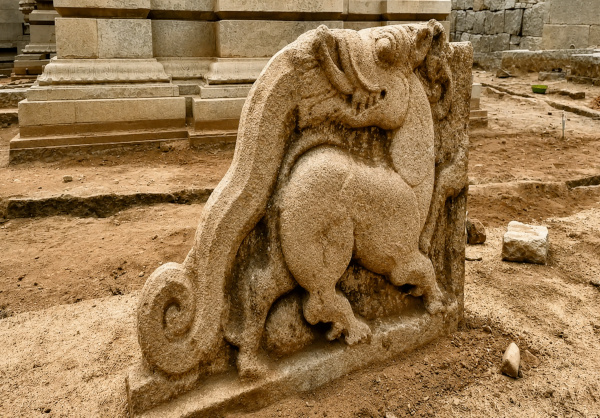
The ruins of Hampi have yielded another important archaeological discovery, with a two-foot-tall stone carving of a Vyala, also known as Yali, and a 23-metre-long stone canal unearthed at the Hazara Rama Temple complex. The finding adds fresh depth to the understanding of Vijayanagara-era temple design, sculptural symbolism and water-management planning at one of India’s most celebrated heritage landscapes.
The Vyala is one of the most powerful figures in South Indian temple architecture. Usually imagined as a composite mythical creature with leonine strength and other animal features, it appears across temple pillars, gateways and sculptural panels as a symbol of protection, royal authority and sacred energy. At Hazara Rama Temple, the new discovery is important because it suggests that such figures were not merely part of wall reliefs or mural-like sculptural programmes, but may also have been carved and installed near major architectural points such as the temple entrance.
This matters because Hazara Rama Temple is already known for its highly narrative sculptural tradition. The temple is associated with the royal and sacred landscape of Vijayanagara, and its carved panels are among the finest visual records of the empire’s artistic confidence. The appearance of a freestanding or installed Vyala figure expands that picture. It suggests a temple environment where mythic guardians, processional imagery, sacred storytelling and royal aesthetics worked together to create a complete visual language.
The discovery was made during soil-digging work connected to development activity in the temple precinct. Along with the Vyala sculpture, archaeologists also found two more damaged Alvar idols and the long stone canal. These finds are significant because they show that the buried layers around Hazara Rama Temple still hold evidence of religious practice, structural planning and ritual movement that may not be visible from the monument’s present surface.
The stone canal is especially revealing. A 23-metre channel made of stone points to organised water management during the Vijayanagara period. In a temple complex, water was not merely a utility; it had ritual, architectural and civic importance. It could be used for ablutions, drainage, seasonal flow, cleansing of sacred areas and controlled movement of water across the precinct. Earlier reporting on the same excavation zone noted that a stone-lined drainage system had been exposed at Hazara Rama Temple, with archaeologists linking it to water circulation and ritual cleansing practices.
This gives the canal a larger meaning. Vijayanagara’s greatness did not rest only on monumental gateways, markets and temples. It also depended on hidden engineering — drains, channels, tanks, stone-lined passages and carefully planned water routes. The visible grandeur of Hampi was supported by an invisible system of urban intelligence. The new canal reminds us that medieval Indian temple architecture often blended devotion with precise civil engineering.
A local interpretation suggests that the narrow canal may have helped channel water from the Queen’s Bath side through the Mahanavami Dibba area. This possibility is striking because it links the find to the wider royal zone of Hampi, where ceremonial spaces, palace remains, water structures and sacred monuments formed a connected urban landscape. The Archaeological Survey of India’s own description of Hampi highlights the importance of the Mahanavami Dibba, tanks, ponds, mandapas, palace remains and other architectural features within the city’s royal and sacred geography.
The Alvar idol fragments add a religious layer to the excavation. The Alvars were Vaishnavite poet-saints whose devotional tradition had a major influence across South India. Their presence in the Hazara Rama Temple precinct points towards the Vaishnavite devotional culture that shaped parts of Vijayanagara’s sacred life. The discovery of damaged idols also raises the possibility that the present ruins preserve only a fraction of the religious sculpture once installed in and around the complex.
This is part of a wider chain of recent discoveries around Hampi. Archaeological work near Hazara Rama Temple has also brought attention to buried structures, additional Alvar sculptures and possible Jain remains, showing that the site was a layered religious and architectural zone rather than a single isolated monument. A recent report also noted the discovery of a buried Vijayanagara-era structure near the southern gate wall of Hazara Rama Temple, with visible elements including a brick-built shikhara and sanctum-related remains.
The latest find therefore strengthens a powerful idea: Hampi is still unfinished as an archaeological story. What tourists see today — the stone chariot, temple towers, royal platforms, elephant stables, mandapas and boulder-strewn ruins — is only the visible skin of a much deeper city. Beneath the soil are broken sculptures, buried shrines, water systems, ritual pathways and architectural fragments that can still change the way historians understand Vijayanagara.
The Vyala sculpture brings back the artistic imagination of the empire. The stone canal brings back its engineering discipline. The Alvar idols bring back its devotional life. Together, these discoveries show Hampi not merely as a picturesque ruin, but as a living archive of stone, water, faith and power. Each excavation adds a new sentence to the story of a capital that once stood among the most magnificent cities of the medieval world.
You may also like
-
Mushika — The Northern Malabar Kingdom Beneath Ezhimala and Beside the Arabian Sea
-
Tosala — The Ancient Heartland of the Daya, Mahanadi and Odisha’s Coastal Plain
-
Odra — The Mahanadi Country of Forested Hills and River Valleys
-
Utkala — The River-Bound Eastern Land Between the Highlands and the Sea
-
Kalinga — The Eastern Kingdom Between Mahendra and the Sea
