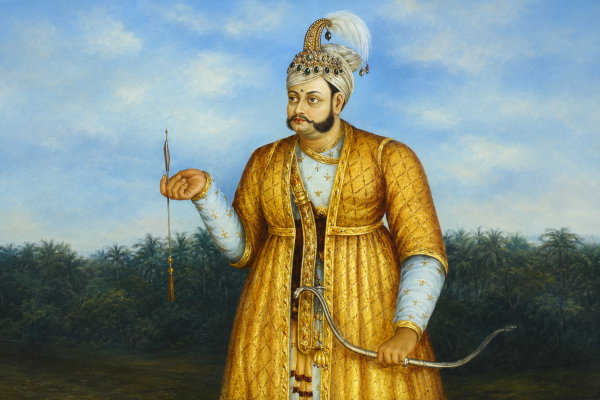
Avittom Thirunal Balarama Varma occupies one of the most difficult places in the history of Travancore. He was not a conquering king like Marthanda Varma, nor a long-reigning stabiliser like Dharma Raja. His rule, from 1798 to 1810, came at a moment when Travancore had already become a major South Indian power, but was entering a new age of British pressure, palace intrigue, financial strain and administrative turbulence. He became ruler as a teenager, inherited a powerful state, and then watched that state get pulled into one of the sharpest political crises in Kerala’s modern history.
Balarama Varma’s reign must be understood as a transition period. Travancore had been built into a disciplined kingdom by Anizham Thirunal Marthanda Varma and strengthened under Karthika Thirunal Rama Varma, better known as Dharma Raja. By the time Dharma Raja died in February 1798, Travancore had expanded from Cape Comorin to the Pampa region and had become one of the strongest states in South India. The Travancore State Manual records that Balarama Varma was installed on the throne at the age of sixteen, inheriting a kingdom at the height of its reputation but entering office without the maturity or administrative authority of his predecessors.
That contrast shaped everything that followed. Dharma Raja had ruled with experience, caution and moral prestige. Balarama Varma entered the palace as a young sovereign surrounded by officials, favourites, court factions and ambitious intermediaries. He was expected to command a state that had survived Mysorean pressure, handled European powers, maintained temple-centred legitimacy and managed a complex revenue system. But the throne had changed before the king had fully grown into it.
One of the first major tragedies of his reign was the fall of Raja Kesavadas, the brilliant Dewan who had served Dharma Raja and had contributed immensely to Travancore’s administration, trade, public works, ports and finances. The State Manual credits Kesavadas with developing Alleppey as a commercial centre, improving roads, bridges, markets, fortifications, temples and revenue arrangements. His removal soon after Balarama Varma’s accession weakened the administrative backbone that could have guided the young ruler through a dangerous decade.
Kesavadas was dismissed and confined as a state prisoner. Soon after, he was found dead in his residence. Historical accounts record rumours of poisoning, while the Court of Directors of the East India Company later stated that there was strong reason to believe he had been poisoned. Whether one accepts every detail of these accounts or treats them cautiously, the political meaning is clear: the early reign of Balarama Varma began with the destruction of one of Travancore’s most capable administrators.
The vacuum was quickly filled by court favourites. Jayanthan Sankaran Namboothiri and his circle gained influence, and the administration began to lose public confidence. The State Manual describes forced financial exactions, arbitrary demands and pressure on officials and local elites. One of those asked to pay a heavy amount was Velu Thampi, then a Karyakkar. He was ordered to pay 20,000 fanams, roughly Rs. 3,000, immediately. He asked for three days, returned south, rallied local support, and helped trigger a popular rising against the ruling clique.
This was the first great turning point of Balarama Varma’s reign. The people who gathered under Velu Thampi demanded the dismissal and banishment of the unpopular ministerial group, an end to forced contributions and relief from excessive imposts. The uprising showed that Travancore’s political culture still had a strong sense of lawful order and royal accountability. The people were not simply rebelling against the throne; they were protesting against those who had captured the machinery around the throne.
Velu Thampi’s rise from this moment became inseparable from Balarama Varma’s reign. He became one of the most powerful figures in the kingdom, first as a force against corrupt palace influence and later as the Dalawa of Travancore. For a time, he was also associated with the British Resident, Colonel Colin Macaulay. This alliance between the Dalawa and the Resident initially looked like a route to administrative order. In reality, it gradually created a deeper problem: Travancore’s internal politics became tied to British intervention.
The background was financial. Travancore had already been under pressure because of war expenses, military arrangements and the changing balance of power after the Mysorean wars. The revised relationship with the East India Company brought heavier subsidy obligations and increased British leverage. The State Manual records that when arrears of subsidy were pressed, Balarama Varma complained that the new treaty forced upon him was unbearable, and he even requested the recall of Macaulay. This shows that the king was not simply passive; he recognised that British interference was becoming a burden on the state.
The crisis sharpened when Velu Thampi, once a supporter of British connection, turned against Macaulay’s interference. The State Manual gives a nuanced reading of Velu Thampi: he had earlier helped persuade the Maharaja to accept treaty conditions, even when many in the country disliked them, but later opposed Macaulay when he used his influence harshly against Travancore. This transformation made Balarama Varma’s court the centre of a dangerous triangle: the Maharaja, the Dalawa and the British Resident were now pulling the state in different directions.
The result was the famous Velu Thampi Revolt of 1808–1809, one of the earliest major anti-British political uprisings in South India. Velu Thampi issued the Kundara Proclamation on 11 January 1809, calling upon the people of Travancore to resist British domination. The State Manual describes the proclamation as a powerful appeal that invoked Travancore’s distinct position, the prestige of its former rulers, the protection of religion and customs, and resentment against the Company’s financial demands.
The proclamation electrified parts of the country. Armed men joined Velu Thampi in large numbers, and the Travancore forces were described as numbering more than 30,000 men with 18 guns. Battles followed around Quilon and Cochin, with British forces eventually gaining the upper hand. The fighting showed both the emotional force of the revolt and the military limits of Travancore against a disciplined Company army with better coordination, reinforcements and firepower.
Balarama Varma’s position during this crisis was painfully complex. He had reason to resent British pressure, but he also had to protect the throne and the state from total destruction. When the revolt failed, Velu Thampi became isolated. The kingdom moved back into a British-supervised order, and Velu Thampi’s death in 1809 marked the end of the armed phase of the rebellion. The aftermath strengthened British influence in Travancore and weakened the older model of royal independence.
Balarama Varma died in 1810, still very young. His reign lasted only about twelve years, but those twelve years were filled with events that changed Travancore permanently. After his death, Gowri Lakshmi Bayi came to power, and the kingdom entered a new administrative phase in which British Residents and reformist Diwans would play an even larger role.
His legacy is therefore not easy to summarise. He was not a strong ruler in the style of Marthanda Varma. He did not leave behind the cultural grandeur associated with Swathi Thirunal or the reformist reputation of later Travancore rulers. But dismissing him merely as a weak king would be too simple. He was a teenage ruler placed at the centre of a collapsing old order. Around him stood ambitious courtiers, a wounded revenue system, a rising British Resident, a powerful Dalawa, a suspicious army and a population increasingly sensitive to taxation and foreign interference.
Balarama Varma’s reign is important because it shows the moment when Travancore moved from sovereign Hindu kingdom to protected princely state under increasing colonial supervision. Under Marthanda Varma, Travancore had defeated European military power at Colachel. Under Dharma Raja, it had preserved stability through diplomacy and defensive strength. Under Balarama Varma, the kingdom confronted a different kind of power: treaty pressure, subsidy debt, resident interference and administrative capture.
This is why his story deserves a more balanced place in Kerala history. He was a ruler of misfortune, but also a ruler of historical consequence. His reign produced the fall of Raja Kesavadas, the rise of Velu Thampi, the Kundara Proclamation, the confrontation with Macaulay, and the final tightening of British influence over Travancore. Few kings in Kerala history witnessed such a dramatic concentration of internal revolt and external pressure within such a short reign.
Balarama Varma’s life also teaches a larger political lesson. A kingdom can be powerful in territory, tradition and memory, yet vulnerable if its administrative centre weakens. Travancore had forts, revenue, temples, ports and soldiers; what it lacked during his reign was steady political command. Once the centre became unstable, palace factions, ministers and foreign residents began to shape the destiny of the state.
In the long arc of Travancore, Balarama Varma stands as the king of the storm between two eras. Before him was the age of expansion and sovereign confidence. After him came the age of regency, British-guided administration and gradual reform. His reign was troubled, but it was also the hinge on which Travancore’s modern political history turned.
You may also like
-
Suhma — The River-and-Forest Country of Southwestern Bengal
-
Gauda — The Western Bengal Country of the Bhagirathi and the Rise of Karnasuvarna
-
Pundra — The Northern Bengal Kingdom of the Karatoya and the Ancient City of Pundranagara
-
Vanga — The River Kingdom of the Bengal Delta and the Eastern Sea
-
Kishkindha — The Boulder Kingdom of Pampa, Rishyamukha and the Tungabhadra
