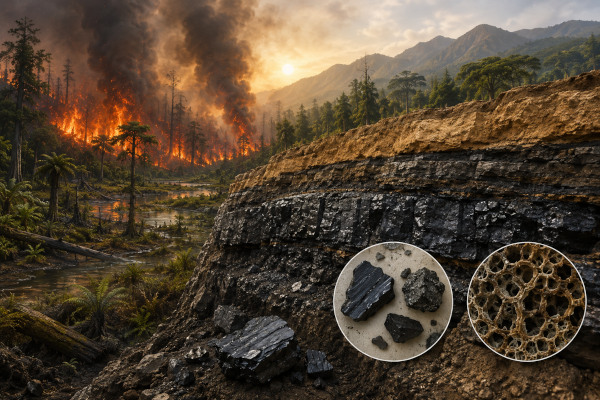
ndian scientists have uncovered molecular evidence of massive ancient wildfires preserved in coal-bearing sediments, opening a new window into how fire shaped Earth’s climate, vegetation and coal-forming environments nearly 250 million years ago. The research, carried out on Gondwana sediments from the Godavari Valley Coalfield, shows how ancient forests responded to intense fire activity during the Permian period and how those events became locked into the geological record.
The study was conducted by researchers from the Birbal Sahni Institute of Palaeosciences, an autonomous institute under the Department of Science and Technology. The team used a multi-proxy approach that combined palynofacies analysis with advanced molecular techniques such as Raman spectroscopy and Fourier Transform Infrared spectroscopy. In simple terms, the scientists studied tiny fragments of organic matter preserved inside sedimentary rocks and then used molecular tools to identify whether those particles were linked to ancient fire events.
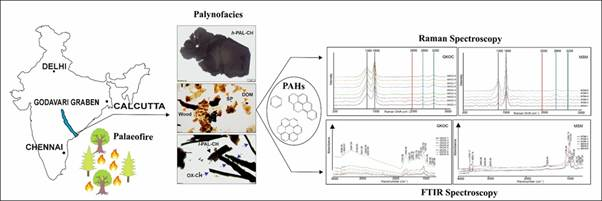
This work is significant because earlier studies of ancient wildfire activity in Indian Permian sediments relied heavily on visible charcoal evidence and microscopic examination. Such methods helped establish that palaeofires existed, but they left uncertainty in distinguishing different types of microcharcoal particles. The new study addresses this gap by adding molecular evidence, allowing researchers to better identify fire-induced organic matter and separate it from other opaque plant-derived particles preserved in the rocks.
The key breakthrough lies in the identification of high-intensity and low-intensity palaeofire-derived microcharcoal particles. These particles were classified based on their shape, preservation, optical features and molecular signatures. The study found signs of combustion-related structural changes in carbonaceous material, including Raman spectral features associated with ordered carbon structures and FTIR indicators of thermal alteration pathways. This gives scientists a sharper method to read the chemical memory of ancient fires preserved inside coal deposits.
The findings also highlight the scientific value of India’s Gondwana coal basins. These sedimentary formations are more than energy resources; they are archives of ancient ecosystems, climate shifts, vegetation patterns and environmental disturbances. When forests burned millions of years ago, fragments of charcoal, plant matter and altered organic particles became embedded in sediments. Over geological time, these materials became part of coal-bearing sequences, preserving evidence of wildfire regimes from a very different Earth.
By studying these ancient fire records, researchers can reconstruct the environmental conditions of the Permian period, when large forested landscapes existed across parts of Gondwana. Fire would have influenced vegetation structure, carbon cycling, sediment deposition and the formation of coal-rich environments. The ability to distinguish fire intensity through microcharcoal signatures gives palaeoscientists a more refined tool to understand how ecosystems responded to repeated or severe burning events.
The study also carries modern relevance. As the world faces rising concerns over extreme wildfire events and climate-linked ecological stress, ancient fire records can help scientists understand long-term relationships between climate, vegetation and fire behaviour. Geological evidence from deep time provides a broader perspective on how ecosystems react to intense environmental change, and how fire can act both as a destructive force and as a driver of landscape transformation.
According to PIB, the research has been published in Geological Journal by Wiley and can support more accurate models of long-term climate change by reconstructing the palaeoenvironment of Gondwana basins. This makes the study important not only for palaeontology and geology, but also for climate science, ecological modelling and future environmental forecasting.
The research team, consisting of Neha Aggarwal, Shivalee Srivastava and Runcie Paul Mathews, has therefore added a valuable new layer to India’s palaeoscience research. Their work shows how coal can preserve more than fossilised plant remains; it can preserve the chemical fingerprints of ancient disasters, allowing scientists to reconstruct vanished forests, lost climates and fire events that shaped Earth long before human civilisation appeared.
India’s latest palaeofire research is a reminder that the planet’s oldest sediments still carry living lessons for the present. The coalfields of the Godavari Valley, formed from ancient organic worlds, now help scientists decode how fire, climate and vegetation interacted across deep time. In an era of changing climate and growing wildfire risks, such research strengthens the bridge between Earth’s distant past and humanity’s environmental future.
Publication link: https://doi.org/10.1002/gj.70295
You may also like
-
Self-assembly of Organic Molecules Opens a New Path to Green Hydrogen Production
-
Bi-layered Single-piece Dental Implant Reduces the Need for Surgical Unterventions
-
NASA Invites ISRO Into Moon Base Programme as US Opens Door Wider to Indian Space Startups
-
ISRO Successfully Completes Final EOS-05 Orbit-Raising Manoeuvre
-
Scientists Uncover A Way to Outsmart Quantum Entanglement Loss with A Single Move
