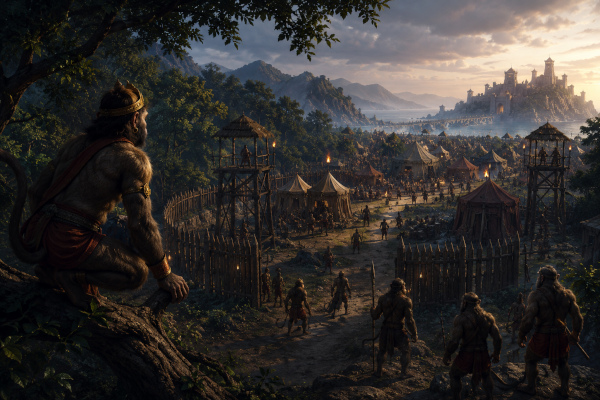
Counter-intelligence is the silent shield of warfare. Armies usually celebrate the arrow, the sword, the missile, the aircraft and the assault formation, yet victory often begins with the quieter work of denying the enemy a clear view of one’s strength. A commander who can see the battlefield clearly fights with confidence. A commander whose spies return confused, intercepted or frightened enters battle through fog. The Ramayana understood this reality with remarkable sharpness. In the Lanka campaign, Ravana sends spies to examine Rama’s army, measure its strength, study its movement and identify vulnerabilities. The episode involving Shardula’s report shows that Rama’s camp had already created a disciplined security environment around the Vanara force. Routes were watched, access points were controlled, and infiltrators were detected quickly. This is battlefield counter-intelligence in its classical form: protect the force, conceal the plan, expose the spy and deny the enemy a reliable picture.
Ravana’s decision to send spies reveals his own strategic anxiety. Lanka was a fortified island kingdom with walls, gates, towers, commanders and reserves, yet the arrival of Rama’s army across the sea changed the balance of confidence. The Vanara force had already achieved the impossible by crossing the ocean through engineering, organisation and morale. Ravana needed to know whether this army was a wild mass of forest warriors or a disciplined invasion force guided by intelligence, leadership and purpose. His spies were sent to observe numbers, formations, leadership centres, supply arrangements, morale, routes and possible weaknesses. In modern military language, Ravana was attempting battlefield reconnaissance through human intelligence. He wanted a ground-level assessment before committing his commanders to decisive combat.
Shardula’s report becomes important because it reveals the strength of Rama’s defensive intelligence posture. He tells Ravana that the Vanara army is difficult to spy upon because the routes are protected and intruders are quickly discovered. This is a sophisticated military detail. The routes around an army are the veins of its operational body. Through them move messengers, scouts, water parties, medical support, reserves, commanders, supplies and assault groups. If enemy agents enter these routes, they can map the army’s internal movement, count units, locate command posts and identify gaps. By securing the routes, Rama’s side protected both movement and information. The battlefield perimeter became a living shield, watched by alert fighters who understood that a spy with accurate knowledge could be as dangerous as a warrior with a weapon.
The Vanara army’s counter-intelligence strength came from its intimate control of terrain. These were warriors of forest, hill, cliff, riverbank and wilderness. They understood movement through natural spaces. They could detect disturbance in paths, unusual behaviour, unfamiliar scent, strange posture and unnatural silence. In a battlefield filled with dust, trees, rocks, camps and temporary routes, such instincts become military assets. Modern armies call this ground dominance. A force that understands its immediate environment can detect infiltrators faster than an enemy expects. Even today, mountain troops, jungle warfare units and special forces rely on pattern recognition: a broken twig, disturbed soil, fresh tracks, misplaced fabric, strange radio silence, abnormal civilian movement or a vehicle parked in the wrong place. The Ramayana presents the same principle through the vigilance of the Vanara force.
Counter-intelligence also depends on identity control. In Ravana’s world, disguise was common. Rakshasas could change form, move through deception and enter spaces through appearance rather than open combat. This made identity verification essential. Rama’s camp had to distinguish between friend, messenger, scout, ally, defector and infiltrator. The presence of Vibhishana had already introduced a delicate intelligence challenge: one former insider from Lanka had joined Rama with valuable knowledge, while Ravana’s agents could attempt similar movement for hostile purposes. This required alert judgement from the commanders. Modern warfare faces the same problem in different forms. A soldier wearing captured uniform, a hostile drone mimicking a civilian quadcopter, a fake social media account posing as a local source, a cyber actor using stolen credentials, or a vehicle carrying forged markings all represent the same ancient problem: the enemy enters through borrowed identity.
Shardula’s difficulty in penetrating the Vanara camp also points to active counter-reconnaissance. The army was protecting itself by watching the watchers. This is more than guarding a gate. Counter-reconnaissance means searching for enemy scouts, tracking suspicious movement, setting observation posts, placing mobile patrols and forcing the enemy’s intelligence network to operate under stress. A spy performs best when the target behaves casually. A spy fails when every path has eyes, every crossing has watchers and every unfamiliar movement attracts attention. Rama’s army appears as a force in high alert, fully aware that Lanka’s rulers would seek information before battle. The camp itself becomes a disciplined intelligence zone.
Modern battlefields operate through the same logic across land, air, sea, space and cyberspace. Today, a commander protects the force from satellites, drones, electronic intercepts, cyber intrusions, human sources, thermal imaging, signals collection and open-source monitoring. The ancient spy has become a drone feed, a malware implant, a compromised smartphone, a satellite image, a leaked movement video or a social media post showing convoy locations. Yet the purpose remains unchanged: the enemy wants to see. Counter-intelligence exists to decide what the enemy sees, how much he sees, when he sees it and whether the information he receives can be trusted.
The episode also shows the importance of perimeter security before a major assault. An army preparing to attack a fortified city must guard its own assembly areas. Soldiers gathering near the front are vulnerable to surprise raids, sabotage, targeted strikes and psychological operations. If Ravana’s spies had mapped Rama’s command arrangements, they could have guided night attacks, assassination attempts, ambushes or disruption operations. By detecting spies early, Rama’s side reduced the enemy’s ability to strike intelligently. Modern forces follow the same discipline before major operations. Assembly areas are camouflaged, access roads are screened, radio emissions are controlled, drones are monitored, electronic signatures are reduced, and movement is broken into secure phases. Before the first assault begins, counter-intelligence has already shaped the battlefield.
Rama’s camp also demonstrates operational security, the protection of plans, strengths, intentions and timing. The greatest secret in war is often the commander’s next movement. Numbers matter, weapons matter and morale matters, yet timing can decide everything. If Ravana learned where Rama would concentrate pressure, which gate would face the heaviest assault, where reserves stood, how the bridgehead was sustained and which commanders led each wing, Lanka could prepare a sharper defensive response. By restricting enemy reconnaissance, Rama preserved the value of surprise and initiative. Modern militaries treat this as OPSEC. Troop movements, deployment orders, electronic emissions, logistics patterns and even routine photographs are controlled because small fragments can become a complete enemy picture when assembled.
The Vanara army’s strength in detecting infiltrators also reflects morale and discipline. A careless army leaks information naturally. A frightened army talks too much. A disorganised army allows strangers to move freely. A confident army watches, verifies, reports and responds. Shardula’s report suggests that the Vanara force had moved beyond raw enthusiasm into organised military behaviour. These warriors had crossed the sea, formed camps, protected approaches and established watch systems. Their morale was channelled into vigilance. This is crucial in modern warfare as well. Counter-intelligence succeeds through culture. Every soldier, sailor, airman, technician, driver, radio operator and camp worker becomes part of the security grid. The intelligence officer designs the system, but the ordinary guard at a checkpoint may become the person who detects the enemy’s most valuable spy.
There is also a psychological layer in the episode. When spies fail, the sending commander loses certainty. Ravana receives a message that Rama’s army is alert, protected and difficult to penetrate. This damages confidence before battle. The enemy appears disciplined, watchful and resilient. A force that detects spies communicates a warning: “We are prepared, and we are watching.” In modern warfare, the exposure of hostile reconnaissance networks has the same effect. When cyber intrusions are detected, drone scouts are brought down, sleeper cells are arrested, hostile agents are identified or surveillance devices are discovered, the opposing side receives a signal that the target has defensive depth. Counter-intelligence therefore shapes psychology as much as security.
The Ramayana’s treatment of this episode also reveals the relationship between intelligence and command judgement. Ravana gathers reports, but his decision-making is clouded by pride. Rama gathers information, protects information and acts with composure. The difference lies in how intelligence is used. Information by itself does little. It requires interpretation, humility and disciplined response. Ravana’s spies provide fragments, warnings and descriptions, yet his strategic arrogance weakens the value of those reports. Rama’s side, guided by purpose and cohesion, turns intelligence into preparation. Modern command structures face the same challenge. Data floods headquarters from drones, satellites, radars, cyber tools, patrols and liaison networks. The winning commander converts information into clear decisions.
Counter-intelligence in this episode also includes the protection of alliances. Rama’s army was a coalition: Ayodhya’s exiled prince, Lakshmana, Sugriva, Hanuman, Jambavan, Angada, Nala, Nila, Vibhishana and vast Vanara formations. Coalitions are powerful, but they carry security complexity because many groups, ranks and channels operate together. Ravana’s spies would naturally seek seams between allies, hoping to identify confusion or rivalry. Protecting the camp meant protecting unity. Modern coalition warfare faces the same requirement. Multinational forces, joint commands and inter-agency operations need shared security protocols, controlled information flow and trust mechanisms. A coalition that guards its communication lines and internal confidence becomes harder to manipulate.
In a twenty-first century setting, Shardula’s failed reconnaissance would resemble an enemy intelligence team attempting to approach a forward operating base guarded by layered surveillance. Outer patrols would monitor likely access routes. Sensors would detect movement. Drones would scan approaches. Signals teams would watch suspicious transmissions. Cyber defenders would monitor network probes. Human intelligence teams would cross-check unfamiliar contacts. Military police would secure entry points. Commanders would restrict maps, plans and movement details. The principle remains ancient: make the enemy work hard for every piece of information, then make him doubt the value of whatever he collects.
The modern equivalent also extends to counter-drone warfare. A battlefield today is constantly watched from above. Small drones perform the work once done by spies: they count vehicles, locate artillery, follow supply routes and guide precision strikes. Defending against them requires detection radars, electronic jamming, camouflage, decoys, dispersal, hardened shelters and disciplined movement. Rama’s protected routes can be seen as an early expression of this same idea. The army secures movement corridors so that enemy observation loses clarity. A visible route becomes a target. A protected route becomes a controlled artery.
Cyber warfare adds another layer to the same concept. A spy once entered a camp through disguise; today an attacker may enter through a compromised device, infected software, fake login page or malicious data link. The aim is similar: gain access, observe patterns, extract secrets and weaken decision-making. Counter-intelligence now includes network monitoring, access control, encryption, authentication, insider-threat detection and strict information discipline. The philosophical foundation remains close to the Ramayana episode. The army must know who enters, what they can see, where they can move and how quickly suspicious activity is detected.
The most striking lesson from Shardula’s report is that security begins before the clash of arms. Rama’s army was preparing for a massive confrontation with Lanka, yet the battle was already underway in the invisible realm of knowledge. Ravana wanted clarity. Rama’s camp created uncertainty for him. Ravana wanted access. Rama’s perimeter denied it. Ravana wanted to measure morale. Rama’s disciplined force projected confidence. This is why counter-intelligence is a combat function, rather than a rear-area formality. It preserves surprise, protects commanders, secures routes, shields alliances and forces the enemy to fight with an incomplete picture.
In the larger military reading of the Ramayana, this episode deserves a central place. Hanuman’s reconnaissance into Lanka shows the power of deep intelligence. Vibhishana’s defection shows the value of insider knowledge. Shardula’s failed spying attempt shows the equal importance of protecting one’s own camp from enemy eyes. Together, these episodes form a complete intelligence cycle: collect information, analyse the enemy, secure the force and control what the opponent can discover. Ancient Indian military imagination understood that victory belongs to the side that sees clearly while making the enemy see poorly.
Counter-intelligence is therefore the discipline of controlled visibility. Rama’s army stood before Lanka with numbers, courage and divine purpose, but it also possessed vigilance. The Vanara warriors guarded routes, watched approaches and exposed infiltrators quickly. In modern terms, they protected their operational picture, secured their perimeter and defended the integrity of command decisions. The episode turns a short report from Shardula into a timeless lesson: before an army breaks the enemy’s walls, it must first protect its own secrets.
You may also like
-
Former DRDO Chief Samir Kamat Confirms Akash Missile Exports to Tajikistan and Turkmenistan
-
MoD Signs ₹586 Crore Contract for Indigenous Auxiliary Power Units for T-72 and T-90 Tanks
-
India–Mongolia Joint Military Exercise Nomadic Elephant 2026 Begins in Pithoragarh
-
Agni-5 Heavy Penetrator Concept Emerges as India Studies Long-Range Bunker-Busting Capability
-
DRDO Gives Private Industry Greater Freedom to Refine Secondary Designs and Subsystems
