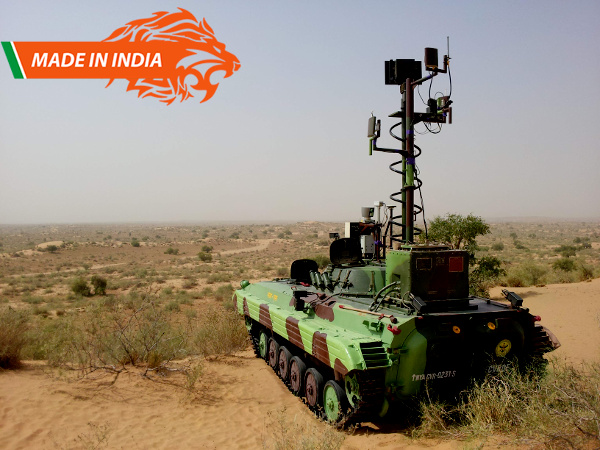
The MUNTRA family of unmanned ground vehicles is one of DRDO’s most important steps in battlefield robotics. Developed by the Combat Vehicles Research and Development Establishment, CVRDE, at Avadi near Chennai, MUNTRA stands for Mission UNmanned TRAcked. It represents India’s attempt to take a proven armoured tracked platform and convert it into a remotely operated and semi-autonomous battlefield system for missions too dangerous for soldiers: surveillance, mine detection, marking of hazardous ground, and reconnaissance in nuclear, biological and chemical threat zones. DRDO’s own Technology Focus issue on unmanned ground vehicles described MUNTRA as CVRDE’s major tracked UGV programme, with variants configured for surveillance, NBC reconnaissance and mine detection/marking.
MUNTRA is often called India’s first unmanned tank, but technically it is better understood as an unmanned tracked ground vehicle rather than a conventional battle tank. Its importance lies less in firepower and more in battlefield survival, sensing and risk reduction. The vehicle gives commanders a way to push sensors into dangerous territory without immediately exposing soldiers, engineers or reconnaissance teams. In modern war, where minefields, IEDs, contaminated zones and forward surveillance gaps can slow entire formations, such machines can become silent force multipliers.
The project began as CVRDE’s effort to convert BMP-II class tracked amphibious vehicles into tele-operated and autonomous platforms. According to DRDO’s Technology Focus account, CVRDE took up the “Conversion of BMP-II into Tele-operated and Autonomous Vehicle” project in 2007, later naming it MUNTRA. The programme developed technologies such as drive-by-wire control, tele-operation, perception systems, robotic manipulators, autonomous navigation, multi-sensor fusion, payload tele-operation, power management and software integration.
The family is built around four major elements. MUNTRA-S is the surveillance variant, designed to observe enemy movement, terrain activity and suspicious targets from a standoff position. MUNTRA-M is meant for mine detection and marking, allowing troops to identify dangerous ground before manned vehicles or infantry enter it. MUNTRA-N is configured for NBC reconnaissance, meaning operations in areas exposed to nuclear, biological or chemical threats. MUNTRA-B acts as the base or command vehicle from which operators control the unmanned platforms through wireless links. DRDO’s archived Technology Focus text describes the system configuration as three mission UGVs and one base vehicle.
The surveillance variant is the most visible member of the family. Reports from the system’s rollout say MUNTRA-S carries a surveillance radar, integrated camera and laser rangefinder, enabling it to observe ground targets up to around 15 km away. Such a platform can monitor crawling infantry, vehicles, suspicious movement or activity along vulnerable approaches. In desert, semi-urban or border environments, this gives troops an extra sensor node that can be placed forward without turning every observation task into a human-risk mission.
MUNTRA-M addresses a different battlefield problem: mines and IEDs. Minefields continue to be among the most effective methods of slowing armoured formations and channelising advancing forces into kill zones. A robotic mine-detection vehicle can reduce the exposure of combat engineers, who are often forced to work under pressure, in hostile terrain, and sometimes under enemy observation. By detecting and marking mine-threat areas, MUNTRA-M fits naturally into route-opening, convoy protection, border-area sanitisation and post-conflict clearance missions.
MUNTRA-N is perhaps the most strategically specialised variant. Chemical, biological, radiological and nuclear environments are among the most dangerous conditions for troops because even reconnaissance can become life-threatening. A tracked unmanned vehicle that can enter a contaminated zone, survey conditions and send back data gives commanders time, information and distance. In any future conflict involving industrial hazards, battlefield chemical contamination or radiological risk, such systems can reduce the need to send soldiers into unknown exposure zones.
The platform’s validation was also important. DRDO’s Technology Focus account states that the MUNTRA UGVs completed rigorous validation trials in summer and winter conditions at Mahajan Field Firing Ranges in Rajasthan. Times of India reported that the vehicle was tested in dusty desert conditions where temperatures touched 52°C, and that the Army was able to tele-operate it comfortably. This matters because robotics on paper and robotics in Indian field conditions are two different things. Desert heat, dust, vibration, poor visibility and long-range communication problems can quickly expose weak engineering.
The real technological value of MUNTRA lies in the conversion architecture. CVRDE had to build a bridge between an armoured tracked vehicle and a robotic control system. That required actuation of steering, braking, acceleration and gear functions; sensor feeds for remote operators; vehicle-health monitoring; obstacle detection; GPS waypoint navigation; and integration of mission payloads. DRDO’s Technology Focus account notes that the autonomous navigation system generated steering, accelerator and brake commands, which were then passed to the drive-by-wire controller. It also records that autonomous navigation on MUNTRA-S was successfully tested at Mahajan in June 2014.
This architecture gives India something more valuable than one vehicle: a technology pathway. Once a laboratory learns how to convert a heavy tracked platform into a tele-operated or autonomous system, the same knowledge can be adapted to other military vehicles, engineer platforms, logistics carriers or hazardous-duty machines. DRDO’s own account says CVRDE reached a level where it had proven capability to convert wheeled or tracked vehicles into rugged tele-operated or autonomous vehicles for demanding terrain and environmental conditions.
MUNTRA also offers lessons for internal security. Times of India reported in 2017 that although the system was developed and tested for the Army, paramilitary forces had shown interest in using it in Naxal-affected areas, though that would require modifications. That interest is logical. In counter-insurgency zones, troops face ambushes, IEDs, suspicious routes, forest tracks and uncertain terrain. A tracked robotic system with surveillance and mine-detection payloads could help in route reconnaissance, camp perimeter monitoring and high-risk area inspection.
The family also shows how India’s unmanned warfare journey is broader than aerial drones. Drones get public attention because they fly, strike and produce dramatic battlefield footage. Ground robots are slower, less glamorous and harder to deploy, but they solve problems that flying platforms cannot. They can examine roads, enter suspicious areas, inspect obstacles, carry heavier sensors, work near troops and operate in terrain where hovering drones may have limited endurance or visibility. In a layered unmanned force, UAVs watch from above while UGVs investigate, confirm, mark and physically interact with the ground.
For the Indian Army, systems like MUNTRA can be especially relevant in three theatres. Along the western front, they can help in desert surveillance, minefield mapping and route opening. Along high-risk internal-security routes, they can reduce exposure to IEDs and ambush-prone tracks. In CBRN emergency scenarios, they can provide reconnaissance before specialised response teams move in. Their greatest value is in the first dangerous hour of a mission, when information is poor and the cost of a wrong step can be fatal.
MUNTRA’s future evolution will depend on autonomy, communications and payload maturity. The next generation of Indian UGVs will need better obstacle understanding, stronger encrypted data links, beyond-line-of-sight control options, AI-assisted target recognition, swarming coordination, modular payload bays and integration with drones and command networks. DRDO’s Technology Focus discussion also pointed to future areas such as high-mobility all-terrain capability, improved power and battery technologies, navigation independent of space-based signals, secure communications under non-line-of-sight conditions, automatic classification and tracking, and swarm operations.
The MUNTRA family should therefore be seen as a foundational project rather than a finished endpoint. It gave India practical experience in robotic conversion of armoured tracked vehicles, sensor integration, remote operation, autonomous navigation and mission-specific unmanned payloads. It also created a domestic knowledge base for larger unmanned ground combat and support systems.
In future warfare, armies will try to preserve trained soldiers for judgment-heavy roles while pushing machines into dull, dirty and dangerous tasks. MUNTRA fits exactly into that transition. It is not a glamorous weapon like a missile or fighter aircraft, but it addresses one of the oldest truths of warfare: the first vehicle or soldier entering unknown ground faces the greatest risk. DRDO’s MUNTRA family gives India a way to send a machine first, gather information, mark danger and keep human beings one step farther from the blast, contamination or ambush.
You may also like
-
Structural Optimisation Reportedly Cuts HAL LUH Vibration by Up to 50%
-
IAF Opens Race to Develop Indigenous High-Altitude Pseudo Satellite for Persistent Surveillance
-
BDL Confirms ASRAAM Missile Facility Fully Operational as Major IAF Requirement Looms
-
DRDO’s Junput Missile Test Facility Back on Track as Bengal Clears 8.73-Acre Coastal Range
-
Pune-Based N3X Labs Flies Scaled WRATH Prototype as Autonomous Aerial Programme Moves Into Hardware Testing
