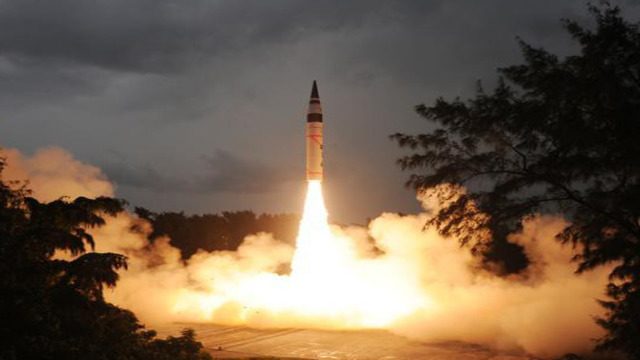
India’s successful test-launch of the Agni-I ballistic missile from the Integrated Test Range at Chandipur, Odisha, on 22 May 2026 is more than a routine missile trial. The most important point in the Ministry of Defence statement is that the launch validated all operational and technical parameters and was carried out under the aegis of the Strategic Forces Command. That single line gives the test its real strategic meaning: Agni-I is not merely a missile on paper, but an operational system whose performance, readiness and reliability continue to be checked under India’s strategic command structure.
Agni-I occupies a crucial place in India’s missile architecture. It is a short-range ballistic missile designed to provide credible deterrence in the lower range band of India’s strategic missile spectrum. While longer-range Agni systems such as Agni-IV and Agni-V often attract more public attention because of their extended reach, Agni-I remains important because deterrence is not built only by range. It is built by coverage, readiness, survivability, command discipline and the ability to respond across different escalation scenarios.
The missile is generally assessed to have a range of around 700 km, with an estimated payload capacity of about 1,000 kg. Open-source technical assessments describe Agni-I as roughly 15 metres long, around 1 metre in diameter, and solid-fuelled, making it a compact and mobile member of the Agni family. Its shorter range gives India a focused strategic option within the regional theatre, while its solid-fuel configuration supports faster readiness compared to older liquid-fuel systems.
The key theme of the latest test is operational validation. Missile development is only the first stage of a strategic weapons programme. The more difficult challenge is to keep the system reliable over years of storage, movement, command handling and periodic user trials. When a missile is tested under the Strategic Forces Command and all operational and technical parameters are validated, it indicates that the user formation is checking the complete chain: launch procedures, system health, trajectory performance, accuracy-related parameters, telemetry, command protocols and mission reliability.
This is where Agni-I becomes strategically significant. In modern deterrence, a missile must not only exist; it must remain dependable under pressure. A successful test reassures the armed forces that the system will perform as expected. It also signals to adversaries that India’s strategic deterrent is regularly maintained, technically verified and integrated into an operational command framework. Such tests are therefore not acts of display alone. They are part of the quiet, disciplined maintenance of credible deterrence.
The involvement of the Strategic Forces Command is central to the story. The SFC is the operational arm responsible for India’s strategic missile forces, and a test under its aegis shows that the launch was linked to user readiness rather than only laboratory demonstration. India’s nuclear doctrine has long emphasised credible minimum deterrence and a posture of No First Use, with nuclear retaliation authorised only by civilian political leadership through the Nuclear Command Authority. In that framework, missiles such as Agni-I are not instruments of aggression; they are instruments of deterrence meant to ensure that any hostile nuclear coercion against India remains unacceptable and risky.
Agni-I also represents the maturity of India’s indigenous missile journey. The Agni family grew from India’s long-term investment in strategic technologies, propulsion, guidance, re-entry systems, launch platforms and command integration. Agni-I may be one of the smaller missiles in the series, but it demonstrates an important principle: a strategic arsenal is not built only around headline-grabbing long-range systems. It needs layered capability across different ranges, so that India’s deterrent posture remains flexible, credible and geographically relevant.
The Chandipur test also underlines the importance of India’s domestic test and evaluation ecosystem. The Integrated Test Range in Odisha has played a central role in validating multiple missile systems over the years. Every successful test helps generate fresh data for engineers, mission planners and user commands. It confirms whether stored systems, production batches, sub-systems, launch equipment and operational procedures remain aligned with required performance standards.
For India, the May 2026 Agni-I launch comes at a time when missile forces are becoming increasingly important in global security calculations. Around the world, nations are investing in precision strike systems, hypersonic technologies, missile defence, long-range artillery and theatre-level deterrence. In this environment, India’s approach has been to maintain a responsible but credible deterrent, backed by indigenous technological depth and periodic operational validation.
Agni-I’s continued testing also shows that India is not neglecting legacy-proven systems while developing newer platforms. Even as systems like Agni-P and Agni-V represent newer generations of missile technology, older operational missiles must be periodically tested, refined and sustained. A credible deterrent is only as strong as its maintenance culture. The 22 May 2026 test therefore sends a message of technical discipline: India continues to verify the readiness of its deployed strategic systems, not merely celebrate new launches.
The larger defence lesson is clear. Strategic power does not come from a single missile, a single test, or a single announcement. It comes from a full ecosystem — design, production, testing, command control, user training, doctrine and political restraint. Agni-I fits into this ecosystem as a compact but important pillar of India’s regional deterrent capability.
India has validated the operational and technical readiness of a key short-range ballistic missile under the Strategic Forces Command. That makes the event significant because it proves the continuing reliability of an existing strategic asset. In deterrence, reliability is power. Agni-I’s successful test reinforces that principle.
You may also like
-
India Advances Project-75(I) and Submarine Modernisation Plans to Strengthen Underwater Warfare Capability
-
Kokasa Launches to Build Indigenous Mission-Critical Systems for Su-30MKI, MiG-29 and T-72
-
Flying Wedge Defence Partners With Portugal’s Keydef to Manufacture Kaal Bhairava and YAMA Drones in Europe
-
ASEAN Diplomats Visit BrahMos Facility as India Showcases Defence Engineering Capabilities
-
India and UAE Agree to Expand Army Cooperation and Desert Cyclone Participation
