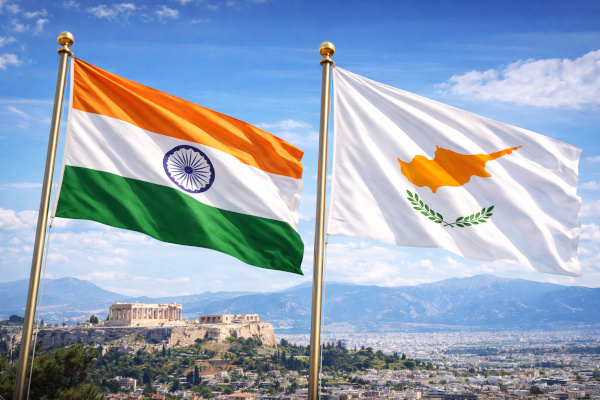
India and Cyprus have taken a major step forward in their bilateral relationship by elevating ties to the level of a Strategic Partnership during the State Visit of the President of the Republic of Cyprus, H.E. Mr. Nikos Christodoulides, to India. The visit produced a wide-ranging list of outcomes covering counter-terrorism, defence cooperation, cyber security, innovation, education, culture, maritime connectivity and consular engagement.
One of the most important outcomes was the signing of an MoU to establish a Joint Working Group on counter-terrorism. This reflects the growing convergence between India and Cyprus on security challenges, particularly at a time when both nations recognise the need for stronger international cooperation against terrorism, radical networks, organised crime and security threats that cross national borders. The mechanism is expected to give both sides a structured platform for dialogue, coordination and exchange of expertise.
Defence cooperation also received a clear institutional push. India and Cyprus announced a Roadmap for Defence Cooperation for 2026–2031, giving the relationship a longer-term framework in the security domain. In addition, a technical arrangement was finalised between the Larnaca Joint Rescue Coordination Center of Cyprus and India’s Ministry of Defence for official coordination and cooperation on Search and Rescue matters. This is especially significant because Cyprus occupies an important location in the Eastern Mediterranean, while India has been steadily expanding its maritime partnerships across key sea lanes.
The two countries also moved to deepen cooperation in technology and cyber security. An MoU was signed between Cyprus’ Deputy Ministry of Research, Innovation and Digital Policy and India’s Ministry of Electronics and Information Technology on innovation and technology. Alongside this, both sides announced the establishment of a dedicated Cyber Security Dialogue, which can help address emerging challenges such as digital infrastructure protection, cyber resilience, data security and secure technology ecosystems.
Education and diplomatic training formed another important pillar of the visit. India’s Sushma Swaraj Institute of Foreign Service and the Diplomatic Academy of Cyprus signed an MoU in the field of diplomatic training, opening the way for greater exchanges between young diplomats and foreign policy professionals. A separate MoU between India’s Ministry of Education and Cyprus’ Ministry of Education, Sport and Youth will strengthen cooperation in higher education and research.
Cultural ties were also given a fresh boost through an MoU on Cultural Cooperation for the years 2026–2030. This agreement can support exchanges in heritage, arts, literature, cultural festivals, academic interaction and people-to-people engagement. For two civilisationally rich societies connected through history, trade and shared democratic values, cultural diplomacy remains a valuable bridge.
In a notable Indo-Pacific development, Cyprus announced its decision to join the Indo-Pacific Oceans Initiative under the pillar of Trade, Connectivity and Maritime Transport. This gives the India-Cyprus partnership a wider strategic dimension beyond bilateral relations, linking the Eastern Mediterranean with India’s broader maritime vision for secure, open and resilient connectivity.
India also announced the gifting of a BHISM Cube — Bharat Health Initiative for Sahyog Hita & Maitri — to the Republic of Cyprus. The BHISM Cube is part of India’s humanitarian assistance and disaster-response approach, designed to provide rapid medical support during emergencies. This gesture adds a health-security and humanitarian dimension to the partnership.
Another outcome was the celebration of the first-ever India-Cyprus Space Day on 18 May 2026, signalling the growing relevance of space cooperation in the bilateral agenda. Cyprus also announced its intention to open a Cyprus Trade Center in Mumbai, which could help expand commercial engagement, investment linkages and business outreach between the two countries.
Overall, the outcomes of President Christodoulides’ visit show that India-Cyprus relations are moving beyond traditional diplomatic goodwill into a more structured and strategic phase. With cooperation now spanning counter-terrorism, defence, cyber security, innovation, education, culture, space, health assistance and maritime connectivity, the partnership has acquired both depth and direction. For India, Cyprus represents a trusted partner in the Eastern Mediterranean and the European Union space. For Cyprus, India offers a fast-growing global economy, a major technology base, and a rising strategic presence in the Indo-Pacific and beyond.
You may also like
-
Exercise Tarang Shakti 2026 Concludes in Jodhpur, Showcasing India’s Air Power, Indigenous Defence Technology
-
US Double Standards in Foreign Policy: 16 Recent Cases Involving India, Russia, China and Global Trade
-
Indian Navy Vice Chief Inspects Japan’s Mogami-Class Stealth Frigate as India-Japan Shipbuilding Cooperation Expands
-
INS Trishul Arrives in UK for Exercise KONKAN 2026 as India and Royal Navy Expand Maritime Cooperation
-
INS Sahyadri Arrives in Russia for Exercise INDRA 2026 to Strengthen India-Russia Naval Cooperation
