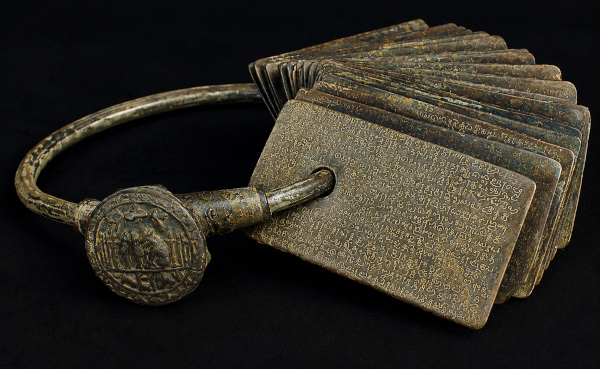
The return of the Anaimangalam Copper Plates from the Netherlands marks far more than the repatriation of an ancient artefact. It brings back to India one of the most important surviving records of the Chola age, a document that links Tamil political power, Indian Ocean trade, Buddhist patronage, Southeast Asian diplomacy and the administrative sophistication of medieval South India. Preserved for generations in the Netherlands and widely known as the Leiden Plates, the copper charter has now returned to public attention as a major symbol of cultural restitution between India and Europe.
The plates belong to the world of Rajaraja Chola I and Rajendra Chola I, two rulers who transformed the Chola kingdom into one of Asia’s most influential maritime powers. Rajaraja Chola I, who ruled from 985 CE to 1014 CE, is remembered not only for military expansion and monumental temple-building, but also for creating a disciplined administrative state that recorded land, revenue and religious grants with remarkable precision. The Anaimangalam charter records a grant connected with the Chudamani Vihara at Nagapattinam, a Buddhist monastery associated with the Srivijaya kingdom of Southeast Asia. This makes the plates a rare witness to a time when the Coromandel Coast was not a remote regional shoreline, but a central artery in the commercial and cultural life of the Indian Ocean.
The physical form of the record itself is striking. Leiden University’s own special collections description identifies the charter as a heavy copper-and-bronze object consisting of 21 copper plates held together by a massive bronze ring, sealed with the emblem of Rajendra Chola I. The entire construction weighs around 30 kilograms, making it not merely a written document but a royal monument in metal. Its inscriptions are in Sanskrit and Tamil: the Sanskrit portion presents the Chola genealogy, while the Tamil section records the grant and recalls the achievements of Rajaraja Chola I.
The importance of the Anaimangalam Copper Plates lies in what they reveal about the Chola state. This was a civilisation that treated land grants, tax assignments and religious endowments as matters worthy of durable inscription. Copper plates were not decorative objects; they were legal, political and sacred records. By engraving a grant on copper, the Chola court ensured that the decision could outlive palm-leaf manuscripts, oral memory and temporary political arrangements. In that sense, the plates are a thousand-year-old administrative archive, carrying evidence of how medieval Tamil rulers governed territory, protected donations and projected legitimacy.
The most fascinating aspect of the charter is its connection with the Chudamani Vihara at Nagapattinam. The monastery was linked to Sri Mara Vijayotunga Varman, a ruler of the Srivijaya realm in present-day Indonesia and the Malay world. The Chola record shows that a Hindu emperor could support a Buddhist institution built by a Southeast Asian ruler in a Tamil port town. That single fact opens a window into the cosmopolitan nature of Nagapattinam: merchants, monks, envoys and sailors would have moved through the port, carrying not only goods but also ideas, scripts, rituals and political messages across the Bay of Bengal.
The plates also complicate simplistic readings of medieval power. Rajaraja Chola’s support for a Buddhist institution shows a pragmatic and expansive model of kingship, where patronage could cross religious and regional boundaries. Yet, under Rajendra Chola I, relations between the Cholas and Srivijaya later became more hostile, culminating in Chola naval expeditions into Southeast Asia. The same historical world therefore contained diplomacy, trade, religious patronage and military competition. The Anaimangalam plates preserve the softer, diplomatic and civilisational side of that relationship, even as later history records the harder edge of Chola naval power.
The journey of the plates to Europe is part of the colonial-era movement of Indian antiquities into foreign collections. ThePrint reports that the plates were brought to the Netherlands around 1700 by Florentius Camper, during the period when Nagapattinam was under Dutch control, and that the precise legal circumstances of the transfer remain unclear. The plates eventually entered the Leiden University Library collection, where they became known to scholars as the Leiden Plates. India’s pursuit of their return reportedly began in 2012 and gained momentum through UNESCO-backed processes and bilateral engagement with the Netherlands.
Their return is therefore not merely a museum matter. It is part of a wider global debate over colonial collections, provenance and the moral responsibility of institutions that hold heritage objects removed from their countries of origin. For India, the Anaimangalam plates are especially valuable because they do not represent an isolated royal donation. They speak to Tamil literacy, Chola administration, the Indian Ocean economy, India-Southeast Asia relations, Buddhist networks and the political confidence of a civilisation that recorded its decisions in stone, copper and temple walls.
The repatriation also strengthens the emotional connection between modern India and the Chola past. The Cholas have often been remembered through temples, bronzes, naval campaigns and literary imagination, but inscriptions are the backbone of serious history. Without records like the Anaimangalam plates, much of the Chola world would remain blurred by legend. With them, historians can reconstruct names, grants, places, institutions and cross-cultural relationships with far greater clarity. The return of these plates therefore restores not only an artefact, but a documentary voice from one of India’s most powerful civilisational moments.
For Tamil heritage, the moment is especially meaningful. The plates are a reminder that the Tamil region was deeply connected with the wider world long before modern globalisation. Nagapattinam looked eastward to Sriwijaya, the Chola court dealt with foreign rulers, Buddhist establishments received royal support, and maritime routes linked South India with Southeast Asia. The Anaimangalam Copper Plates stand at the intersection of all these histories. Their return to India is not just the closing of a colonial-era loop; it is the reopening of a thousand-year-old conversation between land, sea, empire, faith and memory.
You may also like
-
Mushika — The Northern Malabar Kingdom Beneath Ezhimala and Beside the Arabian Sea
-
Tosala — The Ancient Heartland of the Daya, Mahanadi and Odisha’s Coastal Plain
-
Odra — The Mahanadi Country of Forested Hills and River Valleys
-
Utkala — The River-Bound Eastern Land Between the Highlands and the Sea
-
Kalinga — The Eastern Kingdom Between Mahendra and the Sea
