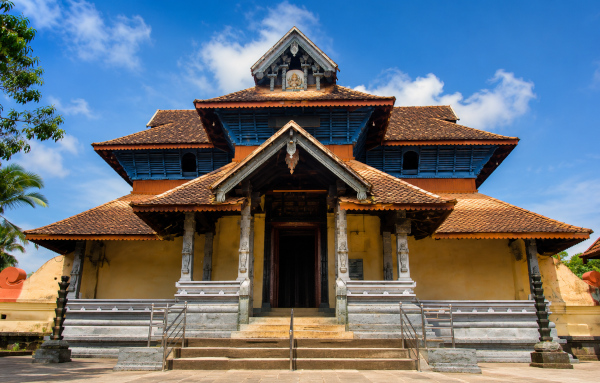
On the quiet banks of the Pamba River in Pathanamthitta district stands one of Kerala’s most revered Krishna temples — the Aranmula Parthasarathy Temple. Dedicated to Lord Krishna as Parthasarathy, the divine charioteer of Arjuna in the Mahabharata, this temple is not merely a place of worship. It is a living centre of legend, architecture, ritual dining, river culture, boat tradition, Vaishnava devotion and Kerala’s sacred geography.
Kerala Tourism specifically identifies Pathanamthitta as a district deeply associated with temple heritage, and Aranmula is one of its most celebrated spiritual centres. The temple is situated in the heritage village of Aranmula, a place known for the Parthasarathy shrine, the Aranmula Vallamkali, the Vallasadya ritual feast and the world-famous Aranmula Kannadi metal mirror tradition. Kerala Tourism describes the temple as a Krishna shrine on the banks of the Pamba, famous for its annual Vallasadya and Vallamkali.
The Deity: Krishna as Parthasarathy
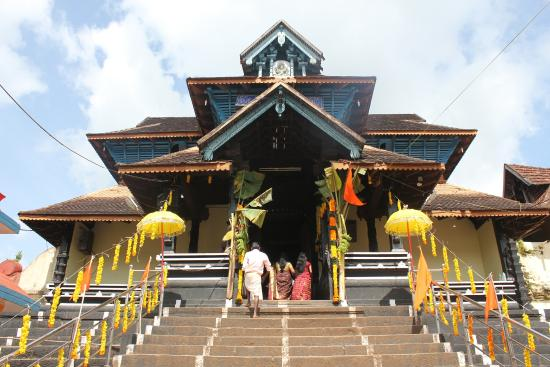
The presiding deity is Lord Krishna in the form of Parthasarathy, meaning “the charioteer of Partha,” another name for Arjuna. This form of Krishna is deeply connected with the Kurukshetra war, where Krishna became Arjuna’s charioteer, guide, philosopher and divine teacher. It is this moment that produced the Bhagavad Gita, making the Parthasarathy form one of the most profound and philosophical images of Krishna.
Unlike the playful Bala Krishna of Guruvayur or the romantic Krishna of Vrindavan tradition, the Aranmula deity carries the majesty of the battlefield teacher. He is Krishna as the strategist of dharma, the counsellor of the confused warrior, and the one who reveals divine wisdom in the middle of crisis. This gives the temple a serious and heroic spiritual personality.
The shrine is also counted among the 108 Divya Desams, the sacred Vishnu temples revered in the Tamil Vaishnava tradition of the Alvars. Kerala Tourism notes that the Aranmula Parthasarathy Temple is one of these Divya Desams and is attributed in tradition to Arjuna.
The Arjuna Legend and the Pandava Connection
The temple’s most powerful legend connects it with Arjuna, the third of the Pandavas. Aranmula is part of a sacred cluster of five ancient Vishnu temples in the Chengannur region, traditionally linked to the five Pandava brothers. In this tradition, each Pandava is believed to have installed or worshipped Vishnu in a different shrine after the events of the Mahabharata.
Aranmula is associated with Arjuna. The legend says that Arjuna, burdened by the moral weight of the Kurukshetra war and especially by the killing of Karna, sought spiritual atonement. Though Karna was his enemy on the battlefield, the manner of his death — while he was struggling with his chariot wheel and was not in full fighting posture — created a dharmic unease in Arjuna’s mind. To purify himself and return to the higher path of devotion, Arjuna is believed to have installed the image of Krishna here.
This legend makes Aranmula a temple of repentance, surrender and restored dharma. The warrior who won the war still had to answer to his conscience. The temple therefore teaches a subtle moral lesson: victory is not always the same as inner peace. Even the greatest warrior must bow before dharma.
The Meaning of the Name Aranmula
The name Aranmula itself is wrapped in legend. One popular belief says that the idol of Lord Krishna was brought to the site on a raft made of six pieces of bamboo. In Malayalam, aaru means six and mula means bamboo, giving rise to the name Aranmula. Kerala Tourism also records this tradition, linking the temple’s name to the legend of the deity being brought on a six-bamboo raft.
The symbolism is beautiful. A deity arriving on a simple bamboo raft down the sacred river is a very Kerala image — river, forest, devotion, community and temple all merging into one.
Architecture: Classic Kerala Temple Style
The Aranmula Parthasarathy Temple is a fine example of traditional Kerala temple architecture. Its beauty does not lie in towering gopurams like the great temples of Tamil Nadu, but in the balance of wood, laterite, copper roofing, sloping lines, enclosed courtyards, lamps and ritual geometry. Kerala Tourism describes the temple’s architecture as a splendid example of Kerala’s traditional style, with wood carvings, mural paintings and a sanctum that carries a strong sacred atmosphere.
The temple follows the typical Kerala kshetra layout. The sreekovil, or sanctum sanctorum, houses the deity. Around it stands the nalambalam, the inner rectangular structure that encloses the sanctum and ritual spaces. The chuttambalam forms the surrounding temple corridor, while the dwajasthambam, or flagstaff, marks the axial sacred line leading toward the deity. The deepasthambam, or lamp pillar, adds to the visual and devotional grandeur, especially during festivals when the temple glows with rows of oil lamps.
The roofing style is distinctly Kerala: sloping tiled or copper-covered roofs designed for the monsoon climate. The heavy rains of the region shaped Kerala temple architecture, giving it deep overhanging eaves and layered rooflines. Wood is used richly, not merely for utility but for sacred storytelling. Carvings associated with episodes from the Ramayana, Mahabharata and Puranic traditions are part of the visual language of such temples.
The temple’s relationship with the Pamba River also adds to its architecture. This is not a shrine isolated from nature; it is a river temple. The steps, approach, processions and boat rituals all make sense only when the Pamba is understood as part of the temple’s sacred body.
The Pamba River and the Sacred Landscape
The Pamba is one of Kerala’s most sacred rivers. It is associated with Sabarimala, with old settlements, with agrarian life and with a chain of temple cultures in central Travancore. At Aranmula, the river is not just a backdrop. It is central to the temple’s identity.
The annual boat traditions, ritual arrivals, processions and community feasts are all linked to the river. The river makes Aranmula a moving temple landscape — one where devotion is not confined within walls but flows through water, songs, oars and community participation.
This connection between river and temple is one of the reasons Aranmula is so distinctive. In many parts of India, temple festivals move through streets. In Aranmula, devotion also moves through water.
Aranmula Vallamkali: The Sacred Boat Tradition
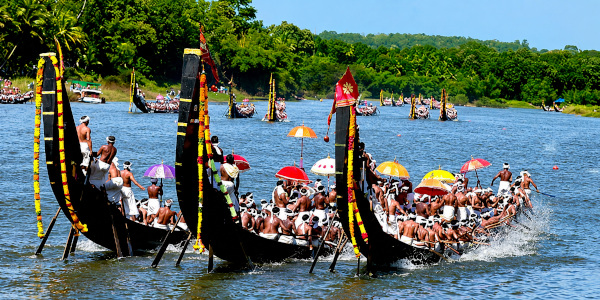
The Aranmula Vallamkali is one of Kerala’s most famous boat traditions. It is often described as a snake boat event, but unlike purely competitive boat races, Aranmula’s tradition has a deep ritual and temple connection. The long boats, known as palliyodams, are regarded with reverence. They are not simply sports vessels; they are ceremonial boats linked to the service of Lord Parthasarathy.
Kerala Tourism identifies the temple as famous for the annual Vallamkali and Vallasadya. The Aranmula boat tradition is associated with Onam season and the Pamba River, and it carries a devotional mood rather than just a sporting atmosphere. The oarsmen sing traditional songs, the boats move in rhythm, and the river becomes a ceremonial pathway.
The legend behind the boat tradition is linked to the protection of temple offerings and the sacred movement of food and devotees. Over time, this became one of Kerala’s most visually powerful cultural events: long snake boats moving over the Pamba, decorated and rowed in unison, with the temple and river forming the sacred axis of the celebration.
Vallasadya: The Ritual Feast of Aranmula
The Vallasadya is one of Aranmula’s greatest traditions. It is not an ordinary feast but a ritual offering connected to the palliyodams and Lord Parthasarathy. Devotees sponsor the feast, and the oarsmen of the palliyodams are treated as representatives of the Lord. The meal is served in the traditional Kerala style on banana leaves, with many dishes arranged in a strict order.
The Vallasadya reflects a very old Indian idea: food is sacred when offered, shared and received with devotion. In Aranmula, the act of feeding is not separate from worship. It becomes annadanam, the sacred giving of food. This is why Aranmula is often remembered not only as a Krishna temple, but also as a place where devotion becomes hospitality.
The temple’s association with food, river and community makes it especially important in Kerala’s living cultural memory. Aranmula does not preserve tradition like a museum; it performs tradition every year through ritual, music, rowing and feeding.
Festivals and Ritual Life
The temple’s ritual calendar is rich. The most famous public associations are with Onam season, the Aranmula Vallamkali and Vallasadya. However, the temple also has its own annual festivals, processions and temple rituals connected to the Vaishnava tradition.
One important aspect of the temple’s wider sacred role is its connection with Sabarimala. The golden attire known as Thanka Anki, offered to Lord Ayyappa, is traditionally taken in procession from Aranmula to Sabarimala during the Mandala season. The Sabarimala-linked official page notes that the Aranmula temple is administered by the Travancore Devaswom Board and gives the temple’s regular opening hours.
This connection gives Aranmula a special place in the sacred network of central Kerala. It is a Krishna temple, a Divya Desam, a river shrine, a Pandava-linked temple and also part of the ritual geography connected with Sabarimala.
Aranmula Kannadi and the Cultural Aura of the Village
Aranmula is also famous for the Aranmula Kannadi, the handmade metal mirror produced by hereditary craft families. Though the mirror is not the central subject of the temple, the cultural identity of Aranmula is incomplete without it. The mirror tradition, the temple, the boat festival and the river together make Aranmula one of Kerala’s rare heritage villages where craft, worship and landscape are intertwined.
The Aranmula Kannadi is not a glass mirror but a polished metal-alloy mirror. Its making is traditionally guarded by artisan families, and it has become one of Kerala’s most iconic heritage objects. In cultural terms, it reflects the same refinement seen in the temple: precision, patience, sacredness and continuity.
Spiritual Meaning of the Temple
The deepest meaning of Aranmula Parthasarathy Temple lies in its image of Krishna as guide. In the Mahabharata, Arjuna is not merely a warrior; he is every human being standing before a difficult moral choice. Krishna as Parthasarathy does not remove the battlefield. He gives wisdom inside it.
That is why Aranmula speaks strongly even today. It is a temple for those who seek clarity, courage and direction. It reminds devotees that life’s battles are not won only by strength, but by surrendering the ego to a higher wisdom.
The temple also shows the Kerala way of preserving sacred culture. It does not separate devotion from food, architecture, river, music, craft or community. At Aranmula, the temple is not only a shrine; it is the centre of a complete civilisation in miniature.
How to Reach Aranmula Parthasarathy Temple
Aranmula is located in Pathanamthitta district and is easily accessible from major towns in central Kerala. The nearest railway station is Chengannur, around 10–11 km from the temple. Kerala Tourism lists Chengannur Railway Station at about 11 km and Thiruvananthapuram International Airport at about 117 km from Aranmula.
By road, Aranmula is well connected to Chengannur, Pathanamthitta and Pandalam. Visitors arriving by train at Chengannur can take a taxi, auto-rickshaw or bus toward Aranmula. Those travelling by air can use Thiruvananthapuram International Airport, while Cochin International Airport is also a practical option depending on the route and travel plan. Incredible India notes that Chengannur is the closest railway station and that Aranmula is connected by road to Chengannur, Pathanamthitta and Pandalam.
The Aranmula Parthasarathy Temple is one of those rare temples where mythology, landscape and living tradition remain inseparable. Its deity is Krishna as the charioteer of Arjuna; its legend carries the memory of the Pandavas; its name recalls a bamboo raft; its architecture reflects Kerala’s monsoon-shaped sacred design; its river hosts the great palliyodams; its ritual feast turns food into worship; and its village preserves one of India’s most unique craft traditions.
For Pathanamthitta, Aranmula is not merely a temple destination. It is a civilisational landmark. It shows how Kerala preserved dharma not only through stone and scripture, but through river, boat, lamp, meal, song, wood, metal and memory.
References:
Kerala Tourism – Aranmula Parthasarathy Temple, Pathanamthitta
https://www.keralatourism.org/temples/pathanamthitta/aranmula-parthasarathy
Kerala Tourism – Aranmula Sree Parthasarathy Temple
https://www.keralatourism.org/destination/aranmula-parthasarathy-temple/564/
Kerala Tourism – Aranmula Heritage Village
https://www.keralatourism.org/destination/aranmula-heritage-village/48/
Incredible India – Aranmula Parthasarathy Temple
https://www.incredibleindia.gov.in/en/kerala/pathanamthitta/aranmula-parthasarathy-temple
Sabarimala Kerala – Aranmula Parthasarathy Temple
https://sabarimala.kerala.gov.in/aranmula-parthasarathy-temple
Aranmula Vallamkali – Official Website
https://aranmulaboatrace.com/
You may also like
-
Mahishaka in the Mahabharata: The Ancient Southern Country of the Upper Kaveri
-
Vanavasi in the Mahabharata: The Ancient Forest Kingdom of Karnataka
-
Kuntala in the Mahabharata: The Ancient Country of Northern Karnataka and Southern Maharashtra
-
Ashmaka or Assaka in the Mahabharata: The Ancient Kingdom of the Godavari Valley
-
Rare Stone Features Emerge as Kerala Archaeology Department Restores Megalithic Kudakkals at Karivellur
