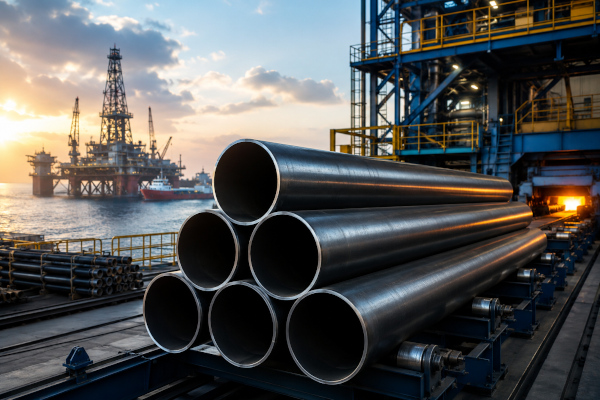
AM/NS India’s Hazira facility in Gujarat has reported a significant manufacturing breakthrough with the successful production of EQ70 ultra-high-strength welded pipes using Submerged Arc Welding technology, a development positioned as a major step forward for India’s offshore steel and marine engineering capability. The report was published on 15 May 2026 by Outlook Business, citing the company’s achievement at its Hazira-based Pipe Mill and the certification of the pipes by the American Bureau of Shipping for offshore and marine applications.
What makes the development important is the grade of steel involved. EQ70 belongs to the high-strength offshore steel family, with a minimum yield strength of around 690 MPa, a level associated with demanding marine structures, shipbuilding applications and offshore drilling infrastructure. Such steel is designed for environments where strength, toughness and reliability are not optional extras but basic survival requirements. Offshore platforms, jack-up rigs and deepwater pipeline systems operate under intense stress, corrosion exposure, pressure cycles and harsh marine conditions. In that world, ordinary steel is not enough; the material must combine strength with weld integrity and long-term durability.
The breakthrough is especially notable because AM/NS India has used Submerged Arc Welding, or SAW, to manufacture the EQ70 pipes. SAW is widely used for producing high-quality welds in heavy engineering, but when applied to ultra-high-strength offshore-grade steel, the process becomes technically demanding. Heat input, weld toughness, microstructure control, crack resistance and dimensional consistency all have to be tightly managed. The Outlook Business report states that the Hazira team spent nearly 12 months developing and refining the process through trials, welding calibration, process optimisation and testing before reaching the ABS certification stage.
For India, the larger significance lies in import substitution and value-added manufacturing. Offshore-grade pipes of this class have traditionally been sourced from specialised global suppliers, particularly in Europe and other advanced steelmaking markets. If AM/NS India can consistently manufacture ABS-certified EQ70 welded pipes domestically, it gives India a stronger place in the high-specification steel supply chain. This is not just about producing more steel; it is about producing steel that can enter critical global engineering sectors.
The applications are strategically important. EQ70 pipes can be used in jack-up rig leg bracing systems, offshore structures and deepwater pipeline infrastructure, where lower weight and high strength can improve project economics. A stronger material can allow thinner and lighter pipe designs without sacrificing structural performance. In offshore projects, weight reduction matters because every tonne affects fabrication, transport, installation and operational cost. That gives high-strength welded pipes a commercial advantage as well as an engineering one.
The certification from the American Bureau of Shipping adds credibility because ABS is one of the globally recognised classification bodies in marine and offshore engineering. Certification means the material and manufacturing process have met required standards for use in critical offshore environments. For an Indian facility to secure such certification in this category strengthens confidence in the country’s ability to produce specialised steel products for international markets.
This also fits into AM/NS India’s wider industrial strategy. The company, a joint venture between ArcelorMittal and Nippon Steel, already operates a major steelmaking and downstream manufacturing base in India. Its official newsroom lists Hazira as the site of recent advanced steel manufacturing investments, including a state-of-the-art automotive steel production line inaugurated in April 2026. The EQ70 pipe development now expands that story from automotive-grade advanced steel into offshore and energy infrastructure steel.
The timing is important. Global energy infrastructure is becoming more technically demanding, not less. Offshore oil and gas, wind energy, marine logistics, hydrogen pipelines and deepwater engineering all require advanced materials. AM/NS India has also indicated that its Hazira Pipe Mill is working on pipe grades for hydrogen transportation using SAW technology, which could place the facility within the emerging clean-energy infrastructure chain.
In practical terms, the Hazira achievement shows how India’s steel sector is moving from volume-led production to technology-led manufacturing. India already has large steelmaking capacity, but the next stage of industrial maturity depends on high-value products: automotive-grade AHSS, offshore-grade pipe, corrosion-resistant steel, special alloys and future energy infrastructure materials. EQ70 welded pipes fall exactly in that category.
For Indian manufacturing, this is the real message of the development. The country is no longer trying only to make basic industrial inputs at scale. It is gradually entering specialised segments where certification, process control, metallurgy and engineering precision define competitiveness. AM/NS India’s ABS-certified EQ70 welded pipes from Hazira therefore represent more than a company milestone. They signal a broader shift in India’s steel story — from mass production to globally benchmarked, high-performance industrial capability.
You may also like
-
Boka Chaul — Assam’s Remarkable Rice That Needs No Cooking
-
Pine Labs Expands in Singapore with Unified Merchant Payments Platform
-
VORAN Partners Italian Manufacturer to Build Light-Aviation Ecosystem in India
-
World Bank Raises India’s FY27 Growth Forecast to 7.1%
-
Adani Power and Druk Green Power to Develop 770 MW Chamkharchhu-I Hydropower Project in Bhutan
