Curculigo orchioides, widely known in India as Kali Musli and in Sanskrit as Talamuli / Musali, is a small medicinal herb whose rhizome or rootstock is the main part used in traditional medicine. In Ayurveda it is valued as a rasayana and vajikarana herb, meaning it is traditionally used to support vitality, tissue nourishment, recovery from debility, and reproductive strength. Modern reviews also note that the plant has been studied for antioxidant, anti-inflammatory, neuroprotective, osteoprotective and reproductive effects, although much of that evidence is still preclinical rather than large human clinical evidence.
One reason Kali Musli is interesting is that its lesser-known benefits go beyond the usual “energy and aphrodisiac” reputation. Traditional and modern literature point toward possible roles in general weakness, recovery, immune support, oxidative-stress protection, kidney-urinary support, and even bone and nervous-system research interest. A 2023 review describes investigation into its pharmacology for inflammation, diabetes, oxidative stress, osteoporosis, neurodegeneration and cancer-related models, while older Ayurvedic-agronomic literature describes it as a tonic, cooling, emollient, diuretic and restorative herb used in general debility and urinary complaints.
For male sexual health, Kali Musli has a strong traditional reputation. Ayurvedic and ethnomedical sources have long described it as a herb for sexual weakness, low vigor, spermatorrhoea, erectile weakness and general reproductive debility. Modern animal studies add some support to that traditional use: PubMed records a 2007 study in male rats where rhizome extract enhanced sexual behaviour, and a 2023 study reported higher testosterone levels and protective effects on reproductive health in male mice under heat stress. That said, this is the key medical caution: these findings are not the same as proof that it will treat erectile dysfunction, infertility, or low testosterone in humans. It is more accurate to say that Kali Musli is a traditionally respected male tonic with encouraging animal data, but limited high-quality human evidence.
How to identify the plant
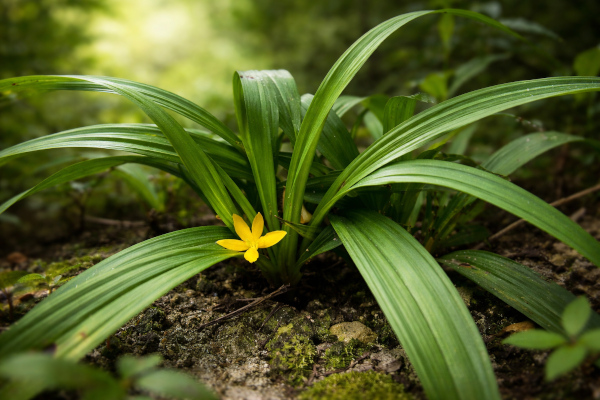
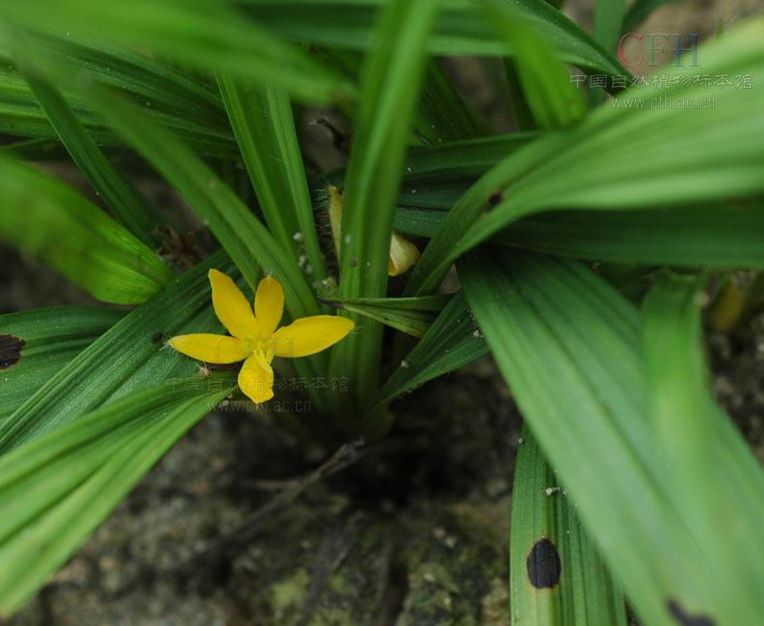
Curculigo orchioides is a small perennial herb, usually much shorter than many people expect when they hear the word musli. India Flora Online describes it as a herb of tropical moist deciduous forests, grasslands and plains, while NParks describes it as a herbaceous perennial reaching about 30 cm in height. Its leaves arise from the base and are usually narrow, linear to lanceolate, crowded around the short stem with sheathing leaf bases. A very useful field clue is the flower: the yellow flowers appear almost at ground level, rather than on a tall showy stalk. The underground part is an elongated tuberous rootstock/rhizome, which is the medicinally used portion.
A practical visual description would be this: if you see a low-growing ground herb with basal strap-like leaves, small yellow flowers close to the ground, and a fleshy medicinal rhizome below the soil, you may be looking at Kali Musli. The fruit is described as oblong, with black seeds, and the plant is found in many parts of India, especially in moist or semi-shaded habitats.
Types of Curculigo orchioides
In ordinary herbal practice, there are not many widely standardized household “types” of Curculigo orchioides in the way mangoes or bananas have named popular varieties. The practical distinction people usually make is between Kali Musli / Black Musli and Safed Musli / White Musli, but these are not the same plant. Kali Musli refers to Curculigo orchioides, while white musli sold in trade is generally from other species, often Chlorophytum species. Within Curculigo orchioides itself, published agronomy work discusses biotypes and quality variation in market samples, rather than well-known consumer varieties. So the honest answer is: the main “type” people mean in Ayurveda is Kali Musli itself, and the more important issue is authenticity, because substitution and adulteration are common in medicinal plant trade.
That authenticity point matters because a 2022 Scientific Reports paper highlighted the need to distinguish Curculigo orchioides rhizome from Curculigo glabrescens rhizome, which had become a major counterfeit in market research. So when buying Kali Musli, the real concern is often genuine species identification, not selecting among many famous internal varieties.
Ayurvedic medicines with Curculigo orchioides
Kerala Agricultural University’s medicinal plant monograph notes that the rootstock of Curculigo orchioides enters classical Ayurvedic formulations such as Vidaryadi Ghrita, Vidaryadi Lehya, Marmagulika, and Musalyadi Churna. In those formulations, the herb is generally used in the broader context of rejuvenation, strength-building, debility, and vajikarana support rather than as an isolated single-purpose herb.
Because Kali Musli is often marketed for stamina and sexual wellness, it also appears in many proprietary polyherbal products, but those formulations vary widely in quality and standardization. For health use, it is wiser to think of Curculigo orchioides as a component in a properly formulated Ayurvedic prescription, especially if the goal is male fertility or sexual function, rather than as a miracle standalone cure.
Its positive side for male sexual health
On the positive side, Kali Musli is one of the few Ayurvedic herbs that has both long-standing traditional vajikarana use and some supportive animal research for male reproductive function. The available studies suggest possible benefits in areas such as sexual behavior, sperm-related parameters, reproductive-organ support, and testosterone under stress models. That makes it especially relevant in discussions of low vigor, fatigue-linked sexual weakness, and reproductive debility. Still, the right expectation is support, not guaranteed cure. For men with persistent erectile dysfunction, infertility, diabetes, hormonal symptoms, or prostate issues, a proper medical evaluation remains important.
In plain terms, Kali Musli is best seen as a traditional restorative herb for male vitality, especially when weakness, stress, and poor stamina are part of the picture. Its reputation is strongest where the goal is to nourish and rebuild, rather than force a quick stimulant-like effect.
Reference:
https://indiaflora-ces.iisc.ac.in/FloraPeninsular/plants.php?name=Curculigo+orchioides
https://indiaflora-ces.iisc.ac.in/herbsheet.php?cat=13&id=3249
https://www.nparks.gov.sg/florafaunaweb/flora/6/0/6069
https://pubmed.ncbi.nlm.nih.gov/17643866/
https://pubmed.ncbi.nlm.nih.gov/19139984/
https://pubmed.ncbi.nlm.nih.gov/21486409/
https://pmc.ncbi.nlm.nih.gov/articles/PMC10136419/
https://pmc.ncbi.nlm.nih.gov/articles/PMC9307770/
https://pmc.ncbi.nlm.nih.gov/articles/PMC4151601/
https://pmc.ncbi.nlm.nih.gov/articles/PMC5736055/
You may also like
-
Karanja — Ayurveda’s Bitter Oil Tree for Skin, Wounds and Kapha-Vata Balance
-
Bengaluru’s SugarStrings.ai Develops Cheek-Swab DNA Test Screening Thousands of Genetic Disorders
-
Green Pyramid Biotech Turns Sophorolipid Research Into a Natural Food-Safety Platform
-
Ashoka — Saraca asoca: Ayurveda’s Celebrated Tree for Rakta and Women’s Health
-
New Smart Technology can Make Diagnosis of Alzheimer’s disease (AD) More Accessible
:%20Ayurveda’s%20Quiet%20Rejuvenator%20for%20Strength,%20Stamina%20and%20Male%20Vitality)