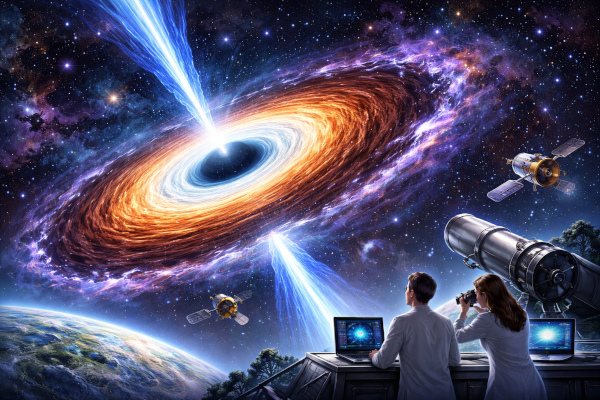
Astronomers from the Raman Research Institute (RRI) have taken a fresh look at one of the universe’s more puzzling high-energy objects and may have uncovered why it produces rare, irregular bursts of X-ray energy. The study focuses on an ultraluminous X-ray source, or ULX, known as M74 X-1, located in the spiral galaxy M74, and suggests that a wobbling accretion disk around the compact object may be behind the unusual flaring behaviour. The findings were reported in The Astrophysical Journal.
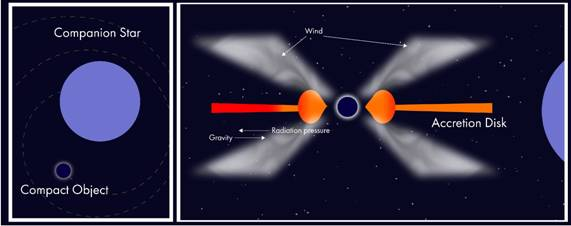
ULXs are among the brightest X-ray-emitting systems in the universe. They are powered by compact objects such as black holes or neutron stars that pull in matter from a companion star. As this material spirals inward, it forms an accretion disk and releases enormous amounts of energy. What makes ULXs especially intriguing is that they can shine far beyond the so-called Eddington limit, the theoretical brightness cap for a celestial object of a given mass. In some cases, they can exceed that limit by more than 100 times, making them a major subject of astrophysical debate.
In the new study, Aman Upadhyay, a PhD student in the Astronomy and Astrophysics division at RRI, and his colleagues analysed observations collected between 2001 and 2021 using NASA’s Chandra X-ray Observatory and ESA’s XMM-Newton space telescope. Their target, M74 X-1, had already attracted attention around 2005 when researchers reported rare flares from the source. These flares were found to recur, but not with clockwork regularity, making the system especially difficult to explain through standard models.
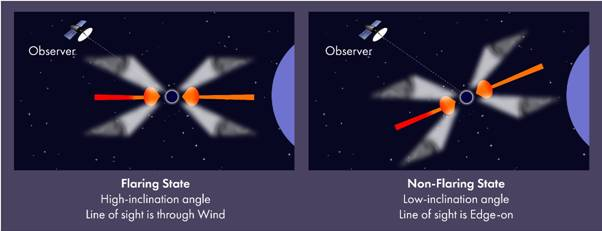
The team examined both flaring and non-flaring data from the source and found an important clue in the flaring spectrum: a noticeable feature around one kilo-electronvolt (keV). According to the researchers, this feature points to the presence of powerful wind being driven off the inner regions of the accretion disk by intense radiation pressure. Yet the non-flaring spectrum appeared to tell a different story, showing that the telescope was at times getting a clearer view of the central, brighter part of the disk without that wind obstructing the line of sight.
To explain the contradiction, the researchers proposed that the accretion disk may be wobbling, much like a spinning top. As the disk shifts, the surrounding wind moves in and out of the telescope’s line of sight, causing the source to appear brighter or dimmer at uneven intervals. This, the team says, could explain why the flares repeat without following a perfectly fixed pattern.
The study also revisits the identity of the compact object powering M74 X-1. Earlier work had suggested it might be an intermediate-mass black hole, a long-sought and relatively elusive class of object. But using updated spectral models, the RRI team estimated the mass at about seven times that of the Sun, which would place it in the category of a stellar-mass black hole. At the same time, the researchers noted that some of the source’s observed properties also resemble those seen in neutron star ULXs, leaving open the possibility that the object could still turn out to be a neutron star.
That uncertainty is now central to the next phase of the research. The team plans to use more advanced methods to search for pulsations from the source. Detecting such pulsations would strongly support the neutron star explanation and help settle the question of what exactly lies at the heart of this unusually bright and erratic cosmic system. Either way, the study adds a new layer of understanding to one of the most fascinating categories of high-energy objects in modern astronomy.
Source: PIB
You may also like
-
IIT Guwahati Develops Affordable Technology to Remove Arsenic and Fluoride From Drinking Water
-
BITS Pilani Goa Develops Pharmaceutical Bioink for 3D-Printed Skin Scaffolds and Customised Medicines
-
New Smart Technology can Make Diagnosis of Alzheimer’s disease (AD) More Accessible
-
Study Identifies Uniqueness of South Asian Gut Microbiome, Critical for Lifestyle Disease Treatment
-
GENESIS EIR 3.0 Offers Up to ₹10 Lakh to Turn Young Indian Innovators Into DeepTech Entrepreneurs
