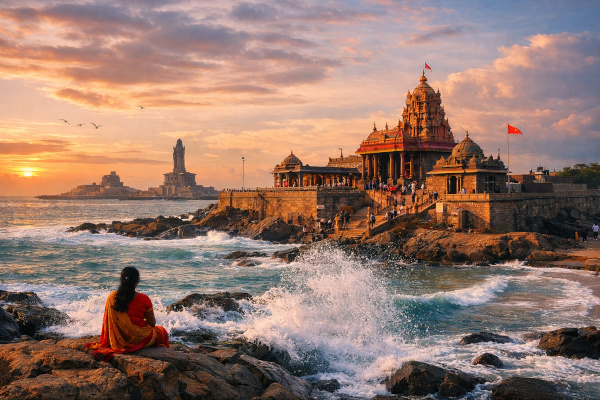
There are temples one visits, and there are temples one feels before one even enters. The Kumari Amman Temple at Kanyakumari belongs to the second kind. It stands at the southernmost tip of mainland India, where the land narrows into rock, wind and salt, and where three great water bodies — the Arabian Sea, the Bay of Bengal, and the Indian Ocean — meet in restless union. The temple is dedicated to Devi Kanyakumari, the virgin goddess, and the town itself takes its name from her. Official tourism sources describe it as one of the 108 Shakti Peethas, a shrine with a traditional history of more than 3,000 years, visited by millions and enclosed within strong stone walls beside the sea.
What makes this temple unforgettable is not merely age, nor just sanctity, nor even its dramatic location. It is the emotional force of its legend. Here, the goddess is not remembered simply as a benign mother or an enthroned queen. She is remembered as a young maiden in penance, a bride whose wedding never happened, a warrior who had to remain unmarried so that evil could be destroyed. The sea outside is beautiful, but the story at the heart of the temple is touched by longing, interruption and destiny.
The goddess and the demon: why Kumari had to remain a virgin
The most widely repeated temple legend begins with the demon Banasura. He had secured a boon that he could be killed only by a virgin girl, and emboldened by that protection, he became a torment to the gods and the worlds. In response, Parasakthi took the form of a maiden — Kumari — and came to this southern shore. Official Tamil Nadu tourism and district sources preserve this tradition clearly: the goddess assumed the form of a virgin so that the demon could finally be defeated.
But the story deepens into something far more tender and tragic. As the goddess performed penance at Kanyakumari, Lord Shiva is said to have fallen in love with her. A divine wedding was arranged. The bride was ready. The auspicious hour was fixed. The sea-washed town awaited celebration. Yet sage Narada, seeing a danger in the marriage, understood that if the goddess ceased to be a virgin, Banasura could no longer be slain. So, in the most famous turn in the temple’s mythology, Narada took the form of a cock and crowed before dawn, making Shiva believe the sacred hour had passed. Shiva turned back on his way from Suchindram, and the marriage never took place. The goddess remained forever Kanya Kumari — the eternal maiden.
That one moment gives the temple its aching emotional event. The legend says the arrangements for the wedding had already been made. Food had been prepared. Ritual expectation had thickened in the night air. Then came interruption, stillness, and the collapse of joy into destiny. In local memory, the goddess did not simply lose a marriage; she accepted a cosmic burden. When Banasura later tried to seize her by force, she killed him and restored order. Only then did she return to penance — not as a rejected figure, but as one who had chosen sacrifice over fulfilment.
This is why the shrine feels different from many other temples of the goddess. Here, power and pathos stand together. The deity is fierce enough to destroy a demon, yet the emotional centre of her mythology is waiting, stillness and renunciation. She remains on the shore, eternally youthful, forever between marriage and transcendence.
A shrine at land’s end
Kanyakumari itself is not an accidental setting. It is one of those rare places where geography intensifies devotion. Official tourism descriptions emphasize that this is the southernmost tip of mainland India, and that the confluence of the three seas gives the place a special sacred and visual power. The temple’s identity is bound to this edge-of-the-world feeling: a goddess at the final point of the land, facing open water and sunrise.
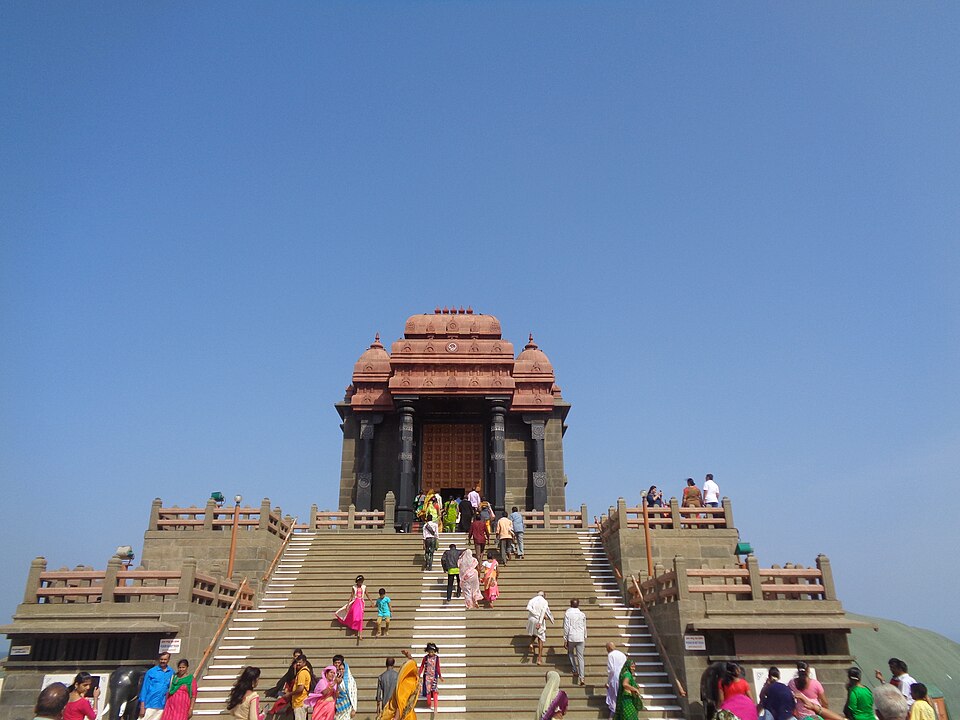
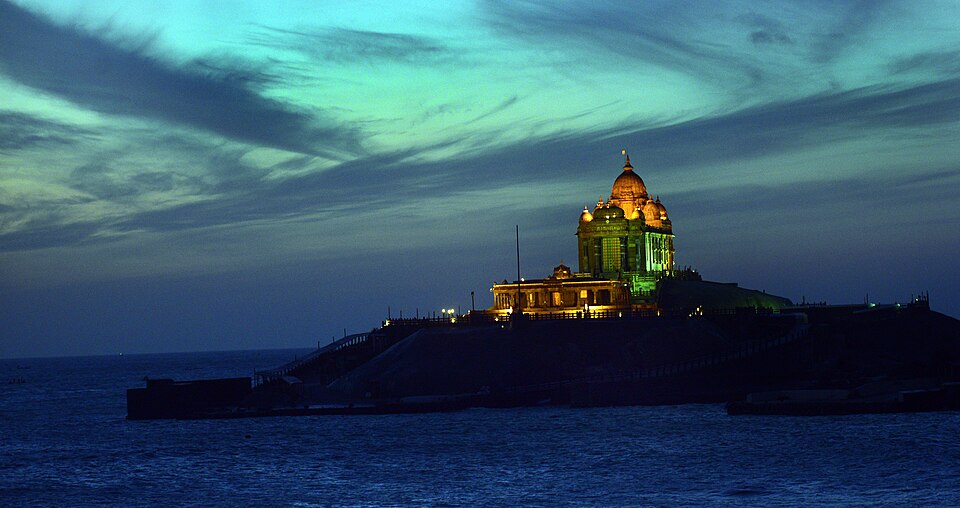
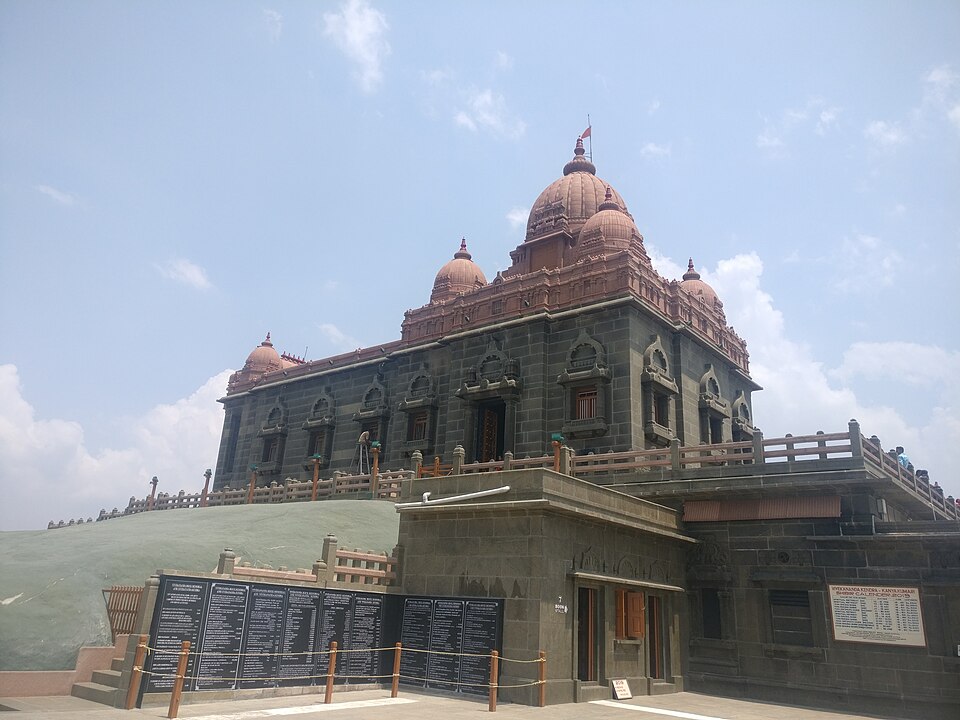
The wider sacred landscape around the temple deepens this feeling even further. The rock now associated with the Vivekananda Rock Memorial, around 500 metres from the mainland, is also linked in local tradition with the goddess’s austerities. District and tourism sources note that this offshore rock is traditionally believed to be the place where Goddess Kumari performed penance, and the associated Shripada tradition preserves the idea of her sacred footprint. In other words, the temple is not just one building; it belongs to a whole sacred seascape of shore, rock, horizon and memory.
How old is the temple? Between legend and history
The temple is traditionally said to be more than 3,000 years old, and that claim continues to appear in official tourism material. That figure should be understood as part of the shrine’s sacred memory and long traditional esteem. Historically, the site is certainly ancient, but like many major Indian temples, its present form is the result of many centuries of rebuilding, patronage and renovation, rather than a structure frozen in one single age.
Scholarly studies of the region suggest that the cult of the goddess is very old, and that the shrine was known in older Tamil literary and religious tradition. Some research papers point out that the worship of the virgin goddess at Kanyakumari is referred to in classical Tamil works such as Silappatikaram and Manimekalai, indicating that the sanctity of the place predates much of the surviving structure. These are not government-authenticated architectural datings, but they do strengthen the case for the shrine’s deep antiquity in religious memory.
As for the built temple, inscriptions and regional historical studies connect it strongly to the Pandya rulers. Research on Kanyakumari’s historical monuments notes that inscriptions found in the temple indicate Pandya patronage, and some studies identify an important rebuilding phase in stone under a Pandya king, often linked to the period of Maran Chadayan in the early medieval centuries. Taken together, the evidence suggests a sensible historical conclusion: the site is older than the current stone fabric, but the temple as we see it owes much to early medieval Pandya construction and later additions.
Temple tradition adds another sacred layer: according to the official tourism account, Parasurama requested the goddess to remain on earth until the end of Kali Yuga and then established the temple by the sea. That belongs to religious tradition rather than verifiable construction history, but it remains central to the devotional imagination of the shrine.
How the temple was constructed and shaped
The temple’s current form reflects the logic of a living coastal shrine rather than a single imperial monument. It is rectangular in plan, enclosed within strong walls, and arranged through a sequence of outer precinct, halls, inner prakaras and sanctum. The Tamil Nadu Hindu Religious and Charitable Endowments Department describes the temple as comprising an outer prakara, mukha mandapa, Navaratri mandapa, dhyana mandapa, inner prakara, a smaller circumambulatory passage around the sanctum, an artha mandapa, and the sanctum itself, all within a rectangular layout.
That description matters because it shows us that the temple was built not only for worship but for movement. South Indian temples are choreographed spaces. One does not merely “enter” them; one advances through them. Courtyards, pillared spaces, enclosed circuits and halls create a gradual deepening of mood, culminating in the encounter with the deity. At Kanyakumari, that architectural movement is sharpened by the awareness of the sea just beyond the walls.
Research literature on the shrine also mentions details such as a Manimandapa before the sanctum, inscribed pillars, subsidiary shrines and a layout shaped by both Dravidian and regional coastal influences. Some academic summaries describe the temple as showing Dravidian style, with intricate carvings on stone walls and black-stone pillars, and also note the influence of the region’s historical connection with Travancore. These later scholarly interpretations should be used with caution, but they broadly align with what a visitor senses: the temple is unmistakably South Indian in vocabulary, yet marked by its liminal coastal setting and cross-regional history.
The architecture: compact, sea-facing, unforgettable
Architecturally, the temple is not overwhelming in the manner of the largest Chola or Nayaka temple-cities. Its power is more intimate. It stands low and firm beside the sea, its sanctity intensified by proximity to wind, tide and horizon. Tamil Nadu Tourism emphasizes the temple’s seaside position and strong enclosing stone walls; the district administration likewise places it at the very edge of the ocean.
The sanctum faces east, toward the sea, though devotees ordinarily enter through the north gate. Both the official tourism site and the HR&CE department note this clearly, and add that the eastern gate is mostly closed, opened only on special occasions. This unusual arrangement has become one of the temple’s defining architectural and ritual features.
The reason the eastern door is famous lies in temple lore. The goddess is said to wear a brilliantly shining nose ornament, traditionally so radiant that ships at sea could mistake it for a lighthouse and drift dangerously toward the rocks. Whether one reads that literally or symbolically, it is a beautiful legend. It gives the deity a luminous, almost tidal presence — as though even the sea could be fooled by her beauty. The architecture, then, is not only masonry; it is also narrative. A closed sea-facing door becomes part of the temple’s mythology.
Within the temple complex are shrines dedicated to Surya Deva, Ganesha, Ayyappa, Bala Sundari and Vijaya Sundari, according to the official tourism description. These subsidiary shrines broaden the temple from a single sanctum into a compact sacred world.
The goddess in the sanctum
At the heart of the temple stands Devi Kanyakumari, the virgin goddess. Official tourism descriptions speak of the “glorious idol” that makes the visitor bow in admiration. Scholarly descriptions identify her as a youthful standing figure associated with maidenhood and penance. More than many formal architectural details, it is this image that defines the shrine.
She is not presented here as domesticated divinity. She is young, radiant, self-contained and powerful. That matters emotionally. You do not stand before a goddess who has completed a narrative; you stand before one who remains in it. Her story is still unfolding in devotional imagination every day: the penance, the waiting, the withheld wedding, the demon’s death, the watch over the seas.
Daily rituals: the temple as a living rhythm
What keeps an ancient temple alive is not stone but repetition. The HR&CE department’s official temple page gives the daily timings: the temple opens from 4:30 AM to 12:30 PM and again from 4:00 PM to 8:30 PM. It also lists key ritual moments including abhishekam, deepaaradhana, uchikala pooja, sayaraksha deepaaradhana, sribali, and the final ekanta deepaaradhana at night.
These details matter because they reveal that this is not a monument preserved behind glass. It is a breathing sacred institution, structured by ritual time. Dawn here is not simply morning; it is opening, bathing, flame, bell, chant. Evening is not simply sunset; it is return, lamp-lighting, procession and closure. In a place where sunrise and sunset over the waters already carry such visual force, the ritual day of the temple acquires an almost theatrical sacredness.
Festivals: when the goddess enters the streets
If the daily rhythm gives the temple continuity, festivals give it emotional intensity. The Kanniyakumari district administration identifies the temple’s principal annual celebrations as the Rath Yatra Festival in May/June and the Navaratri festival in September/October. These are not minor observances. They transform the temple from a place of inward darshan into a public theatre of devotion.
Navaratri at Kumari Amman Temple carries special resonance, because the presiding deity is a form of Shakti — not only a goddess of grace, but a force of cosmic victory. In most temples, Navaratri is festive; here, it is also deeply fitting. The virgin goddess who slew Banasura is remembered in precisely the season when the triumph of the Divine Feminine is celebrated across India.
The Rath Yatra Festival brings another dimension — movement. A temple by the sea is suddenly no longer enclosed. The deity comes into the streets. The festival publicizes sanctity; it lets the goddess pass before the eyes of the town. Even brief official references to the annual chariot festival are enough to suggest how strongly this shrine is bound to collective regional memory.
Some non-official travel and heritage sources also mention additional observances such as Vaikasi celebrations, float or boat-associated rituals, and Kalabham festivals, but the safest officially supported core list remains the Rath Yatra Festival and Navaratri.
Travel significance: why the temple moves even non-devotees
For a pilgrim, this is a Shakti shrine. For a traveller, it is one of India’s most emotionally charged destinations. For many visitors, it is both. The temple’s significance lies not only in theology, but in experience: standing near the shrine at dawn, hearing the sea, watching the sky change, sensing that the land has run out and devotion continues.
It is also remarkably accessible. Tamil Nadu Tourism notes that Kanyakumari railway station is about 1 km away, while Thiruvananthapuram International Airport is around 90 km away. Buses connect the town to major cities including Thiruvananthapuram, Madurai, Coimbatore, Puducherry and Chennai. The best time to visit, according to the tourism department, is November to March, when the weather is cooler and more pleasant.
But travel significance here is not just convenience. It is symbolic geography. To come to Kumari Amman Temple is to come to the end of the mainland and find not emptiness, but a goddess. India does not simply terminate here; it culminates. That is why the temple leaves such a strong impression even on those who arrive first as tourists.
Why Kumari Amman endures
Many temples inspire awe. A few inspire tenderness. Kumari Amman does both. Her temple is old, but not old in the dry sense of archaeology alone. It is old because people have carried her story for centuries: the girl-goddess on the shore, the wedding that failed to happen, the demon who could be slain only by a maiden, the penance that became permanent, the brilliance that reached even the sea.
That may be the real reason this temple endures so powerfully in memory. It is not merely a place where one seeks blessings. It is a place where myth has emotional consequence. The goddess here is not remote. She has loved, waited, sacrificed and fought. And so, at the very edge of India, where three seas keep speaking to the shore, she remains — youthful, watchful, luminous, and forever unfinished.
Reference sources
- Tamil Nadu Tourism, Bhagavathy Amman Temple.
- Tamil Nadu HR&CE Department, Arulmigu Bagavathiamman Temple, Kanyakumari.
- Kanniyakumari District Administration, Bhagavathi Amman Temple – Kanniyakumari.
- Incredible India, Kanniyakumari.
- Tamil Nadu Tourism / District sources on Vivekananda Rock Memorial and Shripada tradition.
- Regional historical and epigraphic studies on Kanyakumari temple history and architecture.
You may also like
-
Mekala in the Mahabharata: The Ancient Highland Kingdom of Amarkantak and the Maikal Hills
-
Anupa in the Mahabharata: The Ancient Narmada Kingdom of Mahishmati and the Maheshwar Region
-
Sarnath Joins UNESCO World Heritage List as India’s Civilisational Legacy Gains Global Recognition
-
Ancient Bazira-Barikot of Gandhara Gains UNESCO Recognition as 3,000 Years of Urban History Emerge From Swat
-
Vaidisha in the Mahabharata-Era Geography: The Ancient Vidisha Region of Central Madhya Pradesh
