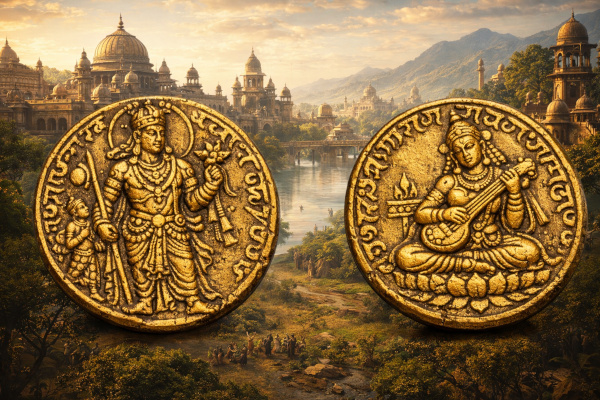
There are some kings who are remembered only because they won battles, and there are others who survive in memory because they shaped an age. Harsha, or Harshavardhana, belongs to the second kind. He ruled much of northern India in the 7th century CE, roughly from 606 to 647 CE, and in many ways he stands at a historical crossroads: after the brilliance of the Guptas, but before the rise of the great regional powers of early medieval India. To read about Harsha is to encounter a ruler who was at once warrior, diplomat, patron of religion, supporter of learning, and, according to tradition, even a playwright. His reign does not feel like a simple chapter in dynastic history; it feels like the last broad sunrise of an older political world.
Harsha was born around 590 CE into the Pushyabhuti, or Vardhana, dynasty, whose early base was at Thanesar in present-day Haryana. He was the younger son of Prabhakaravardhana, and he did not begin life as the obvious heir to an empire. In fact, his rise was forged in crisis. After his father’s death, his elder brother Rajyavardhana came to the throne, but the political situation in north India was tense and fragmented. Harsha’s sister Rajyashri was married into the Maukhari line of Kannauj, and when her husband was killed and his brother in turn died in the violent politics of the age, the young Harsha was thrust into power. Sources such as Bana’s Harshacharita and later historical accounts present his accession not as a comfortable inheritance but as a moment of grief, urgency, and sudden responsibility.
He was still very young when he took the throne in 606 CE, and that fact matters because his career would become one of reconstruction as much as conquest. North India after the Guptas was no longer a single coherent imperial space. It was a mosaic of kingdoms, ambitions, and shifting loyalties. Harsha’s achievement was not that he inherited a ready-made empire, but that he pieced one together. Over time, his influence extended across a wide swathe of northern India, from parts of Punjab in the northwest to Assam in the east, while the core area under his firmer control likely included much of present-day Uttar Pradesh and adjoining regions. He eventually made Kannauj his principal imperial capital, and that city, under him, became one of the great political symbols of North Indian sovereignty.
That expansion, however, had a limit — and one of the most revealing episodes of Harsha’s life is that he was not invincible. At some point around 620 CE, his southern ambitions ran into the formidable Chalukya emperor Pulakeshin II. Harsha attempted to push into the Deccan, but Pulakeshin stopped him, and the Narmada River became the effective boundary between the two powers. This is one of the most important facts about Harsha’s reign because it reminds us that early medieval India was not moving toward one easy imperial unification. Even a king as powerful as Harsha met resistance at the frontier of another strong political world. His greatness lies not in having conquered all of India, but in having dominated a vast northern sphere while recognizing the hard edge of southern power.
And yet, what makes Harsha compelling is that his reputation rests on far more than territory. Much of what we know about him comes from two major witnesses: Bana, his court poet, and Xuanzang, the Chinese Buddhist monk who traveled through India and spent time at Harsha’s court. These two voices do not give us a perfectly neutral portrait. Bana writes with the elegance and exaggeration of a court author; Xuanzang writes with admiration shaped by religious closeness. Still, between them they preserve a vivid image of a ruler who was energetic, accessible, charitable, intellectually curious, and deeply involved in administration. Even when we read them critically, the outline that emerges is of a king who did not simply sit in a palace and receive tribute, but moved, campaigned, judged, patronized, debated, and performed kingship in public.
The world of Harsha’s court was not only political; it was literary. His reign is associated with one of the finest prose stylists in Sanskrit, Bana, whose Harshacharita remains a major source for the age. Harsha himself is traditionally credited with three Sanskrit plays — Ratnavali, Priyadarsika, and Nagananda. Whether every attribution can be proven beyond doubt is still discussed by scholars, but the tradition is old and strong enough to matter. Even if one sets aside the modern question of authorship, the association itself is revealing: Harsha was remembered not merely as a conqueror, but as a cultivated ruler whose court valued refined literature, performance, and the prestige of learning. In Indian political culture, that mattered enormously. Power that did not attract poets could seem incomplete. Harsha’s did not.
His religious life is equally fascinating because it resists easy labels. Some evidence presents Harsha as initially linked to Shaivism, while Xuanzang portrays him as a strong patron of Mahayana Buddhism later in life. This has led historians to see him less as a ruler who abruptly abandoned one faith for another and more as a king shaped by the broad and overlapping religious culture of his age. He could patronize Buddhist institutions while still standing within a wider Brahmanical framework of kingship. That flexibility was not unusual in early India, but in Harsha’s case it became especially visible. He is said to have organized grand religious assemblies, patronized monks and scholars, and cultivated an image of moral kingship through generosity and public piety. His court, by all accounts, was not sectarian in a narrow sense; it was ecumenical, ceremonial, and politically intelligent.
Among the most famous episodes of his reign are the great assemblies associated with Kannauj and Prayaga. Xuanzang’s account describes Harsha hosting magnificent religious and charitable gatherings, including a major conclave at Kannauj and recurring largesse at Prayaga, where he is said to have distributed wealth on a huge scale. There is, no doubt, an element of royal theater here: charity was also politics, and spectacle was also sovereignty. But that does not make it any less important. In the early medieval world, kings ruled not only through armies and officials but through ceremony, redistribution, and moral display. Harsha seems to have understood that instinctively. He wanted to be seen not only as powerful, but as righteous, learned, and generous.
His patronage of learning also left a strong impression on later memory. Nalanda, already an important center of Buddhist learning, flourished in this broader climate of royal support. Harsha is repeatedly associated in historical writing with encouragement to scholars, monasteries, and institutions of education. This is one reason why his age is remembered with a certain glow. It was not a purely military age. It was a time when courts, monasteries, and intellectual networks were linked across regions, and Harsha sat at the center of one of those networks. Xuanzang’s journey itself is part of that story: he came to India in search of learning, and in Harsha’s realm he found both political patronage and a world still capable of sustaining large-scale religious scholarship.
Administratively, Harsha appears to have ruled through a combination of direct authority and subordinate powers, which was typical of the period. His inscriptions and grants suggest a structured governing apparatus, and they also show the growing importance of land grants in early medieval political economy. This was a world in which royal power was real, but it often traveled through alliances, feudatories, officers, and patronage rather than through the kind of tightly centralized bureaucracy modern readers might imagine. Harsha’s empire was impressive, but it was also personal in a very old-fashioned way: it depended heavily on the force of his character, his military movement, and his prestige. That helps explain why, after his death, it did not hold together for long in the same form.
That collapse is crucial to his legacy. Harsha died around 647 CE, and unlike the founders of more enduring dynastic systems, he left no strong successor capable of preserving the imperial structure he had built. In that sense, his reign has a tragic edge. He was immensely successful in life, but his empire did not become a permanent political order. After him, north India again moved toward fragmentation and competition. Yet that very fragility is part of what makes him memorable. Harsha was the kind of ruler whose personality briefly held together a large historical space. When he vanished, the structure loosened. He was not just a king within a system; for a time, he almost was the system.
So how should we remember Harsha today? Not as a mythic superman, and not merely as a name squeezed between the Guptas and the later Rajput and regional kingdoms. He deserves something fuller. He was one of the last great emperors of classical North India, a ruler who emerged from family catastrophe, built a major kingdom out of political fracture, checked his ambition only at the Narmada, welcomed one of Asia’s great pilgrims, patronized literature and religion, and left behind a reign that feels larger than its chronology. His empire lasted about four decades; his memory has lasted nearly fourteen centuries. That alone says something. Harsha mattered not simply because he ruled, but because he represented a certain ideal of kingship — martial, generous, cultured, and public-facing — at a moment when the Indian subcontinent was changing.
In the end, Harsha’s story is not just about a man who wore a crown. It is about an age trying to hold together after the fading of one great order and before the rise of several new ones. He stands there like a bridge: one foot in the classical past, the other in the early medieval future. That is why he still fascinates. He was not merely a ruler of land. He was a ruler of transition.
Reference:
- Encyclopaedia Britannica, “Harsha” — https://www.britannica.com/biography/Harsha
- Encyclopaedia Britannica, “Harshacharita” — https://www.britannica.com/topic/Harshacharita
- Encyclopaedia Britannica, “Bana” — https://www.britannica.com/biography/Bana-Indian-writer
- Encyclopaedia Britannica, “Xuanzang” — https://www.britannica.com/biography/Xuanzang
- Encyclopaedia Britannica, “Pulakeshin II” — https://www.britannica.com/biography/Pulakeshin-II
- Encyclopaedia Britannica, “Nalanda” — https://www.britannica.com/topic/Nalanda
- eGyanKosh / IGNOU, Unit on the Vardhana Dynasty — https://egyankosh.ac.in/bitstream/123456789/115669/3/Unit-13.pdf
- INFLIBNET, “Harshavardhana” — https://ebooks.inflibnet.ac.in/icp01/chapter/harshavardhana/
- Select Inscriptions Bearing on Indian History and Civilization, Vol. II — https://ia601900.us.archive.org/20/items/in.ernet.dli.2015.56669/2015.56669.Select-Inscriptions-Bearing-On-Indian-History-And-Civilization-Vol2.pdf
You may also like
-
Mekala in the Mahabharata: The Ancient Highland Kingdom of Amarkantak and the Maikal Hills
-
Anupa in the Mahabharata: The Ancient Narmada Kingdom of Mahishmati and the Maheshwar Region
-
Sarnath Joins UNESCO World Heritage List as India’s Civilisational Legacy Gains Global Recognition
-
Ancient Bazira-Barikot of Gandhara Gains UNESCO Recognition as 3,000 Years of Urban History Emerge From Swat
-
Vaidisha in the Mahabharata-Era Geography: The Ancient Vidisha Region of Central Madhya Pradesh
