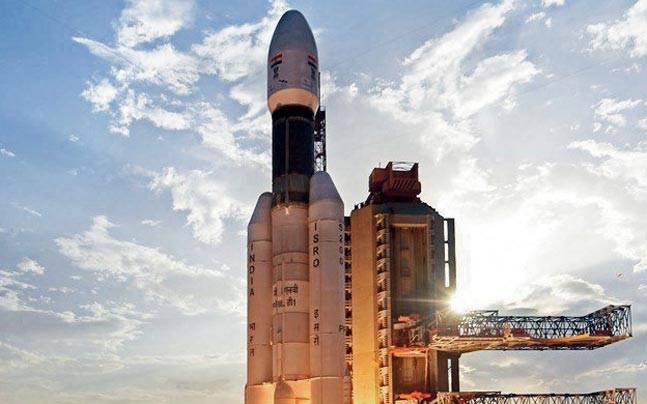
India’s heaviest rocket – Geosynchronous Satellite Launch Vehicle-Mark III (GSLV-Mk III)– carrying 3,423 kg communication satellite GSAT-29 blasted off from the Sriharikota spaceport on Wednesday evening.
Precisely at 5.08 p.m. the GSLV-Mk III rocket on its second developmental flight began its ascent with a strong deep growl that reverberated like a thunder roll breaking free from the second launch pad here at the Satish Dhawan Space Centre (SDSC).
The 43.4-metre rocket weighing about 640 tonne rushed to the blue skies with thick orange flame at its rear.
The GSLV-Mk III with a capacity to carry four-tonne satellite, is a three-stage/engine rocket with two strap-on motors powered by solid fuel. The second stage is a core liquid fuel booster and the third is the cryogenic engine.
The Indian space agency had flown a similar rocket on June 5, 2017, with GSAT-19 satellite. Prior to that ISRO had flown another rocket with 3.7-tonne dummy payload in 2014 to test its in-flight structural stability and aerodynamics.
On Wednesday, just over 16 minutes into its flight the rocket will sling the GSAT-29 at its intended orbit at an altitude of around 207 km.
According to Indian Space Research Organisation (ISRO), GSAT-29 with a life span of 10 years is a multi-beam satellite that carries Ka/Ku-band high throughput communication transponders intended to meet the communication requirements of users including those in remote areas.
In addition, several new technologies such as Q/V-band payload, data transmission through optical communication link will be demonstrated. This will help in realising future advanced satellites, ISRO said.
The satellite also carries a geo-high resolution camera.
India currently has two fully operational rockets — the Polar Satellite Launch Vehicle and GSLV-Mk II — with a lift-off mass of 415 tonnes and a carrying capacity of 2.5 tonnes.
Launch of GSLV Mk-III D2/ GSAT-29 Mission
Source: DP
Image Courtesy:India Today
You may also like
-
AM Intelligence Orders 20,000 NVIDIA Rubin GPUs as India’s AI Compute Build-Out Accelerates
-
Japan’s Semiconductor Companies Deepen India Footprint as Chip Ecosystem Advances
-
India and UAE Explore New Avenues to Expand Trade, Investment and Business Cooperation
-
GalaxEye Advances 30-Satellite OptoSAR Constellation After Securing US Patent
-
Indian Researchers Combine AI and Infrared Spectroscopy to Detect Parkinson’s-Linked Biochemical Changes in Fruit Flies
