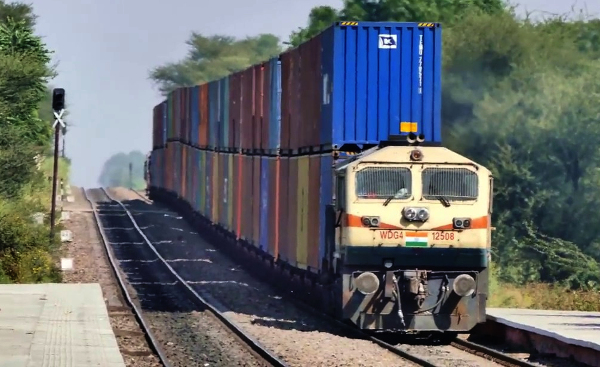
The Government of India has significantly expanded the country’s rail-based logistics infrastructure under the Gati Shakti Multi-Modal Cargo Terminal (GCT) Policy, with 142 cargo terminals now operational across the country and another 310 approved for development. The initiative, aimed at promoting private investment in rail freight infrastructure, has mobilised nearly ₹10,000 crore in private investment while strengthening logistics for key sectors such as cement, steel, power, mining, agriculture and manufacturing.
The Gati Shakti Cargo Terminal Policy was introduced to encourage the establishment of modern rail-linked cargo terminals through private participation. Locations for these terminals are identified based on industrial demand, cargo traffic potential, availability of railway infrastructure and the overall logistics potential of a region. According to the Ministry of Railways, the 142 commissioned terminals together have an estimated freight handling capacity of 224 million tonnes per annum (MTPA), while they handled 146 million tonnes of freight during the financial year 2025–26.
Providing details in a written reply to the Lok Sabha on July 23, 2026, Union Minister for Railways, Information and Broadcasting, and Electronics and Information Technology, Shri Ashwini Vaishnaw said the government has also granted In-Principle Approvals (IPAs) for setting up GCTs at 310 additional locations, reflecting the growing demand for efficient multimodal freight infrastructure across the country.
The GCTs cater to a diverse range of commodities including cement, clinker, steel, coal, fly ash, fertilizers, foodgrains, minerals, containers, automobiles, agricultural produce and other bulk and non-bulk cargo. By providing modern rail-linked logistics facilities closer to production and consumption centres, the terminals have improved freight movement through faster loading and unloading, lower first-mile and last-mile transportation costs, better wagon utilisation and increased modal shift from road to rail. These improvements have enhanced the efficiency and competitiveness of India’s rail freight network while reducing logistics costs for industries and businesses.
The policy has also facilitated the development of integrated logistics infrastructure such as warehouses, silos, cold storage facilities and other value-added services. These facilities are benefiting farmers, local industries and businesses by improving storage, reducing post-harvest losses and providing better market connectivity, while also generating employment and supporting regional economic development.
Among the states, Odisha leads with 12 operational Gati Shakti Cargo Terminals, followed by Rajasthan with 10 terminals, Andhra Pradesh, Bihar and Madhya Pradesh with five terminals each, and Karnataka with four operational terminals. Odisha has also received In-Principle Approvals for 36 additional locations, Rajasthan for 15, Karnataka for 18, Madhya Pradesh for 19, Andhra Pradesh for 14 and Bihar for eight new terminals.
In Andhra Pradesh, one GCT has already been commissioned at Tummalacheruvu in Palnadu district, where it handled 1.214 million tonnes of freight during 2025–26. Another terminal is currently under construction in the region. These facilities are expected to significantly improve the transportation of cement, clinker, minerals, industrial goods and other commodities through rail, providing industries in Palnadu with more economical and reliable logistics solutions while supporting regional economic growth.
In Odisha, a proposal to develop a Gati Shakti Cargo Terminal at Porjanpur in Keonjhar Lok Sabha constituency is currently under consideration. However, the government clarified that no proposals have been received from industry for setting up GCTs at Narkatiaganj in Bihar or Chhindwara district in Madhya Pradesh.
The government believes the Gati Shakti Cargo Terminal Policy is playing a crucial role in strengthening India’s logistics ecosystem by expanding rail freight infrastructure through private investment, improving connectivity for industries and agriculture, reducing transportation costs and creating modern multimodal logistics facilities. With 310 additional terminals approved for development, the initiative is expected to further enhance rail freight capacity and contribute to faster, more efficient and sustainable movement of goods across the country.
Source: PIB
You may also like
-
ICAR Scientists Develop Indigenous Protective Gloves for Cotton Farmers, Sign Commercial Manufacturing Agreement
-
BHEL–Coal India Joint Venture Begins Construction of ₹25,016 Crore Indigenous Coal Gasification Project in Odisha
-
PM Modi to Inaugurate RBI’s Tier IV Data Centre and Cybersecurity Training Institute in Bhubaneswar
-
India Creates 11 Crore Digital Farmer IDs Five Months Ahead of Target, Strengthening AgriStack Infrastructure
-
Chak-Hao Black Rice of Manipur and Nagaland: The Aromatic Purple Heritage Grain with GI Recognition
