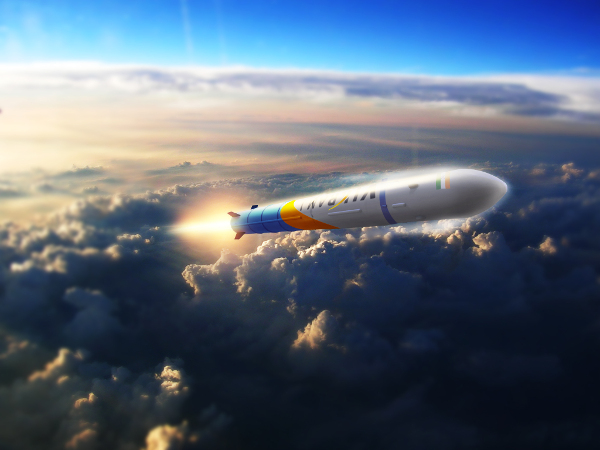
India entered a new phase of its space journey on July 18, 2026, after Vikram-1, the country’s first privately developed orbital launch vehicle, successfully reached its designated Low Earth Orbit from the Satish Dhawan Space Centre at Sriharikota.
Developed by Hyderabad-based Skyroot Aerospace, the rocket was launched under Mission Aagaman and became the first orbital launch vehicle built by an Indian private company to reach space from Indian soil. The achievement represents a landmark moment for India’s private space industry and demonstrates the growing maturity of the country’s commercial launch ecosystem.
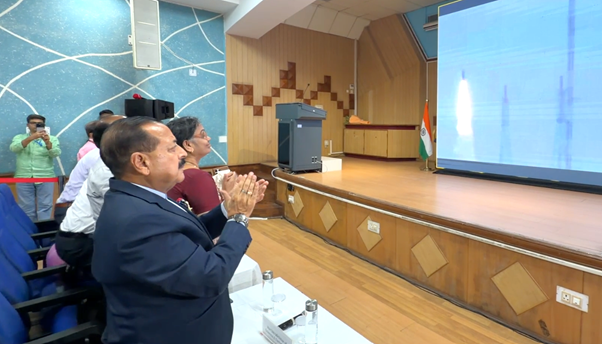
Union Minister of State for Science and Technology and Space Dr. Jitendra Singh witnessed the launch and described the mission as evidence of India’s emergence as a serious global space power. He said the success validated the reforms introduced by the Union Government in 2020 to open the national space sector to private participation.
“For India, the sky is no longer the limit,” the Minister said, highlighting the wider significance of the mission for India’s scientific, technological and entrepreneurial ambitions.
Prime Minister Narendra Modi congratulated the Skyroot Aerospace team and described the launch as a proud milestone for India’s expanding space ecosystem. He said the achievement reflected the country’s growing scientific capabilities, entrepreneurial confidence and innovation-led development.
India’s First Private Orbital Launch
Vikram-1 was designed and manufactured entirely in India and is capable of carrying payloads weighing up to 350 kilograms into Low Earth Orbit. The approximately 22-metre-tall vehicle incorporates several advanced technologies developed by Indian engineers.
The rocket has been described as India’s first all-carbon-composite orbital launch vehicle. It also uses one of the country’s longest monolithic carbon-composite rocket stages, helping reduce structural weight while maintaining the strength required for orbital flight.
Its Orbital Adjustment Module is powered by a fully 3D-printed liquid engine. The vehicle also incorporates ultra-low-shock pneumatic separation mechanisms designed to protect sensitive satellites and experimental payloads during deployment.
The successful flight validated major systems associated with propulsion, avionics, navigation, telemetry, flight control and stage separation. These demonstrations provide Skyroot Aerospace with a technological foundation for future commercial launch missions.
Experimental and Commercial Payloads
The maiden Vikram-1 mission carried experimental payloads and technology demonstrations from Indian and international partners. These payloads were intended to validate advanced technologies in the orbital environment.
The presence of customer payloads on the first orbital mission indicated growing confidence in India’s emerging private launch companies. It also demonstrated the country’s ability to develop cost-effective launch services for small satellites, research institutions, start-ups and international commercial customers.
The global demand for launching small satellites has expanded with the growth of Earth observation, communications, navigation, climate monitoring and space-based data services. Vikram-1’s success gives India an indigenous private platform capable of competing for a share of this rapidly developing market.
Public-Private Partnership Drives Mission
Dr. Jitendra Singh credited Skyroot Aerospace, the Indian Space Research Organisation, the Indian National Space Promotion and Authorization Centre and the Department of Space for developing the institutional framework that made the mission possible.
ISRO provided access to national launch infrastructure, technical expertise and testing facilities, while IN-SPACe facilitated coordination between government agencies and the private company. This collaborative framework allowed Skyroot to design, test and launch an orbital-class rocket within India.
The Minister said the mission demonstrated how public infrastructure, government policy, scientific expertise and private entrepreneurial talent could work together to produce globally competitive technologies.
He also congratulated Skyroot founders Pawan Kumar Chandana and Bharath Daka, praising their technological confidence, creativity and perseverance. Both founders previously worked with ISRO before establishing Skyroot Aerospace in 2018.
The company had earlier launched Vikram-S, India’s first privately developed suborbital rocket, in November 2022. That mission, named Prarambh, tested several technologies that contributed to the development of the orbital Vikram launch vehicle family.
Space Reforms Transform the Sector
India introduced major space-sector reforms in 2020, allowing private companies to undertake activities that had previously remained largely within government institutions. The reforms created opportunities for private participation in rocket development, satellite manufacturing, space-based services, ground infrastructure and commercial launch operations.
IN-SPACe was established as a single-window agency to authorise, promote and supervise private space activities. NewSpace India Limited was strengthened as ISRO’s commercial arm, while ISRO increasingly focused on research, exploration, advanced technology and national missions.
According to the government, India now has more than 400 space start-ups, compared with only a small number before the reforms. The country has also produced its first space-sector unicorn, reflecting increased investor confidence in Indian space technology companies.
India’s space economy is estimated to be approaching USD 9 billion, with a national target of expanding it to nearly USD 44 billion over the coming decade. Private launch vehicles such as Vikram-1 are expected to contribute to this growth by attracting satellite-launch contracts, investment, manufacturing activity and high-skilled employment.
A New Commercial Launch Capability
Vikram-1 has been designed as part of a broader family of rockets intended to serve the small-satellite market. Such vehicles can provide customers with dedicated launch opportunities, flexible orbital deployment and shorter mission preparation periods.
India already possesses extensive experience in satellite launches through ISRO’s Polar Satellite Launch Vehicle and Launch Vehicle Mark-3 programmes. The arrival of privately operated launch systems broadens the country’s capabilities and creates additional options for domestic and international customers.
Skyroot’s success could also encourage greater investment in propulsion systems, advanced materials, avionics, satellite components, testing facilities and spaceport infrastructure. A growing launch industry can support a wider national supply chain involving hundreds of micro, small and medium enterprises.
India’s Expanding Global Role
The Vikram-1 mission strengthens India’s position as a reliable and technologically capable partner in the global space sector. It combines the experience of the national space programme with the speed, flexibility and commercial focus of private enterprise.
The mission also demonstrates India’s ability to develop and launch sophisticated orbital systems using indigenous technologies. Its carbon-composite structures, 3D-printed engine components and precision separation mechanisms reflect the increasing depth of the country’s aerospace manufacturing capabilities.
Dr. Jitendra Singh said the launch represented far more than the success of a single rocket. It signalled the beginning of an era in which Indian start-ups would play a larger role in shaping the global space economy.
With Vikram-1 successfully reaching orbit, India has crossed a significant technological and institutional threshold. The achievement has opened a new chapter in which government agencies and private companies can jointly expand India’s presence in satellite launches, space services, exploration technologies and international commercial missions.
Source: PIB
You may also like
-
New X-Ray Clues from Blazars could Provide Insights on Powering of Active Galaxies
-
A Powerful Punch by Black Hole Jets Shapes the Fate of Galaxies
-
IIT Delhi Develops India’s First Indigenous Micro-GPU for Embedded Graphics Systems
-
Beyond one: Indian Researchers’ Experiment Could Lead to A New Tool for Quantum Measurement
-
DRDO Backs Indigenous 20 mK Dilution Refrigerator in First High-Value Deep-Tech TDF Project
