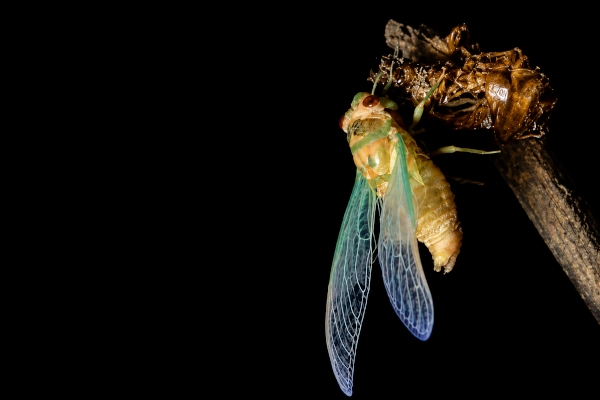
A rare periodical cicada popularly known as the “World Cup cicada” has been recorded near Assam’s Rani Reserve Forest, expanding the documented range of one of Northeast India’s most unusual insects. Scientifically named Chremistica ribhoi, the species is renowned for its synchronised mass emergence once every four years, a cycle that has often coincided with the FIFA World Cup and inspired its popular nickname. The Assam record places the cicada beyond the limited locations in Meghalaya with which it was traditionally associated and opens a new field of inquiry into its distribution, habitat requirements and conservation status.
The cicada was reported during a field assessment around the Rani Reserve Forest landscape, close to Assam’s border with Meghalaya. Until recently, scientific accounts had principally linked the species with Ri Bhoi district, particularly Saiden village and forested areas near the Nongkhyllem Wildlife Sanctuary. Its presence in Assam suggests that populations may occur across a wider belt of suitable forest and bamboo habitat extending across the state boundary.
Chremistica ribhoi was formally described as a new species in 2013 by researchers Sudhanya Ray Hajong and Salmah Yaakop. The original taxonomic study was based on specimens collected from two sites in Ri Bhoi district and established the species as a distinct member of the genus Chremistica. Adult males measure around 25 to 28 millimetres in body length and possess prominent pale spots on the third abdominal segment, along with anatomical characteristics that distinguish them from related cicadas.
The insect spends most of its life underground as a nymph, drawing nourishment from plant roots. After nearly four years beneath the soil, large numbers emerge within a short period, usually after sunset. The nymphs crawl up tree trunks and bamboo stems, shed their outer skins and transform into winged adults. Empty shells remain attached to bark and vegetation, while the adults soon fill the surrounding forest with their characteristic calls. Observations in Meghalaya recorded emergence activity between evening and late night in largely undisturbed forest habitat.
The four-year pattern was documented through mass emergences observed in May 2006 and again in May 2010. Local communities had recognised the cycle long before the insect received its scientific name. In the Khasi language, it is called Ñiangtaser or Niangtaser. “Ñiang” is a general term for insect, while the latter part of the name is believed to be connected with Iewsier village and its surrounding forest, where the phenomenon has long been observed.
The “World Cup” label arose from the community’s observation that the mass appearance frequently occurred during years associated with international football’s largest tournament. The connection transformed a little-known forest insect into a memorable symbol of nature’s biological calendar. While the name creates an impression of a sporting coincidence, the cicada’s predictable cycle represents a sophisticated evolutionary strategy involving long underground development followed by the simultaneous appearance of thousands of adults.
Mass emergence offers the species several advantages. Appearing in huge numbers briefly overwhelms predators, allowing enough adults to survive, mate and produce the next generation. During this period, cicadas become an abundant seasonal food source for birds, reptiles, mammals and other animals. Their emergence also transfers nutrients accumulated underground into the forest ecosystem, creating a short but significant burst of biological activity.
The insect also forms part of the cultural and food traditions of communities in Ri Bhoi. Newly emerged cicadas have traditionally been collected for consumption and used as fishing bait. They may be roasted, cooked, dried or preserved. The Ñiangtaser Festival held in Meghalaya celebrates this relationship through cultural performances, community activities and guided opportunities to witness the natural event.
The Assam observation carries particular scientific importance because knowledge of the species remains limited. Researchers can now examine whether the Rani population belongs to the same synchronised brood as those in Meghalaya, how far its habitat extends and whether additional populations remain undocumented elsewhere in the region. Genetic studies, acoustic surveys and long-term monitoring could reveal whether the Assam and Meghalaya groups remain connected or have developed local variations in their emergence timing. This is an inference based on the expanded geographical record and the species’ specialised four-year life history.
Its long underground phase also makes the World Cup cicada sensitive to changes that may remain invisible during ordinary wildlife surveys. Forest clearance, soil disturbance, fires, infrastructure development and the loss of bamboo or host vegetation can affect an entire generation before adults appear above ground. Since researchers can directly observe mature insects only during brief emergence periods separated by four years, population decline may become evident only after considerable damage has occurred.
The new record underlines the biodiversity value of forests along the Assam–Meghalaya boundary. These landscapes form connected ecological systems even where political borders divide them. Protecting forest cover, bamboo stands, soil conditions and natural drainage around Rani Reserve Forest and neighbouring Ri Bhoi will help preserve the hidden habitat required by the cicada throughout most of its life.
The arrival of Chremistica ribhoi in public view once every four years turns a quiet forest cycle into a dramatic natural spectacle. Its discovery in Assam expands India’s understanding of the species and demonstrates how much of Northeast India’s insect diversity remains to be documented. The World Cup cicada has become a meeting point between science, traditional knowledge and local culture, and its rhythmic return offers a powerful reminder that some of nature’s most remarkable events unfold according to calendars far older than human sporting traditions.
REFERENCES
- Mongabay India. “The Insect That Syncs Up with the Football World Cup.” Published July 2026.
https://india.mongabay.com/2026/07/the-insect-that-syncs-up-with-the-football-world-cup/ - The Times of India. “India’s Rare ‘World Cup’ Insect Appears Once Every Four Years, and Scientists Have Now Discovered It in a New Region.” Published July 15, 2026.
https://timesofindia.indiatimes.com/etimes/animals/indias-rare-world-cup-insect-appears-once-every-four-years-and-scientists-have-now-discovered-it-in-a-new-region/articleshow/132415159.cms - Hajong, Sudhanya Ray and Salmah Yaakop. “Chremistica ribhoi sp. n. (Hemiptera: Cicadidae) from North-East India and Its Mass Emergence.” Zootaxa, Vol. 3702, No. 5, 2013, pp. 493–500.
https://mapress.com/zt/article/view/zootaxa.3702.5.8 - Original Scientific Paper — PDF.
https://mapress.com/zootaxa/2013/f/zt03702p500.pdf
DOI:
https://doi.org/10.11646/zootaxa.3702.5.8
Last modified on: Jul 16-2026
You may also like
-
New X-Ray Clues from Blazars could Provide Insights on Powering of Active Galaxies
-
A Powerful Punch by Black Hole Jets Shapes the Fate of Galaxies
-
IIT Delhi Develops India’s First Indigenous Micro-GPU for Embedded Graphics Systems
-
Beyond one: Indian Researchers’ Experiment Could Lead to A New Tool for Quantum Measurement
-
DRDO Backs Indigenous 20 mK Dilution Refrigerator in First High-Value Deep-Tech TDF Project
