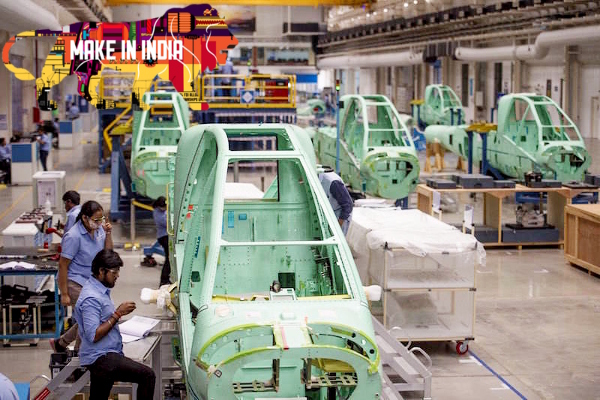
India’s rise as a major economy is no longer being judged only by GDP size, services exports or consumer-market strength. The next and more difficult test is industrial depth: whether the country can build the machines, components, materials, chips, energy systems and supply chains that allow a nation to control its own economic destiny. This is where India’s industrial moment becomes important. The country has already proved that it can become a global services powerhouse. It has also shown that it can attract large-scale assembly, expand digital infrastructure and build world-class engineering talent. But the real leap from a growing economy to an industrial superpower depends on something deeper: the ability to manufacture at scale, localise critical inputs, reduce external vulnerabilities and create vertically integrated production ecosystems.
The policy direction is now clearly visible. India’s Production Linked Incentive framework has become one of the central instruments for converting manufacturing ambition into factory-level investment. Across 14 sectors, PLI schemes had generated investments exceeding ₹2.16 lakh crore by the end of December 2025, while incremental production and sales crossed ₹20.41 lakh crore. The schemes have also resulted in more than 14.39 lakh direct and indirect jobs, with 836 applications approved across the PLI framework.
Electronics is the clearest example of what this shift can look like when policy, market demand and global supply-chain realignment move together. India’s electronics production has expanded sharply over the past decade, while domestic value addition has improved to around 18–20 percent. Mobile phone exports rose from about ₹0.27 lakh crore in FY 2019–20 to ₹2 lakh crore in FY 2024–25, and smartphones emerged as India’s top exported commodity in calendar year 2025. India now has more than 300 mobile manufacturing units, showing how a sector once dominated by imports can become a major export pillar when manufacturing ecosystems begin to mature.
But the mobile-phone story also shows the next challenge. Assembly is only the first rung of industrial power. True strategic manufacturing requires component depth, design capability, precision tooling, chip capacity, advanced materials and capital equipment. A country becomes industrially powerful when its factories do not merely assemble imported parts, but generate the parts, tools, machines and process knowledge that other factories depend on. That is why semiconductors, electronics components, battery materials, machine tools, specialty steel, defence electronics and clean-energy manufacturing are now central to India’s long-term industrial strategy.
The semiconductor push is especially significant because chips sit at the heart of modern power. They run vehicles, satellites, telecom networks, power systems, defence platforms, medical devices, artificial intelligence systems and consumer electronics. India’s semiconductor programme has already moved beyond announcements into approved projects. Tata Electronics is establishing a semiconductor fab in Gujarat with an investment of ₹91,526 crore and a planned capacity of around 50,000 wafer starts per month. Micron is setting up a facility in Gujarat with an investment of ₹22,516 crore, while Tata’s Assam project, CG Power’s Gujarat facility and other approved units in Uttar Pradesh, Odisha, Punjab and Andhra Pradesh show that the ecosystem is beginning to spread beyond one state or one company.
This matters because industrial superpowers are not built only by cheap labour or large markets. They are built by clusters. China, South Korea, Taiwan, Japan and Germany became manufacturing powers by developing dense supplier networks where tooling firms, component makers, material suppliers, research institutions, logistics systems, skilled technicians and anchor manufacturers operate close to each other. India has strong individual companies and skilled engineers, but it still needs deeper industrial clustering in high-end manufacturing. The next stage is not simply “Make in India” as final assembly, but “Design, Tool, Fabricate, Test and Scale in India.”
India’s macroeconomic position gives it momentum. The IMF projects India’s real GDP growth at 6.5 percent for 2026, keeping the country among the strongest major growth engines in the global economy. But growth alone will not remove strategic vulnerability. A large economy can still remain exposed if it depends heavily on overseas sources for energy, fertilisers, chips, advanced machinery, industrial chemicals, sensors, rare earth processing and critical minerals. The real question is whether India can convert growth into resilience.
Energy security remains one of the biggest reminders of this vulnerability. During recent West Asian tensions, the Government of India said crude supply remained secure and noted that India now imports crude from around 40 countries, with about 70 percent of crude imports coming through routes outside the Strait of Hormuz compared with about 55 percent earlier. That diversification is important, but it also shows why energy shocks can still affect India’s inflation, trade balance, industrial costs and currency stability. The same briefing noted India’s total natural gas consumption at about 189 MMSCMD, of which 97.5 MMSCMD was domestically produced, underlining the continued importance of secure energy planning for industry.
Fertiliser security is another less glamorous but equally strategic industrial issue. India’s annual fertiliser consumption in 2023–24 was around 601 LMT, of which 503 LMT was produced domestically while 177 LMT came through imports. A parliamentary committee has also noted that India has no known commercial reserves of potash and is fully dependent on imports for it, along with imported raw materials and intermediates such as rock phosphate, sulphur, ammonia and phosphoric acid for phosphatic and potassic fertilisers. For a country with hundreds of millions dependent on agriculture, fertiliser supply is not merely an agricultural input issue; it is food security, rural stability and inflation management rolled into one.
This is why India’s industrial strategy must be seen as a national resilience project, not just an economic growth programme. The country’s biggest advantage is scale: a vast domestic market, a young workforce, expanding infrastructure, rising defence demand, a digital payments ecosystem, improving logistics and a large pool of engineers. The biggest challenge is depth: the ability to convert that scale into globally competitive manufacturing systems that do not collapse when a shipping lane is threatened, a foreign supplier restricts exports, a war disrupts energy flows or a technology embargo hits advanced sectors.
India’s engineers and technology professionals have helped build some of the world’s most powerful companies. The next step is to ensure that Indian industry builds similar technological depth at home. That means stronger university-industry collaboration, more R&D spending, more patient capital for hardware start-ups, better skilling for technicians, faster testing and certification systems, high-quality industrial parks, and a serious push for machine tools, robotics, automation, industrial software and semiconductor equipment. Without these layers, India can remain a major economy but still depend on others for the most strategic parts of production.
The opportunity is historic because global supply chains are already being redesigned. Companies are looking beyond single-country dependence. Governments are rethinking critical minerals, chips, defence production, batteries and energy systems. Climate commitments are pushing clean manufacturing. Digitalisation is increasing demand for electronics. Defence modernisation is creating domestic demand for sensors, radars, drones, propulsion systems and secure communications. India enters this transition with size, policy focus and geopolitical relevance on its side.
Yet the outcome is not automatic. India can become a large assembly base without becoming an industrial superpower. The difference lies in whether the country builds the hidden layers of manufacturing: precision components, fabrication capability, capital goods, materials science, testing infrastructure, supplier networks and skilled shop-floor talent. If India succeeds, it will not simply export more phones, vehicles, medicines or electronics. It will become one of the countries that defines how the next generation of industrial systems is designed and produced.
India’s industrial rise, therefore, is at a decisive stage. The country has the demand, the demographic strength, the policy instruments and the geopolitical timing. What it now needs is relentless execution. The slogan of self-reliance must translate into factories that can compete globally, supply chains that can withstand shocks, and technologies that are designed as much in Indian labs as assembled in Indian plants. The path to becoming a global industrial superpower will not be won by growth numbers alone. It will be won by industrial depth.
Sources:
Production Linked Incentive Schemes: Investment, Production and Employment Impact — Press Information Bureau
https://www.pib.gov.in/PressReleasePage.aspx?PRID=2246085&lang=1®=3
India’s Electronics Manufacturing Growth and Smartphone Export Performance — Press Information Bureau
https://www.pib.gov.in/PressReleasePage.aspx?PRID=2247771&lang=1®=3
India Semiconductor Mission and Approved Semiconductor Projects — Press Information Bureau
https://www.pib.gov.in/PressReleasePage.aspx?PRID=2247814&lang=1®=3
India Country Data and GDP Growth Outlook — International Monetary Fund
https://www.imf.org/en/countries/ind
India’s Crude Oil Supply Diversification and Energy Security Briefing — Press Information Bureau
https://www.pib.gov.in/PressReleasePage.aspx?PRID=2238525&lang=1®=3
India’s Fertiliser Production, Consumption and Import Data — Press Information Bureau
https://www.pib.gov.in/PressNoteDetails.aspx?ModuleId=3&NoteId=154966&lang=2®=3
Parliamentary Committee Report on Fertiliser Import Dependence and Raw Material Security — Lok Sabha / Sansad
https://sansad.in/getFile/lsscommittee/Chemicals%20%26%20Fertilizers/18_Chemicals_And_Fertilizers_15.pdf?source=loksabhadocs
You may also like
-
India Simplifies Foreign Guest Reporting for Hotels Under New Immigration Framework
-
Indian Pharmaceutical Market Grows 12.96% in August as Chronic Therapies Drive Expansion
-
India Launches Commercial Bio-Based Biodegradable PLA Plastic Under BioE3 Initiative
-
India and GCC Review Joint Action Plan as Free Trade Agreement Negotiations Move Forward
-
Goa Mussarat Mango — The Red-Blushed Monserrate of Goa and the Late-Summer Orchard Heritage of the Konkan Coast
