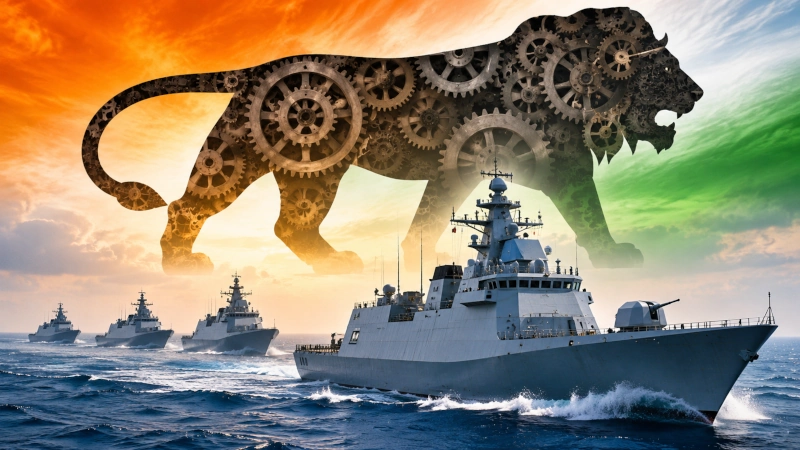
The Ministry of Defence has signed contracts worth ₹53,866.50 crore with Garden Reach Shipbuilders & Engineers Limited (GRSE) and Goa Shipyard Limited (GSL) for the construction of eight Next Generation Corvettes (NGCs) for the Indian Navy. The agreements represent a major investment in indigenous naval shipbuilding and are expected to strengthen India’s maritime defence capabilities while creating substantial opportunities for domestic defence manufacturers and supporting industries.
The contracts were signed on November 2, 2026, at Kartavya Bhawan-2 in New Delhi in the presence of Defence Secretary Rajesh Kumar Singh. Under the agreements, Kolkata-based Garden Reach Shipbuilders & Engineers will construct five corvettes, while Goa Shipyard Limited will manufacture the remaining three vessels. Both companies are Defence Public Sector Undertakings with established capabilities in constructing naval vessels for India’s maritime security requirements.
The project represents an important development in India’s indigenous warship construction programme. According to the Ministry of Defence, it is the first project in which warships designed indigenously by the Indian Navy will be constructed by Defence Public Sector Undertakings selected through a competitive process. The arrangement combines the Navy’s internal design capabilities with the manufacturing expertise of Indian shipyards, creating a framework for developing advanced naval platforms domestically.
Advanced Warships for Multi-Domain Maritime Operations
The eight Next Generation Corvettes will incorporate modern missile systems, weapons and advanced sensor suites designed to support operations across aerial, surface and underwater environments. These capabilities are intended to enable the Indian Navy to undertake a wide range of maritime security missions, including anti-surface warfare, anti-submarine warfare, coastal defence, surveillance and operations in littoral waters.
Corvettes are relatively compact naval combatants designed to perform missions that require mobility, operational flexibility and effective combat capabilities. Their deployment is particularly relevant in coastal and near-shore environments, where naval forces must respond to surface threats, underwater activity and other maritime security challenges. Modern corvettes equipped with advanced weapons and sensors can also support larger naval formations by undertaking surveillance, escort and defensive missions.
The Next Generation Corvettes are expected to strengthen the Indian Navy’s ability to safeguard important maritime trade routes and maintain a sustained presence across strategically significant waters. Their planned capabilities will support the detection and engagement of hostile surface and underwater platforms while contributing to broader maritime domain awareness and coastal security operations.
The Ministry of Defence has identified anti-surface warfare, anti-submarine warfare, littoral combat, maritime surveillance and coastal defence as principal operational roles for the new vessels. Their eventual induction will provide the Navy with additional platforms capable of undertaking multiple missions, improving the distribution of naval assets across different operational requirements.
Indigenous Naval Design and Competitive Shipbuilding
One of the most significant aspects of the programme is the Indian Navy’s responsibility for the indigenous design of the eight warships. The decision reflects the growing importance of domestic naval architecture and design capabilities within India’s defence manufacturing ecosystem, particularly as the country seeks to reduce dependence on foreign suppliers for major military platforms.
The selection of GRSE and GSL through a competitive process also introduces an important industrial dimension to the programme. By allocating construction responsibilities between two established public sector shipyards, the Ministry of Defence aims to utilise domestic manufacturing capacity while encouraging efficiency and the development of specialised shipbuilding capabilities.
The project will require extensive coordination between naval designers, shipbuilders, equipment manufacturers and technology suppliers. Constructing modern warships involves the integration of propulsion systems, combat management equipment, sensors, weapons, communications infrastructure and numerous supporting technologies into a single operational platform. The participation of Indian industrial partners in these activities is expected to strengthen the domestic supply chain for sophisticated naval systems.
The programme also provides an opportunity for Indian manufacturers to expand their involvement in the production of specialised marine equipment and defence technologies. A greater domestic manufacturing base can contribute to long-term maintenance, repair, upgrades and lifecycle support for naval vessels, although the precise indigenous content and equipment configuration of the new corvettes have not yet been detailed in the announcement.
Major Employment Opportunities Across the Shipbuilding Industry
Beyond its strategic significance, the ₹53,866.50 crore programme is expected to generate substantial employment across India’s shipbuilding and defence manufacturing sectors. According to the Ministry of Defence, construction of the eight corvettes is projected to create approximately 72 lakh person-days of employment directly within the shipyards over the next ten years.
The economic impact is expected to extend considerably beyond the two shipyards responsible for constructing the vessels. The Ministry estimates that ancillary industries and Micro, Small and Medium Enterprises (MSMEs) associated with the programme could generate another 460 lakh person-days of employment during the same period. Together, these projections amount to approximately 532 lakh person-days of employment across shipyards and supporting industries.
These estimates highlight the extensive industrial activity associated with large naval construction programmes. Warship manufacturing requires contributions from multiple sectors, including engineering, metallurgy, electrical systems, electronics, precision manufacturing, machinery, fabrication and specialised marine equipment. The involvement of domestic suppliers can therefore create opportunities for businesses operating across different segments of India’s industrial economy.
The projected employment benefits will depend on the implementation of the construction programme and the participation of domestic suppliers over the coming decade. Nevertheless, the scale of the contracts indicates the potential for sustained industrial activity, workforce development and specialised manufacturing opportunities in India’s naval shipbuilding ecosystem.
Strengthening Aatmanirbhar Bharat in Defence Manufacturing
The acquisition of eight indigenously designed Next Generation Corvettes forms part of India’s broader efforts to increase domestic participation in defence production under the Aatmanirbhar Bharat and Make in India initiatives. The programme seeks to combine indigenous engineering expertise, Indian manufacturing infrastructure and domestically sourced materials and equipment in the construction of advanced naval platforms.
Naval shipbuilding occupies an important position in India’s defence industrial development because major warship programmes require the integration of numerous sophisticated technologies and manufacturing processes. Expanding domestic capabilities in these areas can support the development of specialised expertise, strengthen industrial supply chains and improve the availability of technical support throughout the operational lives of naval vessels.
The Ministry of Defence has emphasised that the project will encourage collaboration among Defence Public Sector Undertakings, private shipyards, industrial partners and MSMEs. Such cooperation is particularly important for building a sustainable defence manufacturing ecosystem in which smaller enterprises can participate in the supply of components, subsystems and specialised engineering services required by larger shipbuilding programmes.
The involvement of GRSE and GSL also demonstrates the role of India’s public sector shipyards in implementing major naval modernisation projects. Their participation in constructing the new corvettes is expected to contribute to the expansion of domestic shipbuilding expertise while providing additional opportunities for Indian equipment manufacturers and technology providers.
Expanding India’s Future Naval Capabilities
The Next Generation Corvette programme comes as India continues to focus on strengthening its maritime security capabilities and developing a more self-reliant naval manufacturing base. The country’s extensive coastline, island territories, maritime trade connections and responsibilities in the Indian Ocean region create requirements for naval platforms capable of performing surveillance, defensive and combat missions across different operational environments.
The addition of eight advanced corvettes will eventually provide the Indian Navy with more vessels designed for operations in coastal and littoral waters, while also supporting missions involving maritime presence, protection of shipping routes and responses to surface and underwater threats. Their contribution to naval readiness will depend on the successful completion of construction, integration of onboard systems, testing and operational induction.
The Ministry of Defence has not specified individual vessel delivery schedules, detailed displacement figures, propulsion arrangements or the precise missile and sensor systems that will be installed on the new warships. These aspects will become important indicators of the programme’s technological and operational development as construction progresses.
With contracts valued at ₹53,866.50 crore, the eight-corvette acquisition represents a substantial commitment to indigenous naval design and manufacturing. By combining the Indian Navy’s design expertise with the shipbuilding capabilities of GRSE and GSL, the programme is expected to strengthen India’s maritime defence infrastructure while supporting employment, industrial development and the expansion of domestic defence production.
You may also like
-
India and Vietnam Agree to Deepen Defence Cooperation as NSA Ajit Doval Holds Talks in Hanoi
-
India Optel Flags Off First Indigenous SIGMA 30N Navigation Systems for K9 Vajra Artillery
-
CISF Introduces Specialised Security Commands to Protect India’s Critical PSU and Industrial Infrastructure
-
Indian and South Korean Navies Conduct Joint Maritime Drills off Busan to Strengthen Operational Cooperation
-
Trishulopulsion Showcases Supersonic Sea-Skimming Naval Target Concept at SWAVLAMBAN 2026
