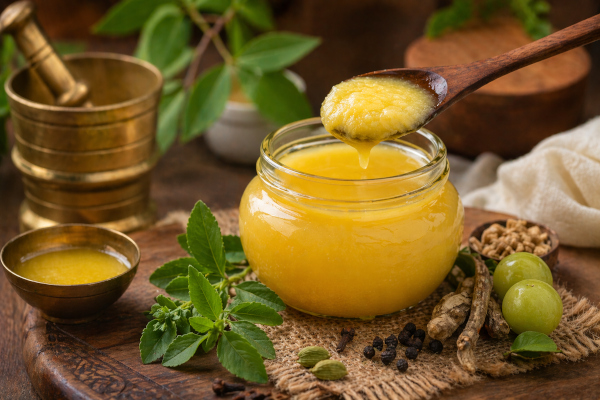
In Ayurveda, ghee is not treated as an ordinary cooking fat. It is known as Ghrita, a refined form of butter in which water and milk solids are removed, leaving behind a rich, aromatic milk fat. FSSAI describes ghee as a milk-fat product made by almost total removal of water and milk solids-not-fat, with a characteristic flavour and physical structure developed through the process.
Ayurveda gives ghee a special place because it is both food and anupana — a carrier substance that helps herbs travel deeper into the body. This is why many classical Ayurvedic formulations are prepared as medicated ghees, where herbs are cooked into ghee through a process known as Sneha Kalpana or Snehapaka. Modern reviews note that Ayurveda catalogues ghee according to milk source, preparation method, age and physical form, and that classical literature uses it widely as a therapeutic base.
From an Ayurvedic point of view, ghee is considered snigdha — unctuous, smooth and lubricating. It is traditionally used to nourish ojas, support agni, calm excess vata, soften dryness, improve palatability of food and act as a medium for herbs. This is why a spoon of ghee over hot rice, dal, khichdi, millet porridge or medicinal decoction is not merely a taste enhancer in Indian homes; it is a practical Ayurvedic idea that food should be digestible, lubricating and strength-giving.
Nutritionally, ghee is extremely energy dense. A 100 g portion of clarified butter/ghee contains about 900 calories, 100 g fat, 60 g saturated fat, 300 mg cholesterol, no carbohydrates and no protein, according to USDA-derived nutrition data. This means ghee should be respected as a concentrated food, not casually poured without measure. In Ayurveda too, the usefulness of ghee depends on matra — the correct quantity — and on the person’s digestion, season, age, disease condition and lifestyle.
The great benefit of ghee in the Indian kitchen is that it makes simple food complete. A little ghee on hot rice, dal, chapati, dosa, upma, pongal or khichdi improves aroma, satiety and mouthfeel. Since ghee is almost entirely fat, it can help the body absorb fat-soluble nutrients from food. In traditional cooking, this is why vegetables, spices and medicinal foods are often gently cooked with ghee: turmeric, black pepper, cumin, ajwain, ginger, garlic, curry leaves and pepper rasam all bloom beautifully in it.
Ayurveda also values ghee for the mind. Preparations such as Brahmi Ghrita, Saraswata Ghrita, Kalyanaka Ghrita, Mahakalyanaka Ghrita and Panchagavya Ghrita are traditionally used under medical supervision for memory, sleep, nervous-system support and mental wellness. A modern review of ghee notes that some studies on formulations such as Kalyanaka Ghrita have explored effects on cognition, oxidative stress and inflammatory markers, though more human clinical research is needed before making strong medical claims.
In Panchakarma, ghee has a separate role through Snehapana, the internal administration of medicated fats before cleansing therapies. Government-linked Ayurveda resources describe Snehan as the use of medicated fats or oil massage for specific therapeutic purposes, and Snehapana generally involves internal use of medicated ghee or oil under professional supervision. This is not a home experiment; therapeutic high-dose ghee intake should be done only with an Ayurvedic physician, because wrong use can aggravate digestion, heaviness, nausea or lipid problems.
Common Ayurvedic Uses of Ghee at Home
For daily food, ½ to 1 teaspoon of ghee over hot rice, dal, khichdi or millet porridge is a practical traditional use. For dry throat or dry cough tendency, families often use warm milk with a small amount of ghee, sometimes with turmeric or black pepper, though people with dairy sensitivity, high cholesterol or active respiratory congestion should be careful. For constipation caused by dryness, some households use warm milk with ghee at night, but this should not replace medical treatment if constipation is chronic, painful or associated with bleeding.
For children and elders, ghee is traditionally added in tiny quantities to warm food to improve taste and nourishment. For students or people doing mental work, Ayurveda-inspired kitchens often use Brahmi, Shankhapushpi or almond-based foods with ghee, but classical medicated ghees should be used only after consultation. For post-illness recovery, soft foods like rice gruel, moong dal khichdi or kanji with a small amount of ghee are used because they are gentle, warm and easy to digest.
Types of Ghee
Cow ghee is the most widely praised in Ayurveda and is traditionally considered lighter and more sattvic. Buffalo ghee is heavier, richer and more cooling, often giving greater satiety but requiring stronger digestion. Cultured ghee, made from curd-churned butter, is valued in traditional households because it reflects the older Indian method. A2 ghee has become popular recently, but the health claims around A2 products should be treated carefully unless supported by reliable testing and transparent sourcing. The most important point is purity: genuine ghee should be made from milk fat, not vegetable fat blends or adulterated oils.
Food safety matters because adulteration is a real issue. FSSAI standards state that ghee and related milk-fat products are derived from milk or milk products through removal of water and milk solids-not-fat, and consumer guidance notes that ghee should meet prescribed milk-fat standards. Good ghee should have a clean aroma, granular texture when cooled, golden to pale yellow colour depending on feed and season, and should melt clearly without strange waxy residue.
Ghee and Heart Health: The Balanced View
Ghee is beneficial when used with intelligence, but it is not a licence for excess. The American Heart Association warns that too much saturated fat can raise LDL cholesterol, and recommends keeping saturated fat below 6% of total calories, which is about 13 g per day for a 2,000-calorie diet. Since 100 g of ghee contains about 60 g saturated fat, even small spoonfuls matter in a modern sedentary lifestyle.
So the Ayurvedic principle is beautifully practical: use ghee like medicine in food, not like sauce on everything. A physically active person with good digestion may tolerate it well. A sedentary person with obesity, fatty liver, high LDL cholesterol, diabetes, heart disease or gallbladder issues should use it cautiously and follow medical advice. Ayurveda never says that a good substance remains good in unlimited quantity; even nectar becomes trouble when taken without measure.
Simple Ayurvedic Food Ideas with Ghee
Moong dal khichdi with ghee is one of the best examples of Indian food as medicine. Rice, moong dal, cumin, ginger, turmeric and a small spoon of ghee create a meal that is warm, soft, digestible and nourishing. Pepper-cumin rasam with ghee is useful in rainy weather or low appetite because the spices stimulate digestion while ghee softens their sharpness. Ragi or wheat porridge with ghee gives strength and satiety. Steamed vegetables finished with ghee and jeera make simple food more digestible. Hot rice with ghee and moringa leaf dal combines fat-soluble nutrition, protein and traditional digestive wisdom.
Ghee is also deeply woven into Indian rituals. It is used in deepam, homa, temple offerings and prasada because it represents purity, nourishment and transformation. In the lamp, ghee becomes light. In the kitchen, it becomes flavour. In Ayurveda, it becomes a carrier. That is why ghee occupies a rare place in Indian civilisation: it moves from cow to kitchen, from kitchen to medicine, from medicine to ritual, and from ritual to memory.
The final wisdom is simple. Ghee is not just fat. It is one of India’s most refined food technologies — a way of preserving milk essence, carrying herbs, improving digestion, enriching recipes and turning ordinary food into something warm, fragrant and healing. Used moderately, in the right person, with the right meal, ghee proves what Indian kitchens have known for centuries: food is not merely something to fill the stomach; it is daily medicine, culture and nourishment served on a plate.
Sources:
https://pubmed.ncbi.nlm.nih.gov/38181707
https://pmc.ncbi.nlm.nih.gov/articles/PMC10789628
https://tools.myfooddata.com/nutrition-facts/171314/100g
https://www.heart.org/en/healthy-living/healthy-eating/eat-smart/fats/saturated-fats
https://en.vikaspedia.in/viewcontent/health/ayush/ayurveda-1/snehapana
You may also like
-
Ayurveda and Mental Fatigue in the Digital Age: Ancient Wisdom for a Calm and Focused Mind
-
Bharat Biotech’s Nucelion and VeGen Bio Partner to Manufacture Advanced Dual-Target CAR-T Cancer Therapy in India
-
Ayurveda and Anger: How Emotional Excess Affects Physical and Mental Health
-
Ayurveda and Stress: Daily Practices for Mental Balance and Emotional Well-Being
-
Ayurveda and Bowel Routine: Why Regularity Matters for Digestive Health
