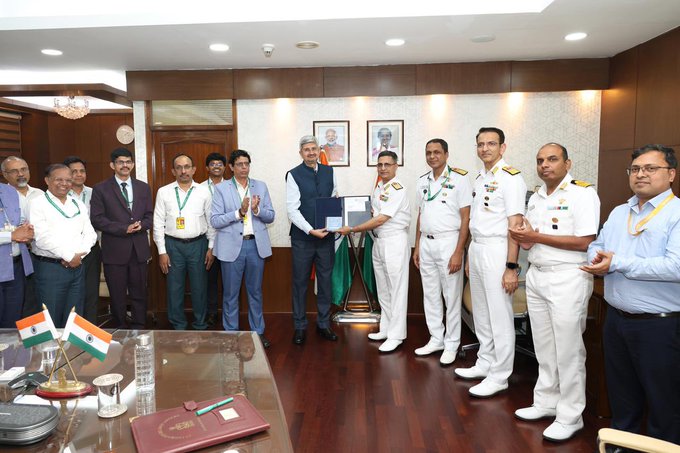
The Defence Research and Development Organisation and the Indian Navy have completed a major hydrodynamic testing milestone for a frontline Indian naval ship project, strengthening India’s indigenous warship design capability. The assessment was carried out by DRDO’s Naval Science and Technological Laboratory in collaboration with the Indian Navy’s Warship Design Bureau.
The work covered hydrodynamic performance assessment and model testing, a critical phase in warship development where the ship’s hull behaviour is studied before full-scale construction and operational deployment. According to DRDO, the testing demonstrated capabilities in hull hydrodynamics, computational fluid dynamics simulations and experimental model trials.
The assessment examined key performance parameters such as resistance, propulsion, sea-keeping and manoeuvrability. These factors are central to how a warship performs at sea: resistance affects speed and fuel efficiency, propulsion determines power transfer and endurance, sea-keeping reflects the vessel’s stability in rough waters, while manoeuvrability is crucial for tactical movement during operations.
DRDO said the outcomes were benchmarked against leading international standards, establishing parity in accuracy, reliability and technical depth. This is significant because hydrodynamic validation is one of the most technically demanding parts of modern naval architecture, especially for combat vessels expected to operate across varied sea states and mission profiles.
The project deliverables were formally handed over by Dr Samir V Kamat, Secretary, Department of Defence R&D and Chairman DRDO, to Sanjay Sadhu, Controller of Warship Production and Acquisition, in the presence of senior DRDO scientists and Indian Navy officials.
The achievement highlights the growing depth of India’s domestic warship design ecosystem. With NSTL providing hydrodynamic expertise and the Warship Design Bureau bringing naval design requirements, the project reflects closer integration between research laboratories and operational naval planners. This kind of collaboration is vital for reducing dependence on foreign design validation and for improving India’s ability to build advanced frontline warships within the country.
In practical terms, successful hydrodynamic testing gives designers confidence that the vessel’s hull form, propulsion behaviour and handling characteristics are aligned with mission requirements. For the Navy, this means better predictability before a ship enters construction or trials. For India’s defence industry, it marks another step toward self-reliant design, testing and validation of complex naval platforms.
The milestone therefore goes beyond a laboratory achievement. It strengthens India’s ability to design warships that are faster, more stable, more efficient and better suited to modern maritime operations. As the Indian Navy expands its indigenous fleet, such testing capabilities will become increasingly important in shaping future destroyers, frigates, corvettes and specialised combat vessels.
You may also like
-
Indian Army Special Forces Depart for Indonesia for Exercise Garuda Shakti 2026
-
India to Train 600 Nigerian Army Soldiers in Specialised Jungle and Mountain Warfare
-
India Moves Towards Five-Year Assured Orders for Defence Startups Under New Procurement Reforms
-
Zen Technologies Introduces Indigenous Hyper-Strike Falcon AI-Guided Counter-Drone Interceptor
-
L&T and Germany’s SCHOTTEL Expand Partnership for Controllable Pitch Propeller Systems in Indian Shipbuilding
