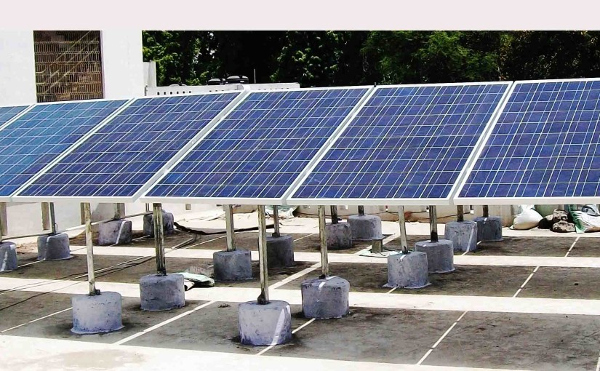
India’s clean energy manufacturing drive received a fresh boost with the dedication of the 200 MW Solar Module Manufacturing Line of Central Electronics Limited to the nation. The facility was inaugurated by Union Minister Dr. Jitendra Singh, who said renewable and clean energy would play a major role in India’s long-term development journey and in achieving the country’s net-zero emissions target by 2070.
The new manufacturing line is significant because it strengthens domestic capacity in a sector that has become central to India’s energy security, industrial growth and climate commitments. Solar power is no longer just an environmental priority for India; it has become a strategic manufacturing sector linked to self-reliance, import reduction, technology development and the larger Viksit Bharat 2047 vision. By expanding solar module manufacturing under a public-sector enterprise, the government is also underlining the role of indigenous institutions in building future-ready energy infrastructure.
Central Electronics Limited has a long association with India’s solar journey. The company is a Government of India enterprise under the Department of Scientific and Industrial Research, Ministry of Science & Technology, and was established in 1974 to commercially exploit indigenous technologies developed by national laboratories and R&D institutions. CEL’s official profile describes it as a pioneer in solar photovoltaic technology, along with other business areas such as railway electronics and strategic electronics.
Dr. Jitendra Singh recalled CEL’s historic role in India’s renewable energy sector, noting that India’s first solar cell was manufactured by CEL in 1977 and that the organisation also contributed to the country’s early solar power journey. The PIB release states that CEL’s latest 200 MW manufacturing line marks a major milestone for the clean energy ecosystem and reflects India’s growing confidence in indigenous manufacturing.
The speed of implementation was also highlighted as an important achievement. According to the PIB release, the Request for Proposal for the project was floated on 24 April 2025, the successful bidder was selected within one month, and the manufacturing line became operational in less than a year. CEL’s own tender page also records the 24 April 2025 tender for selection of a bidder to set up a 200 MWp solar module manufacturing line at CEL Sahibabad under the Make in India initiative.
The inauguration also comes at a time when CEL is being repositioned as a broader technology enterprise rather than a legacy public-sector unit. Dr. Singh said the company had moved from a phase where it was once close to disinvestment to becoming a profit-making, revenue-generating Mini Ratna enterprise. He described this turnaround as an example of institutional revival driven by leadership, policy support, operational discipline and the efforts of scientists, engineers and employees.
Beyond solar manufacturing, CEL is now expanding into future-facing sectors such as vertical-axis wind turbines, hybrid renewable systems, data centres, advanced defence electronics, electronic warfare and small weapon systems. This wider portfolio places CEL at the intersection of clean energy, strategic electronics and national technology self-reliance.
The event also saw technology collaboration initiatives between CSIR laboratories and CEL. Dr. Singh welcomed technology transfer initiatives involving CSIR-National Aerospace Laboratories and CEL for the Automated Weather Observing System and the new-generation Drishti Transmissometer System. He said technologies developed in national laboratories must increasingly move towards commercialisation and public use through industry partnerships.
The larger message from the inauguration is that India’s clean energy transition is increasingly being tied to domestic manufacturing and indigenous technology. The 200 MW Solar Module Manufacturing Line is not only an addition to production capacity; it is also a statement that India wants its renewable energy expansion to be supported by Indian institutions, Indian engineering capability and Indian industrial capacity. In that sense, CEL’s new line represents both an energy-sector milestone and a strategic manufacturing signal for the coming decade.
You may also like
-
Pine Labs Expands in Singapore with Unified Merchant Payments Platform
-
VORAN Partners Italian Manufacturer to Build Light-Aviation Ecosystem in India
-
World Bank Raises India’s FY27 Growth Forecast to 7.1%
-
Adani Power and Druk Green Power to Develop 770 MW Chamkharchhu-I Hydropower Project in Bhutan
-
Cabinet Approves ₹10,000 Crore SME Growth Fund to Scale Indian Manufacturing
