Indian defence-electronics company Astra Microwave Products Limited has entered a new phase of expansion, with its order book rising to approximately ₹4,341 crore by August 2026, more than double the ₹2,141 crore recorded at the end of March.
The sharp increase has been driven primarily by a landmark ₹2,205-crore order from Hindustan Aeronautics Limited for critical subsystems associated with the indigenous Uttam radar programme. At the same time, Astra Microwave is positioning itself for additional opportunities involving the Virupaksha radar, Angad electronic-warfare systems, anti-drone systems, software-defined radios and other DRDO electronic-warfare programmes.
The scale of this transition was highlighted by CRISIL Ratings on 28 August 2026, when it upgraded Astra Microwave’s long-term rating to CRISIL A+/Stable from CRISIL A/Positive. CRISIL said the company’s business profile had strengthened considerably because of rising scale, improved revenue visibility, higher operating profitability and growing participation in value-added indigenous defence programmes.
Order Book More Than Doubles in Five Months
Astra Microwave ended FY2025-26 with an order book of approximately ₹2,141 crore. By August, this had increased to around ₹4,341 crore.
The change is significant not simply because of the absolute value of the backlog but because defence now dominates it. According to CRISIL, approximately 84% of Astra Microwave’s August 2026 order book consists of defence-related contracts, including defence exports.
This gives the company substantial execution visibility over the coming years and underlines its transformation from a specialist manufacturer of microwave and radio-frequency components into a significant participant in India’s radar, electronic-warfare and strategic-electronics programmes.
CRISIL expects Astra Microwave’s revenues to grow by approximately 15–18% in FY2026-27, supported largely by domestic defence contracts. Defence, including exports, contributed approximately 86% of the company’s revenue during FY2025-26 and is expected to account for around 80–85% during FY2026-27.
₹2,205-Crore Uttam Radar Order Transforms the Backlog
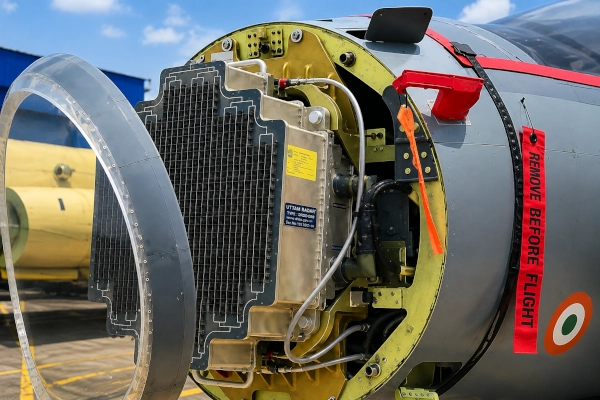
The largest contributor to the expanding order book is Astra Microwave’s order from Hindustan Aeronautics Limited for the Uttam Active Electronically Scanned Array radar programme.
Astra Microwave disclosed in July that it had received an order valued at approximately ₹2,205.23 crore for the procurement of 122 Active Antenna Array Units and 121 Interface Frames for the Uttam Radar. The order is scheduled for execution over a multi-year period.
The value of the order is extraordinary in relation to Astra Microwave’s existing business. The company’s revenue during FY2025-26 was approximately ₹1,163 crore, meaning the single Uttam contract is worth almost twice its annual revenue.
CRISIL consequently identified the HAL order as the principal factor behind the company’s order book rising to ₹4,341 crore.
Active Antenna Array Unit Is at the Heart of an AESA Radar
Astra Microwave’s role in the Uttam programme centres on one of the most important parts of an AESA radar—the Active Antenna Array Unit, or AAAU.
In an active electronically scanned array, the radar beam is steered electronically instead of relying primarily on mechanical movement of the antenna. The antenna face consists of numerous transmit-and-receive elements whose signals can be controlled electronically to direct radar energy rapidly across different areas.
Astra Microwave’s own radar-electronics portfolio includes Active Antenna Array Units, transmit-receive modules, wideband T/R modules, beam-forming equipment, digital receivers, waveform generators, exciters, receivers, solid-state power amplifiers and other microwave and RF components used in advanced radar systems.
This technological breadth is important because modern AESA radars depend on extremely close integration between microwave electronics, antenna technology, signal generation, reception, power amplification and digital processing.
The Uttam contract therefore represents considerably more than a conventional component-production order. It places Astra Microwave within the production chain of one of India’s most important indigenous airborne radar programmes.
Uttam Strengthens Indigenous Fighter-Radar Capability
The Uttam AESA radar was developed under DRDO’s radar-development ecosystem as an indigenous airborne fire-control radar.
AESA technology offers several operational advantages over older mechanically scanned radar architectures. Electronic steering allows the beam to move almost instantaneously without mechanically repositioning the entire antenna. This can support faster target searches, simultaneous tracking functions, more flexible radar modes and greater reliability because the antenna does not depend on a single high-power transmitter in the same way as older designs.
For India, the importance of Uttam also lies in ownership of the underlying radar technology.
An indigenous radar architecture offers greater freedom to integrate Indian weapons, electronic-warfare systems and future software upgrades without remaining dependent on the approval or technological roadmap of a foreign radar supplier.
The productionisation of Uttam consequently represents one of the more important steps in the wider effort to increase indigenous content within Indian combat-aircraft electronics.
Astra Microwave’s ₹2,205-crore order demonstrates that this programme is now creating a substantial domestic manufacturing chain around the radar rather than remaining confined to laboratory development.
From Microwave Components to Strategic Defence Electronics
Astra Microwave began primarily as a specialist manufacturer of radio-frequency and microwave components and subsystems.
Its technological capabilities have gradually expanded into higher-level radar electronics, electronic warfare, communication systems, antennas, semiconductor technologies and complete subsystems.
CRISIL now describes the company as having transitioned from an RF and microwave component supplier into a strategic defence player participating in several critical indigenous programmes.
This transition is important because the economic and technological value of defence electronics rises considerably as companies move upward from manufacturing discrete components toward designing and supplying complex subsystems and eventually complete systems.
Astra Microwave’s improving profitability provides evidence of that shift. Its operating margin increased from approximately 25.1% in FY2024-25 to 29.6% in FY2025-26. CRISIL attributed the improvement partly to growing contributions from complex radar and electronic-warfare systems, increasing technological capability and greater value addition.
Virupaksha Radar Emerges in Astra’s Future Pipeline
One of the most interesting disclosures in the CRISIL assessment is Astra Microwave’s expected participation in the Virupaksha radar programme.
CRISIL lists Virupaksha among the programmes expected to support Astra Microwave’s future order pipeline, alongside Angad electronic-warfare systems, anti-drone systems, indigenous radar products and additional DRDO electronic-warfare projects.
Virupaksha is associated with India’s effort to develop more advanced indigenous airborne radar capabilities, and its appearance in Astra Microwave’s commercial pipeline indicates the company’s potential involvement in the next generation of Indian radar programmes beyond Uttam.
The precise value, subsystem allocation and delivery schedule associated with any future Virupaksha work have not been publicly detailed in the CRISIL document. These opportunities should therefore be treated as pipeline programmes rather than confirmed orders at this stage.
That distinction is important because CRISIL states that confirmed orders from several of these programmes are expected over the coming months but does not indicate that all have already been awarded.
Angad Electronic-Warfare Systems Add Another Growth Area
Electronic warfare represents another major expansion area.
CRISIL specifically identifies Angad Electronic Warfare Systems as part of Astra Microwave’s expected order pipeline.
Modern electronic warfare systems are designed to detect, analyse, classify and potentially counter electromagnetic emissions such as radar and communication signals. Their importance has increased dramatically as contemporary battlefields have become increasingly dependent on sensors, networked communications, radar-guided weapons and unmanned systems.
For an organisation with decades of microwave and RF engineering experience, electronic warfare is a natural technological extension.
Many of the underlying technologies—including wideband receivers, RF front ends, signal generation, microwave modules, amplifiers and antenna systems—overlap with capabilities required for advanced radars.
The growing prominence of EW within Astra Microwave’s portfolio therefore reflects both the changing nature of warfare and the company’s gradual movement toward more sophisticated defence-electronics programmes.
Anti-Drone Systems Enter the Pipeline
The CRISIL report also identifies anti-drone systems among Astra Microwave’s expected future opportunities.
Counter-unmanned-aircraft technology has become one of the fastest-growing areas of defence electronics globally.
Small drones increasingly present threats to military bases, ammunition depots, command centres, warships, airfields and frontline formations. Counter-drone architectures may therefore combine surveillance radar, radio-frequency detection, electro-optical sensors, electronic jamming and other effectors.
Astra Microwave’s experience in radar and RF technologies places it within several of the electronic layers required for such systems.
The CRISIL disclosure does not specify the particular anti-drone programme, customer or system architecture under consideration, and it would therefore be inappropriate to attribute a specific counter-UAS product or contract to the company without further disclosure.
Nevertheless, its inclusion in the expected order pipeline demonstrates that counter-UAS has become another potentially important growth area for Astra Microwave.
Software-Defined Radios Broaden the Communications Portfolio
Software Defined Radios are another programme family specifically identified by CRISIL among Astra Microwave’s strategic defence activities.
Unlike traditional radios in which many functions are fixed through dedicated hardware, software-defined architectures allow waveforms and communications functions to be implemented and modified substantially through software.
This provides armed forces with greater flexibility to support different operating bands, communication standards and secure waveforms through common hardware platforms.
Astra Microwave has strengthened its communications presence partly through its joint venture Astra Rafael Comsys Private Limited, which expands the group’s footprint in tactical and defence communication systems. CRISIL specifically notes that the joint venture has added to Astra’s capabilities in this field.
QRSAM Connects Astra to India’s Air-Defence Ecosystem
CRISIL also identifies Astra Microwave as being involved with the Quick Reaction Surface-to-Air Missile programme.
QRSAM is an indigenous mobile air-defence system developed for the Indian Army to provide protection to formations against hostile aircraft and other airborne threats.
Although the CRISIL assessment does not detail Astra Microwave’s exact subsystem role, participation in such programmes is consistent with its core capabilities in radar electronics, microwave components and associated RF technologies.
Air-defence systems require multiple sophisticated electronic elements, ranging from surveillance and tracking radars to guidance-related electronics and communications networks.
Participation in QRSAM consequently places Astra Microwave within a strategically important segment of India’s indigenous integrated air-defence ecosystem.
AMCA Opens the Door to Next-Generation Combat Aircraft
Perhaps even more important from a long-term perspective is Astra Microwave’s involvement with India’s Advanced Medium Combat Aircraft programme.
CRISIL lists AMCA among the marquee indigenous defence programmes in which Astra Microwave is participating.
AMCA represents India’s effort to develop an indigenous next-generation stealth combat aircraft incorporating advanced sensors, electronic warfare, data fusion and networked combat capabilities.
An aircraft of this type requires considerably more sophisticated RF and microwave electronics than earlier generations because radar, electronic support measures, communications and electronic-warfare functions must operate within an increasingly integrated sensor architecture.
Astra Microwave’s presence in the programme therefore gives it exposure to technologies likely to influence Indian combat-aircraft electronics well beyond the current generation of Tejas systems.
However, CRISIL does not specify the exact AMCA subsystem for which Astra Microwave is responsible. Its participation should therefore not be interpreted as confirmation that the company is supplying the complete AMCA radar or EW suite.
AEW&C Extends the Opportunity Beyond Fighter Aircraft
Astra Microwave is also participating in India’s Airborne Early Warning and Control programme, according to CRISIL.
AEW&C aircraft carry large airborne radar and electronic-sensor systems capable of detecting and tracking targets across wide areas while supporting airborne command-and-control operations.
Such platforms are particularly demanding from an RF and microwave-engineering perspective because they combine powerful radar arrays, sophisticated receivers, communications equipment and signal-processing architectures.
Participation in airborne early-warning projects therefore complements Astra Microwave’s work on fighter radars such as Uttam and provides another avenue for moving into higher-value airborne electronics.
Relationships with DRDO, HAL and BEL Become Strategic Assets
Astra Microwave’s growth is also supported by long-standing relationships with several of India’s most important strategic organisations.
CRISIL identifies HAL, Bharat Electronics Limited, DRDO, ISRO and other defence establishments among the company’s principal customers.
Astra’s own disclosure page records recurring orders from HAL, BEL and DRDO over several years, demonstrating that the Uttam contract is part of a much wider relationship with India’s public-sector and research establishments rather than an isolated transaction.
These relationships are particularly valuable in defence electronics because qualification cycles are lengthy.
Subsystems may require years of development, environmental testing, platform integration, flight or field trials and certification before being cleared for series production.
A company that successfully enters a development programme can therefore retain an important role when that programme transitions into large-scale production.
The Uttam radar appears to illustrate precisely this progression.
Semiconductor Capability Adds Vertical Integration
Astra Microwave has also been investing in semiconductor capabilities through its subsidiary Aelius Semiconductors.
CRISIL specifically highlights semiconductor design capability as part of the group’s broader technological strength.
Semiconductor technologies are particularly important for radar and electronic-warfare systems because their performance depends heavily on specialised microwave and RF devices.
Increasing domestic design capability in these areas can potentially reduce dependence on imported components while giving Indian companies greater control over product development and future upgrades.
This backward integration also supports Astra Microwave’s effort to increase value addition within higher-margin indigenous defence programmes.
Space and Meteorology Businesses to Be Demerged
As its defence business expands, Astra Microwave is preparing to separate several of its non-defence activities.
The company plans to demerge its space, meteorology and hydrology businesses into Astra Space Technologies Limited, which is intended eventually to become a separately listed company.
CRISIL notes that these businesses accounted for approximately 14% of Astra Microwave’s FY2025-26 revenue. The restructuring is expected to increase management focus on the core defence business while the expanding defence backlog compensates for the revenues transferred to the new entity.
The proposed demerger therefore reinforces the broader transformation underway within Astra Microwave.
What began as a diversified microwave-electronics business serving defence, space and meteorological customers is increasingly becoming a defence-focused strategic-electronics company.
Stronger Margins but Long Defence Cycles Remain a Challenge
The rapid expansion also creates execution challenges.
Defence electronics programmes typically involve long manufacturing cycles, extensive customer testing, third-party inspections and delayed billing milestones.
CRISIL notes that Astra Microwave continues to carry a relatively high working-capital requirement because of these long programme gestation periods.
Nevertheless, there has been improvement. Adjusted debtor days declined to approximately 218 days in FY2025-26 from 273 days a year earlier, while gross current assets declined to approximately 429 days from more than 500 days.
The company also held around ₹190 crore of unencumbered cash and equivalents at the end of March 2026, while expected annual capital expenditure of ₹75–80 crore is planned to be funded through a combination of debt and equity.
CRISIL therefore describes Astra Microwave’s liquidity position as adequate and its financial risk profile as healthy.
From Uttam to the Next Generation of Indian Defence Electronics
The importance of Astra Microwave’s ₹4,341-crore order book lies not merely in its size.
It demonstrates how India’s indigenous radar and electronic-warfare programmes are beginning to produce substantial manufacturing opportunities for specialised domestic private-sector companies.
The ₹2,205-crore Uttam radar order is the clearest example. Instead of DRDO developing a technology that remains dependent on imported production hardware, the programme is generating a domestic industrial chain in which companies such as Astra Microwave manufacture sophisticated radar subsystems at series-production scale.
The next stage could be considerably broader.
Virupaksha radar, Angad electronic warfare, anti-drone systems, software-defined radios and additional DRDO EW programmes already appear in the company’s expected order pipeline. At the same time, Astra Microwave is participating in major national programmes including QRSAM, AMCA and AEW&C.
These programmes span fighter aircraft, airborne surveillance, air defence, electronic warfare, tactical communications and counter-drone operations—several of the most technologically demanding segments of modern warfare.
Astra Microwave is consequently moving from the relatively narrow role of a microwave-component manufacturer toward becoming a broader indigenous defence-electronics supplier.
With approximately 84% of its ₹4,341-crore order backlog already defence-related, the transformation is no longer merely prospective. It is increasingly visible in the company’s confirmed contracts, revenue mix and manufacturing pipeline.
The Uttam AESA radar has provided the biggest single catalyst so far. The more important question now is how much of the next generation of India’s indigenous radar, electronic-warfare and communication programmes Astra Microwave will ultimately capture as those systems transition from development into production.
You may also like
-
India’s Economic Warfare Challenge: Strategic Autonomy, Energy Security and the Rise of a Global Power
-
India-US Trade Deal Stalemate: Why Washington’s Tariff Pressure Has Failed to Secure an Agreement
-
US Double Standards in Foreign Policy: 16 Recent Cases Involving India, Russia, China and Global Trade
-
India’s Arctic Energy Ambitions: Russian Oil, LNG and a New Sea Route to Indian Ports
-
Indian Navy Vice Chief Inspects Japan’s Mogami-Class Stealth Frigate as India-Japan Shipbuilding Cooperation Expands
