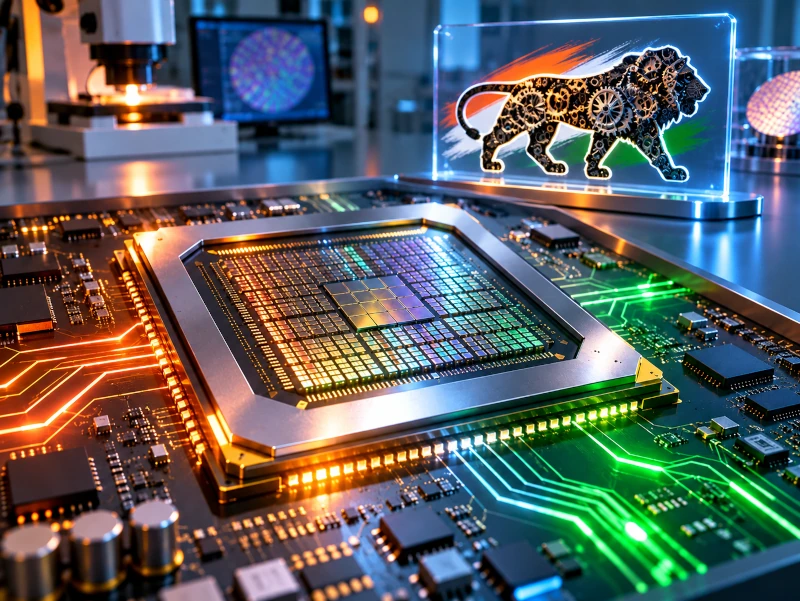
The Centre for Development of Advanced Computing (C-DAC), an autonomous scientific society under the Ministry of Electronics and Information Technology (MeitY), is targeting the development of an indigenous silicon-based Graphics Processing Unit (GPU) by mid-2028. The proposed processor, envisaged with approximately 32,000 computing cores, represents an important initiative towards strengthening India’s capabilities in artificial intelligence hardware, semiconductor design and high-performance computing. C-DAC is also seeking private-sector partners to support the transition of its existing functional model into a commercially viable semiconductor product.
From Functional Prototype to Silicon-Based Processor
C-DAC Director General E. Magesh outlined the development roadmap on 26 November 2026 during Tec-Verse 2026 in Chennai, with the institution subsequently featuring the development on its official website. The GPU has reached the functional-model stage and is currently operating on Field-Programmable Gate Array (FPGA) hardware, which allows engineers to evaluate processor functionality before manufacturing a dedicated semiconductor chip. The next stages will involve physical chip design, semiconductor fabrication, packaging, testing and performance validation.
The transition from an FPGA-based model to a dedicated silicon processor represents a significant engineering challenge. The development process must address power consumption, thermal management, memory bandwidth, computational efficiency and manufacturing constraints. Successful completion of these stages would establish the foundation for an indigenous GPU capable of supporting demanding computing applications.
Developing a 32,000-Core Indigenous GPU
The proposed GPU architecture is expected to incorporate approximately 32,000 computing cores designed to perform numerous computational operations simultaneously. Unlike conventional Central Processing Units (CPUs), which generally employ a smaller number of powerful processing cores, GPUs are particularly suited to highly parallel workloads. This capability makes them important for artificial intelligence, scientific simulations, image processing and large-scale data analytics.
However, the number of processing cores alone does not determine the overall performance of a GPU. Architectural efficiency, memory systems, software compatibility and power requirements will also influence its practical capabilities. Comprehensive benchmarking will be necessary once the silicon-based processor becomes available to establish its suitability for different computing workloads.
Private-Sector Participation in Semiconductor Development
C-DAC is seeking collaboration with domestic private-sector companies to advance the GPU from its present development stage towards commercialisation. Such partnerships could bring together public-sector research expertise and industrial capabilities in semiconductor engineering, fabrication coordination, advanced packaging and product development. Private-sector participation would also help address the substantial financial and technological requirements associated with bringing a complex semiconductor product to market.
The institution intends to achieve cost competitiveness through large-scale manufacturing and economies of scale. A commercially sustainable domestic GPU ecosystem could provide Indian enterprises, research institutions and technology startups with additional computing hardware options. However, product pricing, manufacturing volumes and commercial availability will depend on the successful completion of development and the establishment of appropriate industrial partnerships.
Strengthening India’s Artificial Intelligence Infrastructure
The rapid expansion of artificial intelligence has significantly increased global demand for advanced computing hardware. Training machine learning models, operating generative AI applications and processing large datasets often require substantial GPU-based computing resources. India’s dependence on internationally developed accelerators makes indigenous processor development an important component of its long-term technological strategy.
A domestically designed GPU could complement initiatives such as the IndiaAI Mission and the National Supercomputing Mission by expanding the country’s indigenous computing capabilities. It could also support the development of specialised hardware solutions for Indian research institutions, universities and technology companies. The practical benefits would depend on the processor’s eventual performance, reliability and compatibility with established AI software ecosystems.
Building an Indigenous GPU Software Ecosystem
Developing a competitive GPU involves considerably more than manufacturing the semiconductor itself. Operating system drivers, programming frameworks, compilers, mathematical libraries and software development tools are essential for enabling researchers and developers to utilise its computational capabilities. Established international GPU platforms have benefited from extensive software ecosystems developed over many years.
C-DAC’s initiative therefore presents an opportunity to strengthen India’s expertise in both semiconductor architecture and computing software. Collaboration with universities, research laboratories, startups and established technology companies could contribute to the development of compatible applications and programming environments. An integrated hardware and software ecosystem would be important for encouraging widespread adoption of indigenous GPU technology.
Extending C-DAC’s Legacy in Indigenous Computing
C-DAC has played a central role in India’s development of advanced computing technologies since its establishment in 1988. Its PARAM supercomputer programme demonstrated the country’s ability to develop indigenous high-performance computing systems and laid the foundation for subsequent generations of scientific computing infrastructure. The institution has also contributed to processor development, embedded systems and semiconductor design through initiatives such as the VEGA processor family.
The indigenous GPU programme extends this technological legacy into a domain increasingly important for artificial intelligence and data-intensive scientific research. Developing domestic expertise in parallel processor architecture could complement India’s existing strengths in software engineering and information technology services. Over time, these capabilities could support a more comprehensive national computing ecosystem encompassing processor design, system integration and application development.
Potential Applications Across Strategic and Industrial Sectors
An indigenous GPU platform could eventually support a wide range of applications across healthcare, aerospace, agriculture, industrial manufacturing and scientific research. Computationally intensive activities such as climate modelling, medical image analysis, materials discovery and engineering simulations could benefit from expanded access to parallel computing infrastructure. Artificial intelligence startups could also gain an additional hardware platform for developing and deploying specialised applications.
Domestic GPU development could create opportunities for India’s semiconductor design companies, electronics manufacturers and computing infrastructure providers. Its wider industrial impact would depend on the successful integration of the processor into commercially viable computing systems. Establishing reliable manufacturing and software support would be essential for translating the research initiative into practical technological capabilities.
Advancing India’s Semiconductor Self-Reliance
C-DAC’s target of developing an indigenous silicon-based GPU by mid-2028 represents a significant step towards expanding India’s capabilities in advanced semiconductor design and artificial intelligence hardware. Although the processor remains at the functional-model stage, the initiative demonstrates a sustained effort to build domestic expertise in technologies that underpin the global digital economy. Successful execution, supported by industrial collaboration and a robust software ecosystem, could strengthen India’s computing infrastructure, semiconductor research capabilities and long-term technological autonomy.
You may also like
-
Hetero Plans Indian Launch of Long-Acting HIV Prevention Medicine
-
India and Canada Advance CEPA Negotiations Towards C$70 Billion Bilateral Trade Target
-
Indian AI Specialists Participate in Moscow’s AI Journey 2026 International Conference
-
L&T Secures Order to Develop 900 MWh Battery Energy Storage Project in Gujarat
-
Alpex Solar Commences Commercial Production at 2.2 GW TOPCon Solar Cell Facility
