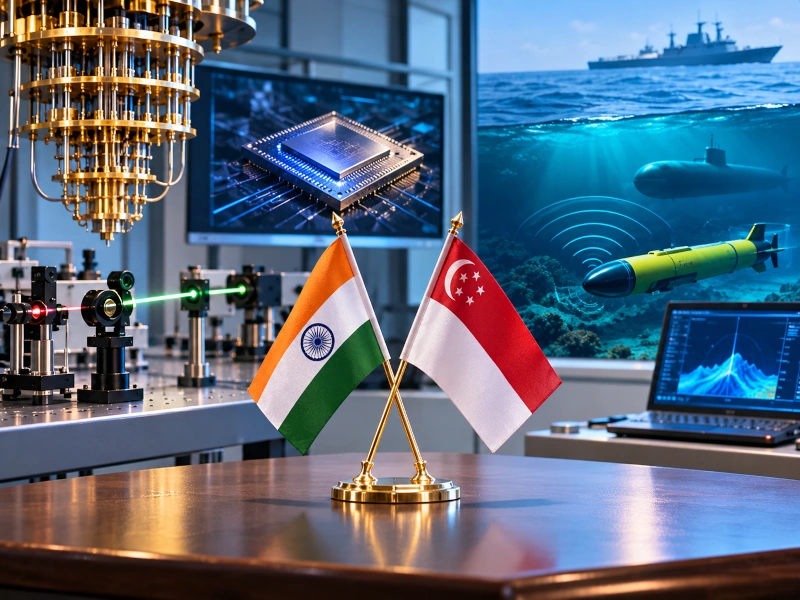
India and Singapore are exploring opportunities to expand bilateral defence research cooperation across quantum technologies, lasers, microelectronics and underwater systems. The India–Singapore Defence Technology Steering Committee held discussions at the Naval Physical and Oceanographic Laboratory (NPOL), Kochi, Kerala, on 18–19 November 2026. According to information attributed to the Defence Research and Development Organisation (DRDO) on 21 November, the meeting focused on identifying opportunities for collaborative research, scientific exchanges and greater institutional engagement between the two countries.
Expanding Bilateral Defence Research Cooperation
The Defence Technology Steering Committee provides an institutional platform for India and Singapore to identify areas of mutual interest in defence science and technological development. The discussions in Kochi explored opportunities to expand cooperation through collaborative research programmes, scientific information exchange and reciprocal visits by researchers and technical specialists.
The engagement reflects the growing importance of scientific and technological cooperation within bilateral defence relationships. By bringing together research institutions and technical expertise, India and Singapore have opportunities to complement their established defence engagements with longer-term scientific and industrial collaboration.
Exploring Quantum Technologies and Advanced Photonics
Quantum technologies emerged as one of the areas identified for potential bilateral research cooperation. Quantum science offers applications across precision measurement, computing, communications and advanced sensing, making it an increasingly important field of scientific investigation. Collaborative research could provide opportunities for exchanging expertise and developing specialised scientific capabilities.
Laser technologies and photonics were also identified as areas of mutual interest. These disciplines have applications across optical communications, precision instrumentation, scientific measurement and advanced sensing systems. Cooperation in these fields could contribute to the development of specialised engineering expertise and strengthen the broader research ecosystems of both countries.
Strengthening Microelectronics Research
Microelectronics constitutes another important area of potential cooperation between India and Singapore. The development of advanced electronic components, integrated circuits and semiconductor technologies is fundamental to modern aerospace, communications and scientific instrumentation. Both countries have opportunities to draw upon their respective research institutions and industrial capabilities to explore complementary areas of development.
Singapore possesses an established semiconductor manufacturing and electronics ecosystem, while India is expanding its domestic capabilities through investments in semiconductor fabrication, design and advanced electronics manufacturing. Greater institutional engagement could support knowledge exchange, specialised workforce development and collaborative scientific investigations in these strategically important technologies.
Advancing Underwater Research and Maritime Technologies
Underwater domain awareness and associated research capabilities formed another important component of the discussions. The selection of NPOL, Kochi, as the venue is particularly relevant given the laboratory’s longstanding involvement in underwater acoustics, sonar technologies and oceanographic research. NPOL is a specialised DRDO laboratory contributing to India’s indigenous naval research and development capabilities.
India and Singapore share an interest in maritime security, navigational safety and the stability of regional sea routes. Scientific cooperation in underwater technologies could complement their existing maritime engagements while creating opportunities to exchange knowledge in ocean sciences, underwater acoustics and specialised research instrumentation.
Exploring Shared Research and Testing Infrastructure
The committee also discussed opportunities for cooperation involving research and testing infrastructure. Access to specialised experimental facilities and scientific instrumentation can play an important role in evaluating emerging technologies, supporting collaborative investigations and improving research efficiency.
Reciprocal institutional visits and scientific exchanges could help researchers identify complementary capabilities and establish areas suitable for future collaboration. These discussions represent an exploratory stage of cooperation, with specific research programmes and implementation arrangements subject to subsequent institutional decisions.
Building on India–Singapore Defence Relations
India and Singapore maintain an established defence relationship encompassing military exercises, professional exchanges, maritime engagement and institutional dialogue. The addition of emerging technologies to this framework reflects the expanding scope of bilateral cooperation beyond conventional military engagements.
The Defence Technology Steering Committee offers a mechanism for connecting scientific institutions with broader bilateral defence priorities. Greater cooperation between research organisations could strengthen technological capabilities while encouraging sustained engagement between scientists, engineers and technical specialists from both countries.
Strengthening India’s Advanced Defence Research Ecosystem
The discussions at NPOL highlight the importance of international scientific partnerships in complementing India’s indigenous research and development programmes. Engagement in quantum technologies, photonics, microelectronics and underwater sciences provides opportunities for Indian research institutions to exchange knowledge, develop specialised expertise and strengthen their participation in international scientific networks.
Continued cooperation between DRDO and Singapore’s defence research establishment offers a promising foundation for mutually beneficial technological development. By combining domestic innovation with international scientific engagement, India can further strengthen its advanced research ecosystem and contribute to sustained technological cooperation across the Indo-Pacific.
References
- Defence Research and Development Organisation (DRDO) — Announcement concerning the India–Singapore Defence Technology Steering Committee meeting at NPOL, Kochi, dated 21 November 2026.https://x.com/DRDO_India/status/2123965289897554101
- Defence Research and Development Organisation — Naval Physical and Oceanographic Laboratory (NPOL), Kochi.https://www.drdo.gov.in/
- Ministry of Defence, Government of Singapore — Official information on bilateral defence cooperation.https://www.mindef.gov.sg/
You may also like
-
Vayuvya Defence Successfully Test-Fires Indigenous Vayu 250 Micro Jet Engine
-
DRDO Awards Laser-Based Drone Communication Contract to olee.space
-
IG Defence Successfully Test-Fires Indigenous JWALA MK-1 Counter-Drone Missile at Pokhran
-
India and Nepal Sign Eight Cooperation Agreements
-
Vama SkyLight Emerges as L1 Bidder for ₹6.95 Crore Indian Army Tethered Drone Tender
